



New Solution For Wind Turbine Cargoes
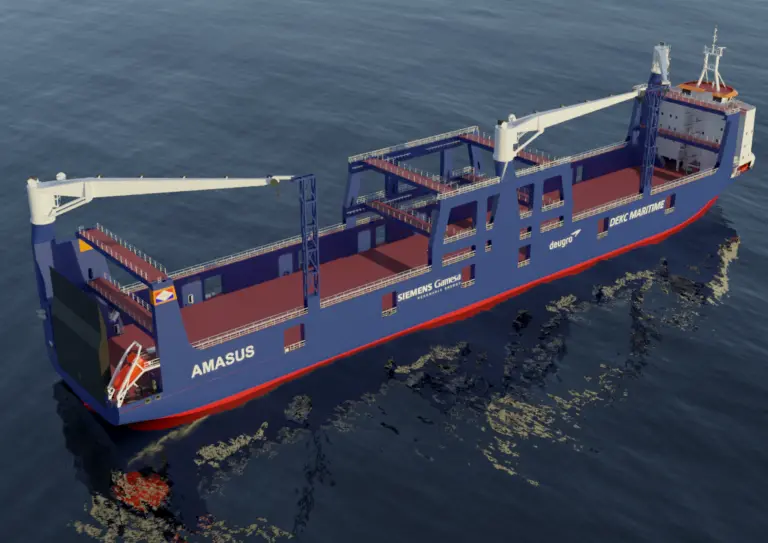
The project implemented by logistics specialist deugro Danmark in association with Dutch shipping company Amasus Offshore entails 168m, ro-ro and crane-equipped newbuilds for long-term charter to wind engineering group Siemens Gamesa.
Each vessel will be fitted with a stern ramp, three Liebherr cranes and a unique gantry system, allowing stowage of wind turbine blades and other parts in three tiers. The handling arrangements build on the Rotra template employed in two ships converted for deployment with deugro in 2016/2017, and subsequently further modified last year.
Whereas the seminal Rotra Mare and Rotra Vente have customised bow access and an all-aft superstructure, the nascent ships, to be named Rotra Futura and Rotra Horizon, have the deckhouse and accommodation positioned forward, obviating line-of-sight limitations. The skeletal frames to be arranged bulwark-to-bulwark will enable tiered transportation of wind turbine components while also facilitating unobstructed use of the cranes, one mounted starboard side and two on the port side.
Signalling another export win for China’s increasingly product-diversified shipbuilding industry, the Amasus contract has been awarded to Jiangsu Zhenjiang Shipyard, located to the east of the Run Yang Bridge complex, downstream of Nanjing on the Yangtze. Deliveries are scheduled during the spring and summer of 2025.
Based on a design developed by the Dutch engineering consultancy DEKC Maritime of Groningen, the vessels have been conceived to accommodate the increasing size and weight of the next and future generations of offshore windmill elements and, at the same time, achieve best-in-class cargo intake and flexibility in cargo composition and loading method.
Siemens Gamesa’s global commodity manager Christian Johansen said “With our record order backlog, we will be installing a significant number of wind turbines at sea globally, with increasingly larger and more complex components. By this agreement, we have taken another important step towards securing our ability to execute projects safely, on time and at the right cost level.”
Reducing each ship’s overall carbon footprint was among the main targets in the early stages of the technical project. According to deugro, low energy consumption will be realised through the adoption of a Wartsila diesel engine model claimed to offer a 15% reduction in fuel burn compared to today’s standards, coupled with a hydro-optimised hull shape and low-resistance underwater hull coating.
In addition, an efficient power train with a hybrid propulsion arrangement and an exhaust gas cleaning system achieving IMO Tier III criteria have been specified for integration into the new vessels, together with the application of waste heat recovery (WHR) technology.
Related Articles
 METHANOL
 GENERAL NEWS
 HYDROGEN