



Japanese Builder Commits Wholesale To Dual-Fuel
The plan is central to the parent Tsuneishi organisation’s policy of reducing carbon emissions in every sphere of its business, and not only in vessel construction. While shipbuilding accounts for nearly two-thirds of Tsuneishi Holdings’ turnover, its various other interests include shipowning, ship management, energy, and metal recycling, and the overall aim is to become carbon-neutral throughout by 2050.
The 2050 goal is to be achieved through emission reductions complemented by environmental credits and/or carbon offset. Salient in the latter regard is the group’s ownership of 25,000 hectares of forest in Paraguay.
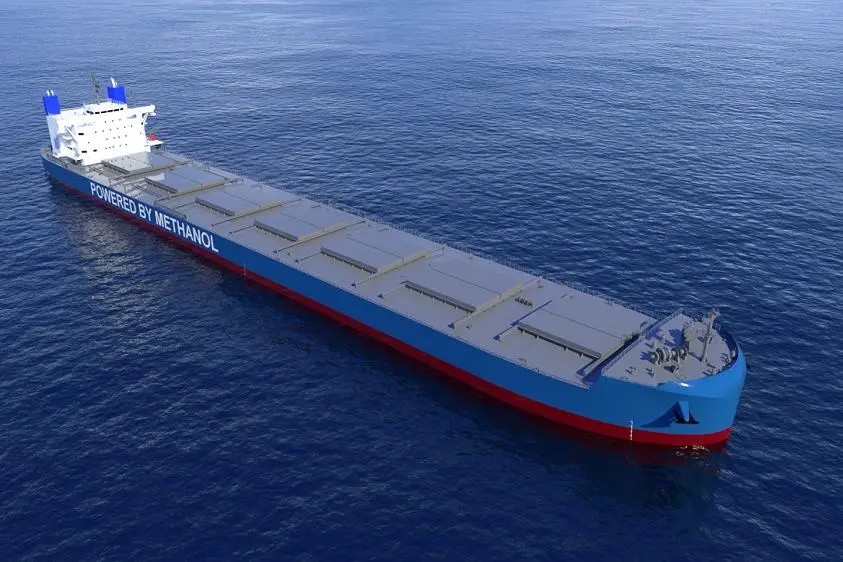
A pillar of recent and current R&D work is the development of methanol-fuelled vessels. Methanol can deliver an immediate benefit in environmental impact while allowing for future take-up of zero-emission ‘green’ methanol. An early result of these endeavours is a methanol-capable dual-fuel Kamsarmax bulk carrier, the first of its kind worldwide, which has already attracted a raft of contracts.
Through the primary use of methanol fuel in combination with a revised hull form, the design offers a 15% reduction in CO2 relative to the standard Kamsarmax type.
Since the announcement of the design at the beginning of 2023, Tsuneishi has secured orders for 13 of the dual-fuel Kamsarmax vessels. The group is a pre-eminent force in the production of bulk carriers across the range, and has won more than 350 sales in the Kamsarmax category alone over two decades. The contract list for the latest version was opened this year when two of the 81,200dwt vessels were booked for Mitsui & Co, followed by two for Lauritzen NextGen Shipping, with all four to be employed by Cargill Ocean Transportation.
The new Kamsarmax has main dimensions of 229m x 32.26m x 20.15m. The fuel efficiency of the design coupled with the high-capacity of the methanol fuel tank ensure the requisite range for deep-sea bulk cargo transportation. Furthermore, the location of the independent tank on the stern does not impinge on underdeck revenue-earning volume.
Tsuneishi’s portfolio now also includes a methanol dual-fuel, two-stroke powered Ultramax bulker of 65,700dwt, for which at least one contract is in hand. The group has laid plans for the development of dual-fuel methanol designs of what it describes as “medium-sized” bulk carriers and container ships in the near future.
Last year, the new order intake by Tsuneishi Shipbuilding, Tsuneishi Heavy Industries(Cebu) and Tsuneishi Zhoushan amounted to 35 vessels, meeting the business target. Newbuild deliveries totalled 38, comprising container ships, bulkers and tugs.
The consistent acquisition activity of recent years has continued with the introduction into the Tsuneishi fold of Mitsui E&S Shipbuilding, Niigata Shipbuilding & Repair, Yura Dock Co and Kanda Dockyard.
At the end of December 2022, the group had 48 owned ships enrolled with various subsidiaries. Although the average age at that point was only 4.4 years, the intention is to continually replace tonnage with the latest designs of newbuilds offering enhanced environmental performance. This provides in-house scope for the shipbuilding business. Moreover, a stated aim is to reduce the owned ship ratio of bulk carriers through more investment in other vessel types.
Nowithstanding the current focus on methanol, consideration is also being given to other companion fuels in a dual-fuel powering setup. An illustration of this approach is the collaborative design work being undertaken by Tsuneishi and Mitsui E&S Shipbuilding with Mitsui OSK Lines(MOL) on an ammonia-fuelled, mid-size LPG/ammonia carrier.
Related Articles
 ALTERNATIVE FUELS & LUBRICANTS
 GENERAL NEWS
 GENERAL NEWS