



Compressed hydrogen solution ready to compete in Europe’s regional trade
Martin Carolan, Provaris Managing Director and CEO, says recent announcements relating to ports and pipelines in Europe indicate they are getting ready for hydrogen delivery from 2027. This fits with his timeframe for offering a competitive alternative. Already partnered with Norwegian Hydrogen, he is in talks with companies in the UK, Germany and southern Europe. The company is ideally targeting supply that is less than 1,000 nautical miles to port, and up to 2,000 nautical miles, where Carolan says Provaris’s compressed hydrogen transport solution is “super competitive.”
Provaris and Norwegian Hydrogen entered a collaboration in January to accelerate the development of a hydrogen value chain covering large scale production and export of hydrogen from the Nordics to key ports of Europe. A preferred site in Norway has been identified for a production facility. The project aims to deliver 50,000 tonnes of green hydrogen a year commencing in 2027, with a competitive transport cost for compression, loading, shipping and discharge of EUR 1.00-1.50/kg, based on the use of Provaris’s recently launched floating storage (H2Leo) and two of its H2Neo compressed hydrogen carriers. The partners are now developing a blueprint for multiple bulk-scale compressed hydrogen export sites in Europe.
Germany and the Netherlands are already considered key import locations for bulk-scale hydrogen and are well advanced in the planning and development of the HyPerLink project which aims to develop an open access, cross-border hydrogen backbone in northern Germany. This will include connection between sites for the large-scale import of hydrogen and final consumers in industrial and urban centres in Northern Germany. A grid system established from repurposing of existing gas storage and pipelines will allow for integration with Provaris’ compressed hydrogen solution at the ports in Netherlands and Germany. The project is expecting to deliver a large scale hydrogen network (up to 7.2GW) with a total length of approximately 610km.
The benefits of storage
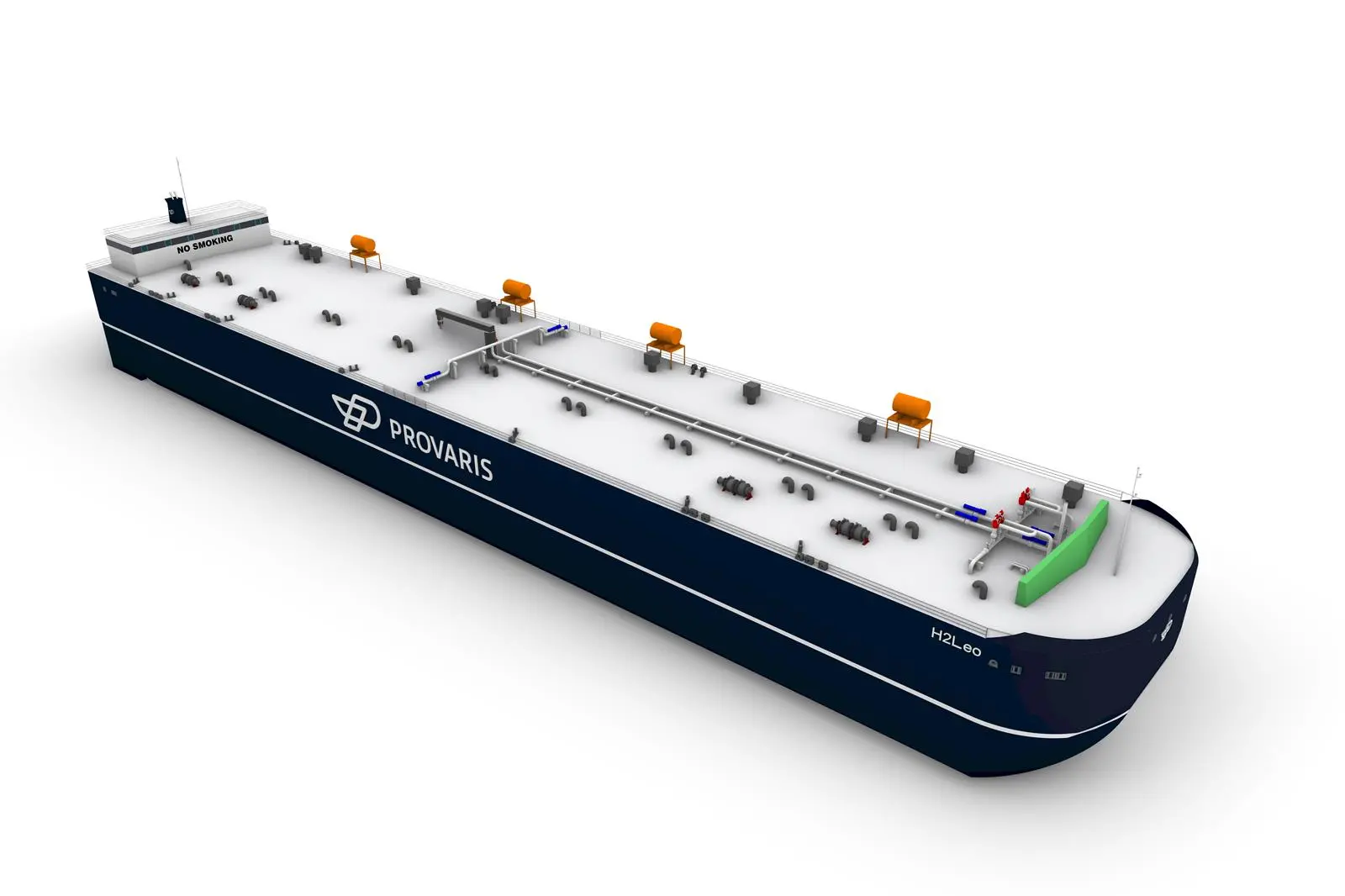
Hydrogen storage capacity will be built in. Provaris launched its gaseous hydrogen floating storage solution, H2Leo, earlier this year after earlier launching the design of a compressed hydrogen carrier, H2Neo. The storage concept has a design capacity range of 300 to 600 tonnes of hydrogen, expandable to up to 2,000 tonnes. “We have undertaken research in 2022 with the support of a consultant looking for storage solutions up to 500 tonnes,” says Carolan. “When looking at the alternatives of purchasing containerised solutions that use carbon fibre high pressure tanks or customer build c-type carbon steel, the capital costs for such scale resulted in a range of US$1-2 million per tonne of hydrogen storage. With our proprietary tanks integrated with a barge hull design, the cost per tonnes, based on 300-600 tonnes of storage capacity, is estimated to be US$200,000 to US$300,000 per tonne.”
Storage adds flexibility and redundancy to the loading and discharge of hydrogen cargos to cater for variability in hydrogen supply based on renewable power generation. “It will also optimise the round trip scheduling and in some instances remove the need for a carrier. This reduces overall capex which flows on to lowering overall delivered costs.
“Additionally, we know that all giga-watt scale supply chains for ammonia that are based on renewable generation and hydrogen supply will require hydrogen storage and power storage (batteries). The amount of storage will vary based on the load factor of the renewable supply, but this can be in the range of 200-600 tonnes.”
A further potential use for the barge would be maritime bunkering operations. “We have held discussions in Norway and other areas where bunker storage applications for small ships and ferries are planned to run on compressed hydrogen and fuel cells. The logistics will need fixed land-based storage or an alternative would be a floating barge near to the shore where you can have the advantage of central location, without the complication of exclusion zones for hazid.”
Carolan also sees potential for barge storage along the river systems in Europe to be located near industries such as cement or chemical or steel.
The H2Leo floating storage barge is designed to have two cargo tanks with independent isolation, safety valves, and manifolds for compressed hydrogen transfer. The company targets a US$0.2 – 0.3 million/tonne capital cost for the H2Leo, making it significantly cheaper than onshore solutions.
The ongoing development of H2Leo will run parallel to the remaining engineering and approvals for the H2Neo hydrogen carriers, targeting prototype testing and final class approval later this year, with H2Leo set to become available in 2025.
Australian project pipeline
In January, Provaris released a feasibility study for exporting compressed hydrogen from the HyEnergy project in Western Australia, with the design basis of the study demonstrating an export solution for 200,000 tonnes per annum. The project is a proposed green hydrogen production project developed by Province Resources located in Western Australia’s Gascoyne Region, Carnarvon. The project involves the installation of a wind and solar farm with a proposed renewable energy capacity of at least 8GW over a land area in excess of 350,000ha.
HyEnergy is envisaged to be developed as a 5.2GW electrolyser facility, producing up to 550,000tpa of green hydrogen for export to Singapore. An offshore loading terminal will use a Single Anchor Loading system designed by APL NOV, which has delivered and commissioned similar technologies to the offshore oil and gas industry. The proprietary system provides high operability limits, allowing connection and loading to take place at a significant wave height of 3.5m. The mooring and riser assembly and pipeline end manifold is located subsea, reducing the risk of collision with vessels and has low visual and environmental impact. The study confirmed the technical and economic feasibility of the export using compression.
Analysis of Singapore’s existing receiving port facilities indicates Jurong Island as a suitable location to unload hydrogen. Jurong Island is the largest energy precinct in Singapore with several potential offtakers. The unloading terminal is envisaged to consist of two island berths in a linear arrangement with supporting unloading terminal equipment and infrastructure to enable compressed hydrogen transfer to the end customers and future grid infrastructure.
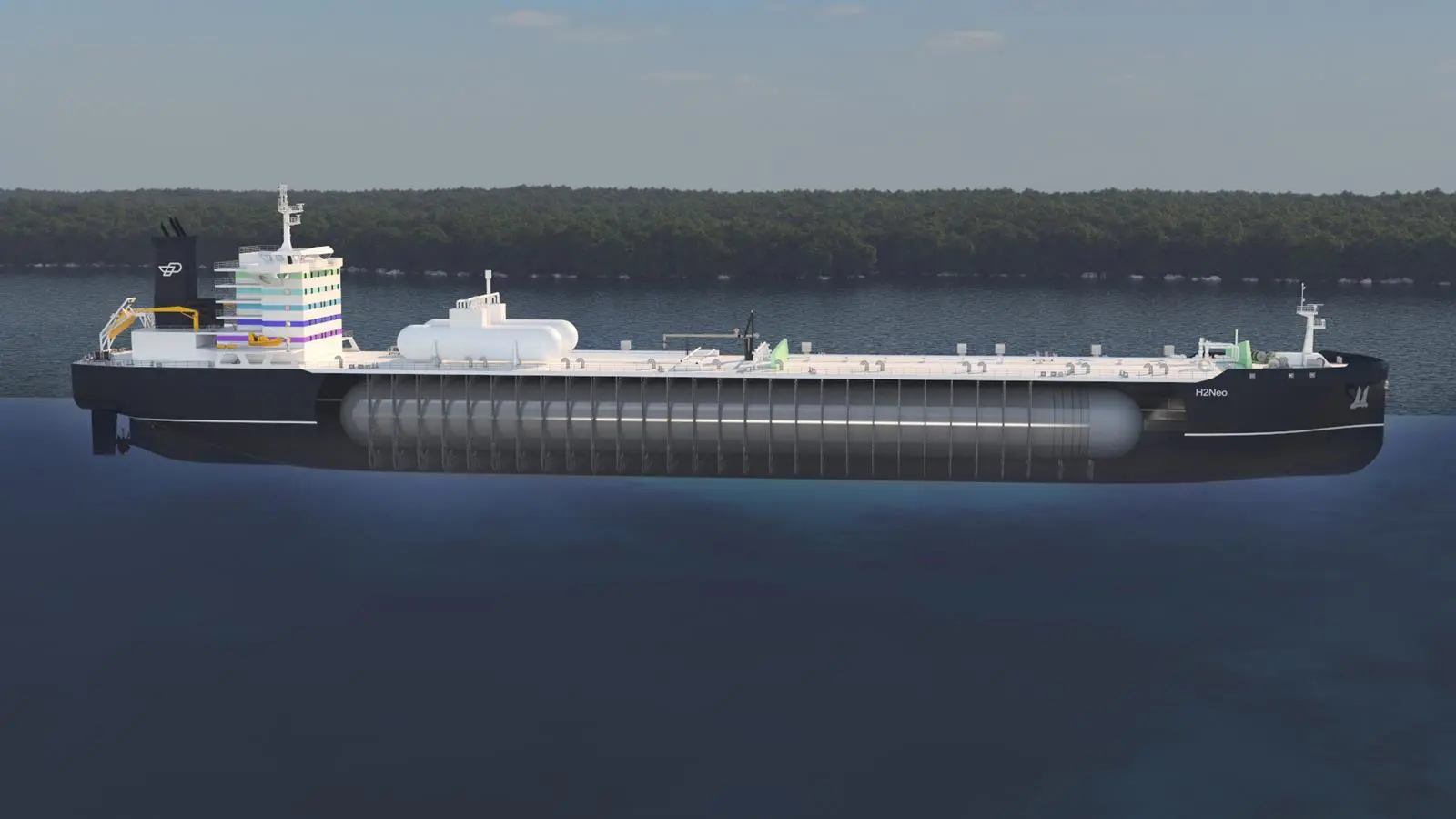
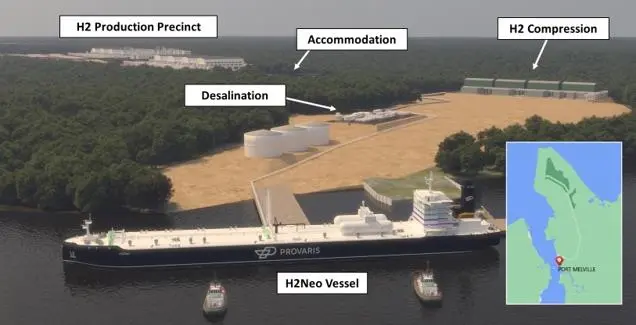
Also in Australia, Provaris is developing its own Tiwi H2 export project. Located on the Tiwi Islands, the project scale proposes an export volume of 100,000 tonnes per annum, using a fleet of its H2Neo carriers. The Tiwi H2 Project intends to use solar energy to produce up to 100,000 tonnes per annum of green hydrogen for export markets in the Asia-Pacific region. The Tiwi Islands have existing port infrastructure and an industrial precinct at Port Melville, and the company is now engaged in pre-FEED activities.
“The combination of low environmental impact, port infrastructure, proximity to market and compression provides Provaris and the Tiwi H2 Project with a potential first-mover advantage in the region, by targeting first exports in 2027, and has the potential to be Australia’s first export project of gaseous green hydrogen,” says Carolan.
Compression advantages
In May, Provaris released a report comparing the delivery cost of hydrogen using either compression, liquefaction or ammonia when integrated with a variable renewable energy profile to produce hydrogen. The study states that energy use and losses across the entire supply chain (generation, production, and delivery) associated with liquefaction and ammonia exceed 40%, while compression remains below 20%. Further, compression is the most cost-effective option for regional transport distances from 500 to 4,000 nautical miles with volumes of up to 500,000 tonnes per annum. Liquefaction and ammonia suffer from high levels of renewable energy curtailment, energy use in the conversion process (20-30% loss), and energy use in the conversion back to gaseous hydrogen upon delivery (5-30% loss).
The report concludes that compression is the most compatible alternative for variable renewable generation profiles as it can fully “load follow”, eliminating additional capex required for a battery as well as hydrogen storage to manage variability. A bulk-scale hydrogen storage solution is required regardless of the hydrogen energy vector selected, and the recent launch of the H2Leo floating storage solution is a low-cost alternative for hydrogen storage.
“We are witnessing a remarkable increase in awareness and comprehension of some of the formidable challenges associated with delivering green hydrogen and the need for scalable solutions before 2030,” says Carolan. “Relying predominantly on ammonia supply chains to deliver hydrogen is not necessarily an efficient solution for governments and industries that require gaseous hydrogen to achieve emission reduction targets.
“By embracing compression as a crucial element in our hydrogen infrastructure, we ensure a swifter realisation of emission targets for hard to abate sectors and effectively address the challenges we have ahead of us.”
Related Articles
 ALTERNATIVE FUELS & LUBRICANTS
 GENERAL NEWS
 GENERAL NEWS