



Australia Looking for Hydrogen Headstart

There’s some concern that the clean energy funding provided in the US’s Inflation Reduction Act will pull project and technology developers from around the world. Australia has ambitious plans to become a leading green hydrogen producer and exporter, and perhaps in part to counter a “brain drain” to overseas projects, the nation has allocated A$2 billion in its latest federal budget to subsidise projects that will reduce the cost of producing green hydrogen at home.
The program will help bridge the commercial gap for early projects and put Australia on course for up to a gigawatt of electrolyser capacity by 2030 by funding two or three flagship projects that can be scaled up to meet that goal. Expressions of interest will be accepted in 2024, and contracts will be awarded and provided with ongoing payments over a 10-year period from 2026-27.
Australian Renewable Energy Agency (ARENA) CEO Darren Miller said: “Australia has an unparalleled opportunity to become a global green hydrogen leader, but we can’t afford to lose our momentum as other competing countries step up their ambitions and support. With this funding, we are looking to incentivise green hydrogen production in Australia by backing early projects that will be among the largest in the world.”
Industry has been positive about the programme. Fortescue, which has a pipeline of hydrogen projects both in Australia and overseas, said it demonstrates how seriously the government is taking the green hydrogen industry and its critical role in Australia’s future. Australia has the highest solar radiation per square metre of any continent in the world.
Enough sunlight falls on a 50 square kilometre area to satisfy our entire nation’s electricity needs, says Mark Hutchinson, CEO Fortescue Future Industries. “According to a 2022 study, Australia would need to allocate just 2% of its land mass to solar and wind to replace all of the energy it currently exports via LNG and thermal coal with green electrons and green molecules.”
bp also has a project pipeline. Lucy Nation, bp’s vice president, hydrogen – Australia and Asia Pacific said, “The Albanese Government has provided a much-needed response that gives industry increased confidence to invest. This program of competitive production contracts assists producers by helping to de-risk significant investments in an important new industry as well as attract global capital to Australia.”
Australian H2 projects
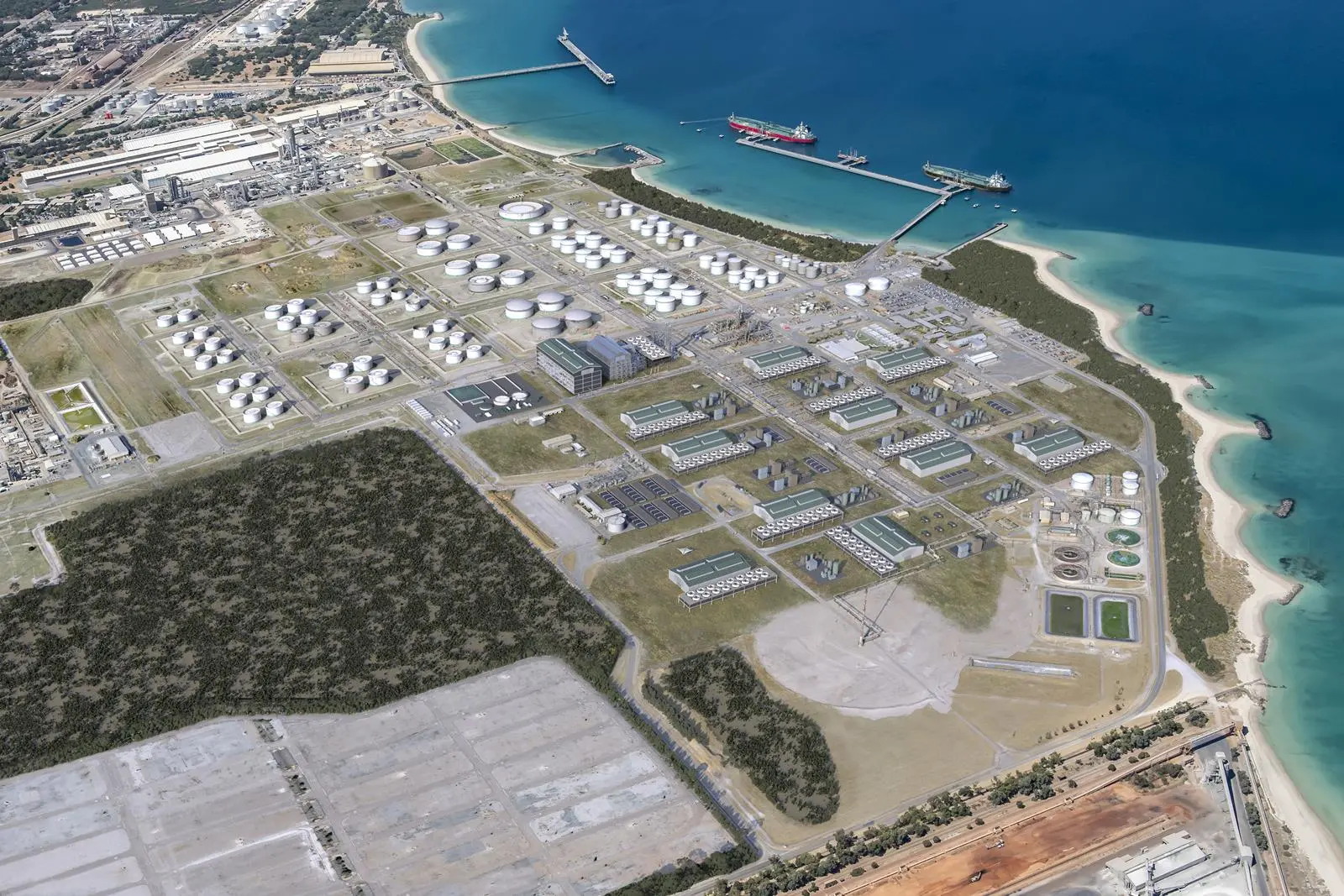
bp is progressing three world-scale hydrogen projects in Western Australia with H2 Kwinana in the Kwinana Industrial Precinct, Project GERI (Geraldton Export-Scale Renewable Investment), and the Australian Renewable Energy Hub in the Pilbara, a joint venture with Macquarie, CWP Global and Intercontinental Energy.
The Australian Government has already announced up to A$70 million in funding for the green hydrogen hub at Kwinana which brings together a unique combination of existing infrastructure, concentrated industrial demand, and strong connections to one of Australia’s largest industrial hubs. The hub will include installation of an electrolyser of at least 75MW, hydrogen storage, compression and truck loading facilities, and upgrades to bp’s existing on-site hydrogen pipeline. The hydrogen produced will support domestic and export demand including hydrogen supply for bp’s renewable fuels production, ammonia, metals and minerals processing, on-site gas blending and hydrogen for heavy duty transport.
The Australian Renewable Energy Hub project offers a major decarbonisation opportunity for the Pilbara, an industrial region identified for having significant potential for emissions reductions through the greening of iron ore mining and processing, green steel production, diesel fuel displacement and potential use and bunkering of green shipping fuels at Port Hedland. At full scale, the project is expected to be capable of producing around 1.6 million tonnes of green hydrogen, or 9 million tonnes of green ammonia, per annum and abate around 17 million tonnes of carbon in domestic and export markets annually.
bp’s hydrogen projects represent the opportunity to decarbonise today’s industry and set conditions for tomorrow’s low carbon economy, says Nation. This includes decarbonised energy for processing critical minerals and supplying hydrogen to Australia’s major trade partners as they also decarbonise their economies.
ARENA has also announced $20 million in funding to Stanwell Corporation to support a front-end engineering and design (FEED) study for a large-scale renewable hydrogen project in Gladstone, Queensland. The $117 million project will finalise the development stage of the Central Queensland Hydrogen (CQ-H2) Project, which will initially involve the installation of up to 640MW of electrolysers to produce hydrogen for commercial operations commencing in 2028. The hydrogen production facility will produce gaseous renewable hydrogen that will be purchased by offtakers and converted to renewable ammonia and liquefied hydrogen for export. The facility will initially produce 200 tonnes per day (tpd), with full scale anticipated to be 800 tpd for commercial operations in 2031.
De-risking Australian manufacturing
The Australian government is also targeting Australian manufacturing, with Tim Ayres, Assistant Minister for Trade and Manufacturing, saying there’s clear intent to set up a process to make sure that, given what’s happening overseas, particularly in the American system where there are big production subsidies for manufacturing there, that Australian manufacturing maintains its competitive edge. “The Government is sending that clear market signal to the investment community and the scientific community now that Australia should be the destination for renewable energy investment.”
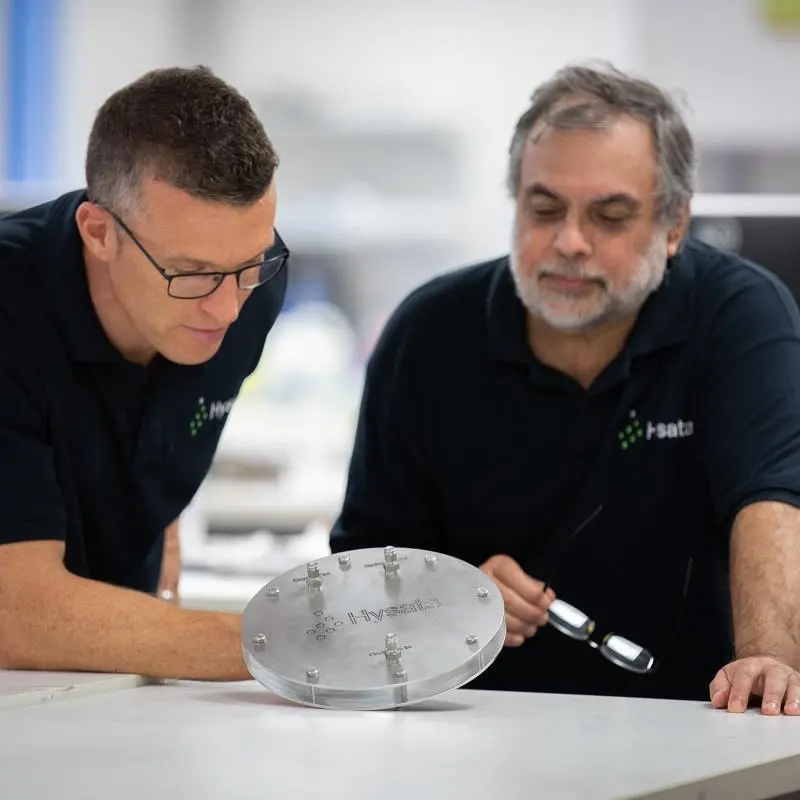
Paul Barrett, CEO of Australian electrolyser technology company Hysata, said the Headstart program funds his company’s customers. “There’s going to be multiple projects around Australia that have now got an economic benefit to get their green hydrogen projects to scale quickly. And as a manufacturer of electrolysers, that are the technology that manufactures the green hydrogen, we’ve now got an opportunity to sell early to these Australian customers rather than shipping our product overseas.”
Capillary-fed electrolysis cell
He says Hysata, a company spun out of the University of Wollongong, can make hydrogen cheaper than anyone else in the world. Research published in scientific journal Nature Communications confirms Hysata’s ‘capillary-fed electrolysis cell’ can produce green hydrogen from water at 98% cell energy efficiency, well above International Renewable Energy Agency’s (IRENA) 2050 target and significantly better than existing electrolyser technologies, enabling a hydrogen production cost well below A$2/kg (US$1.50/kg). The technology involves water supplied to hydrogen- and oxygen-evolving electrodes via capillary-induced transport along a porous inter-electrode separator, leading to inherently bubble-free operation at the electrodes.
Professor Kondo Francois Aguey-Zinsou of the University of Sydney says one of the main goals right now is to take hydrogen production and storage to industrial scale. His research includes solid-state hydrogen storage: rather than compressing and liquifying hydrogen, this involves holding hydrogen atoms within a solid substance.
In the early days that substance was often magnesium, but Aguey-Zinsou and his team are investigating combinations of metals, termed intermetallics, to find one that would maximise hydrogen absorption and stability. This offers the possibility of hydrogen being part of a solid-state device that could be easily carried and plugged into fuel cells. An electric bike and barbecue have already been built to successfully demonstrate the principle.
Nanoscale advances
Scientists from the University of NSW have demonstrated a novel technique for creating tiny 3D materials that could eventually make fuel cells cheaper and more sustainable. In the study published in Science Advances, the researchers show it’s possible to sequentially ‘grow’ interconnected hierarchical structures in 3D at the nanoscale which have unique chemical and physical properties to support energy conversion reactions.
The researchers were able to carefully grow hexagonal crystal–structured nickel branches on cubic crystal–structured cores to create 3D hierarchical structures with dimensions of around 10-20 nanometres. The resulting interconnected 3D nanostructure has a high surface area, high conductivity due to the direct connection of a metallic core and branches, and has surfaces that can be chemically modified.
In conventional catalysts, which are often spherical, most atoms are stuck in the middle of the sphere. There are very few atoms on the surface, meaning most of the material is wasted as it can’t take part in the reaction environment. These new 3D nanostructures are engineered to expose more atoms to the reaction environment, which can facilitate more efficient and effective catalysis for energy conversion.
“If this is used in a fuel cell or battery, having a higher surface area for the catalyst means the reaction will be more efficient when converting hydrogen into electricity,” says Professor Richard Tilley. This means that less of the material needs to be used for the reaction so costs will be reduced, making energy production more sustainable and ultimately shifting dependence further away from fossil fuels.
Related Articles
 ALTERNATIVE FUELS & LUBRICANTS
 GENERAL NEWS
 GENERAL NEWS