



Simplicity of design brings operational and cost advantages to ABB Dynafin
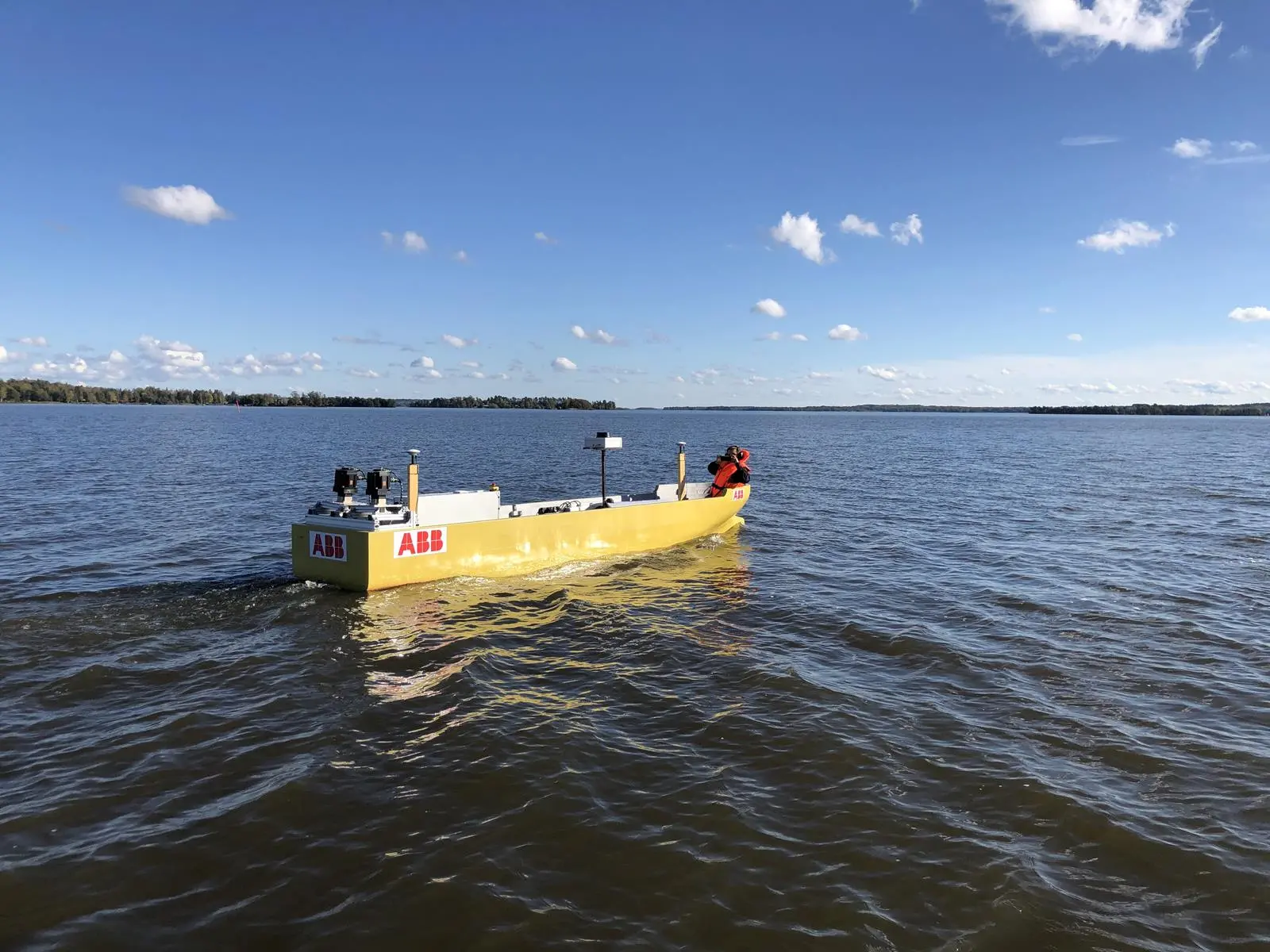
Based on modelling and pre-launch studies, the ABB Dynafin concept is expected to achieve an open water efficiency level of up to 85%. Translating the open water efficiency into a fuel savings, ABB expects to be able to deliver a fuel consumption saving of 15-22%. The first full-scale prototype is estimated to be available for pilot installation in 2025.
How it works
The new propulsion concept features a main electric motor that powers a large wheel rotating at a moderate 30-80 rounds per minute. Vertical blades, each controlled by an individual motor and control system, extend from the wheel. The profiled blades project outward from the bottom of the ship. Each blade can rotate both around the global axis of the main wheel and around its own local axis, which acts as a pivot point for enforcing a prescribed pitch motion.
The combined motion of the wheel and blades generates propulsion and steering forces simultaneously, enabling high levels of operational efficiency and precision without the use of a rudder. The propulsor can also change thrust direction almost instantaneously, increasing vessel manoeuvrability. In contrast, an azimuth thruster, where a conventional propeller is rotated around the vertical axis to direct its thrust, is slower and thus less efficient in manoeuvring the vessel.
The main wheel is equipped with four to six identical blade modules, consisting of a blade, a direct-drive motor, and a frequency converter to control the torque and rpm. The direction of rotation of the main wheel is kept the same under all operational situations, so the amount and direction of thrust is managed by a combination of adjusting the movement of the blades and rpm of the main wheel.
“It’s actually a very simple structure. There’s no separate gears. There’s no gearbox or complicated power transmission. It continues as a shaft through the bearings and then we have put the motor directly on the shaft without any extra complexities,” says Janne Pohjalainen, Global Product Line Manager for ABB Dynafin™, ABB Marine & Ports, “The unique thing is that we are adjusting the blade trajectory along the way while it is rotating. Within the one revolution of the total wheel, we are actively driving the blade in different angles of attack.”
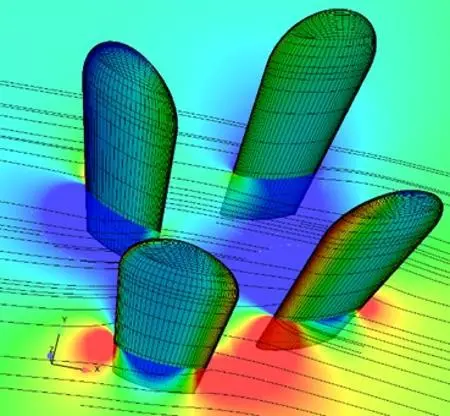
The ABB Dynafin can also be operated in ‘rudder mode’, meaning that all the blades are controlled like conventional rudders. This feature can benefit double-ended vessels and sail-assisted vessels, and it also increases redundancy in failure situations, providing partial steering capability. “If a vessel hits an object and somehow damages a blade, a propeller becomes more or less useless for any practical purposes, but here by the nature of the concept, if there is damage to one or more blades, we can stop the main wheel and control the angle of the remaining blades to still create steering forces,” says Pohjalainen.
Blade design
The propulsor’s rectangular shape, larger than the circle of a same-sized screw propeller, means that it has a larger propulsive area which lowers the loading of the blades and results in a low thrust loading coefficient (CT). The lower the CT, the higher the ideal open-water efficiency of a propulsor. Additionally, the wheel diameter is not limited by the ship’s draught as conventional propellers are, so ABB Dynafin propulsors are particularly well suited to shallow-water vessels with limited draft.
Screw propellers with rotation axes parallel to the inflow induce rotational losses in their wake. This is avoided in the cycloidal propulsor, as there are no major rotational components in the wake flow. The absence of rudder and shaft struts also means less drag than traditional propellers.
The high aspect ratio of each blade (blade span divided by chord i.e., the longitudinal dimension of the cross-section of blade) significantly increases the lift/drag ratio of each blade compared to a conventional screw propeller.
Each blade is individually controlled by an electric motor, frequency converter, and control logic, without mechanical restrictions. This enables the imitation of a high-efficiency fishtail movement and adjustment of the blade movement (eccentricity, advance ratio, and angle of attack) depending on different vessel operational situations, maximizing efficiency and thrust in both transit and DP modes.
In addition to having a direct electrical power train for both the main wheel and the blade modules, construction of the concept allows powering of the main wheel mechanically via a bevel gear. This feature enables the ABB Dynafin to be connected directly on to a main engine in vessel segments where electrical power trains are typically not used.
Testing
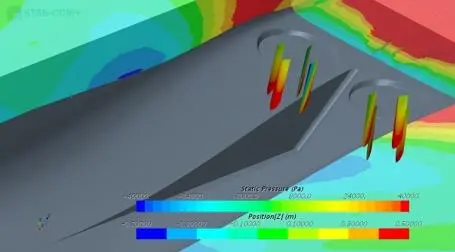
The propulsion concept is built upon the strong legacy of ABB’s Azipod® propulsion system, and from that perspective, much of the power and control technologies driving ABB Dynafin are based on those already perfected by ABB.
The concept has been extensively tested, and a scale model has been tested in lake trials. Propulsors were retrofitted to a platform support vessel hull so that a direct comparison could be made with Azipod® units in the same power range. The final phase of concept-proof was to confirm manoeuvrability in lake trials using a test matrix based on IMO manoeuvring parameters. This was the first time such tests have been carried out with a trochoidal propeller.
Ensuring the practical reliability of the design has been ABB’s unique design success compared to other trochoidal designs proposed in the past, says Pohjalainen. “It has to be simple enough to really work in real life for 30 years, and I think that’s the radical and unique thing here. We have put something on the table that can do that.”
Advantages
The improvements that ABB Dynafin brings to vessel efficiency will lead to lower power demand and the possibility of reducing the size of installed engines, optimising the size of fuel tanks and energy storage systems to meet lower power demand requirements. Pohjalainen says that the compressed footprint of the unit, and the comparatively limited requirements for auxiliary units, also allows naval architects to optimise cargo capacity within a given vessel envelope.
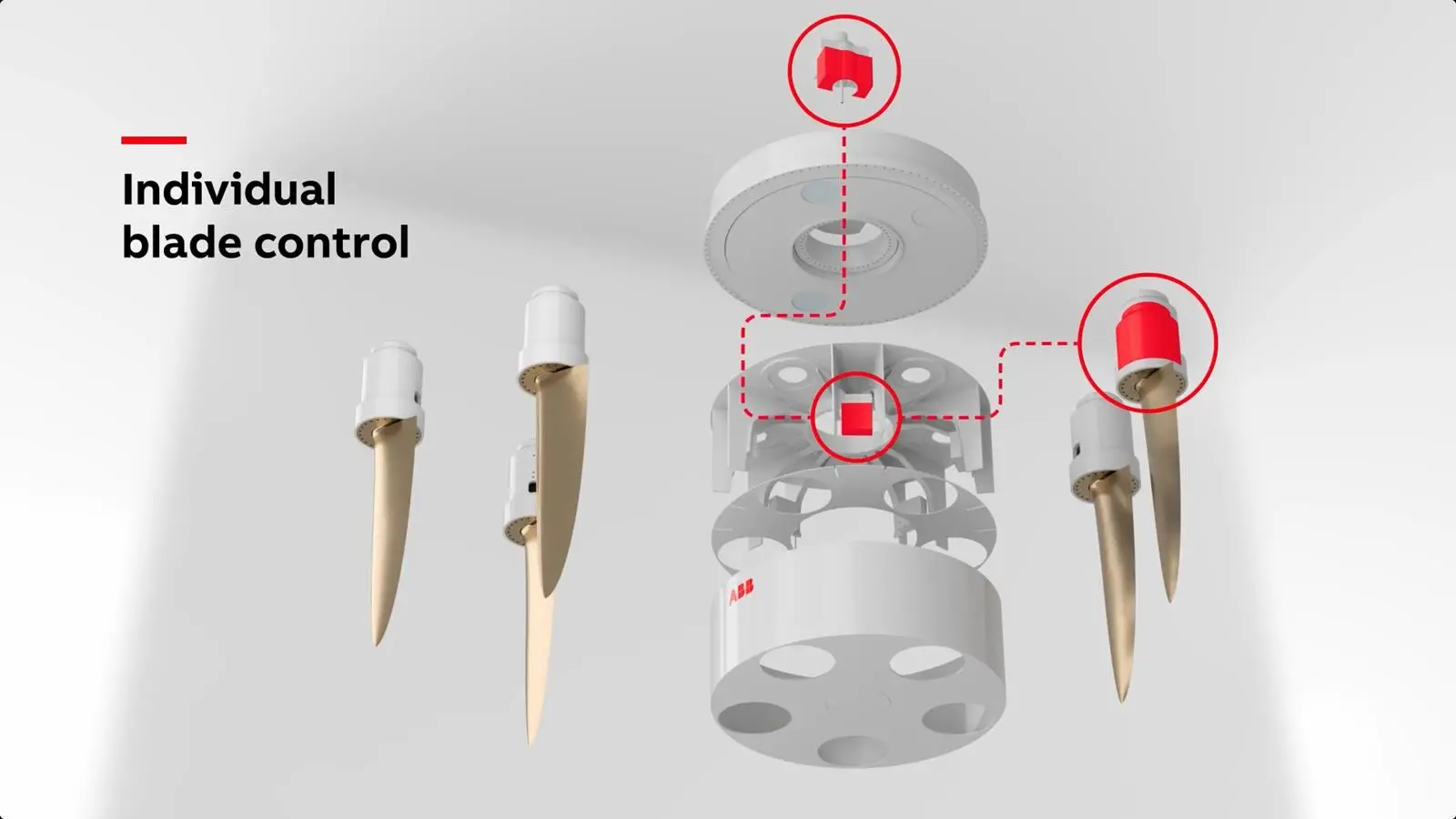
ABB Dynafin’s instant control of thrust and direction, including for DP, supports operational safety and flexibility even in demanding sea conditions. Its responsiveness means faster port approaches and departures, better resilience to weather and therefore a wider availability window as well as lower fuel consumption, says Pohjalainen. “We want to offer a wider operating window. We are not necessarily offering brute force, instead it’s quicker reaction to the environment and then actually using less power there.”
The system’s low rotational speed minimizes cavitation, pressure pulses, noise, and vibration. The lower levels of underwater noise enable operation in sensitive sea areas.
Maintainability
The number of components in ABB Azipod® units has been reduced compared to competing azimuthing thruster systems, and the ABB Dynafin minimizes the total amount of components even further by combining the functionality of the propulsor and steering units in one single package and by having a direct electrical power train for both the main wheel and the blade modules.
In addition, the absence of wear-sensitive gears and the moderate rpm of the main wheel minimizes wear on components. Construction of the unit also allows access inside the main wheel, enabling inspection and replacement of many components inside the vessel, improving the ability to monitor components and increasing the availability of the vessel. The unit’s modular structure and higher degree of standardisation also serve to improve the availability of spare parts.
“We want to sell ABB Dynafin on its total cost of ownership,” says Pohjalainen. “Initial investment will be higher, but we are absolutely convinced that when the shipowner looks at the total cost of ownership – both fuel costs and maintenance – it’s really a winning formula.”
Target market
He says: “We are looking at the ferry and car passenger segments, mid-sized cruise vessels, as well as the offshore and energy segments. Other vessels, like yachts and research vessels are also possible, but we are focusing on unit power of one to four megawatts, initially.”
In terms of developing higher capacity units, Pohjalainen noted that there were no inherent limitations that would restrict the scope of the propulsion concept, but added that higher capacity units might require the deployment of new technologies and materials to overcome existing technical constraints.
As part of an electric propulsion power system, the concept is fully compatible with zero-emission battery and fuel cell technologies. Pohjalainen envisages that vessels will have ABB Dynafin pairs, but rather than being a physical necessity, it reflects the redundancy that features in passenger vessel designs. A pair at the stern and a pair at the bow is a possibility for vessels requiring a high level of manoeuvrability, and in this case bow thrusters would not be required. “We already see that we are generating a lot of creative thinking about ship design possibilities.”
Pohjalainen is not yet ready to announce development plans with specific owners and class societies, but fruitful discussions are on-going.
Related Articles
 ALTERNATIVE FUELS & LUBRICANTS
 GENERAL NEWS
 GENERAL NEWS