



Debut For Revised Korean LNG Tank System
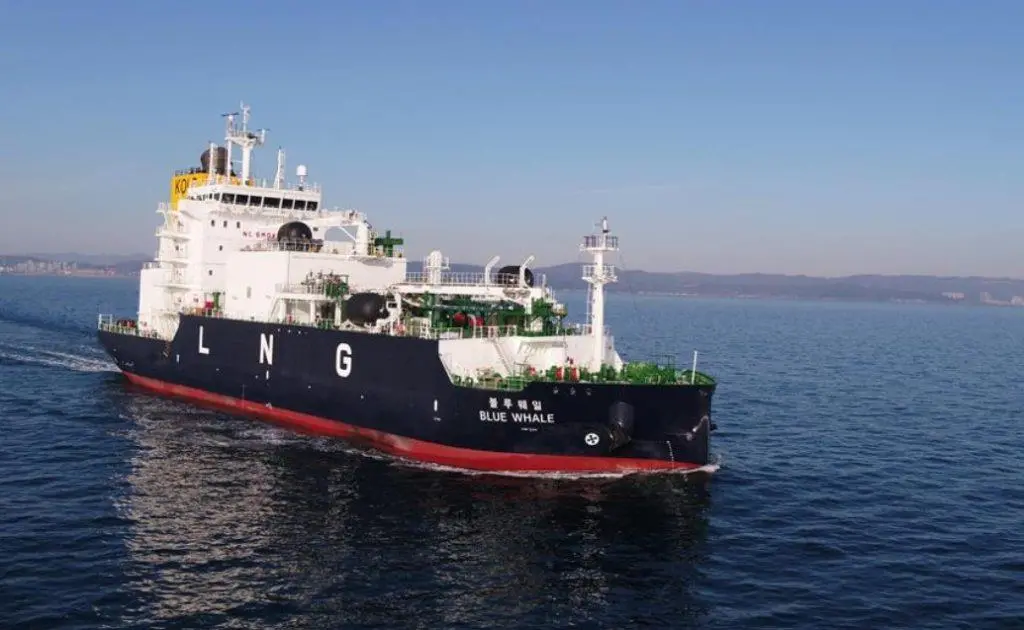
The technology initially developed between 2004 and 2014 that gave rise to the KC-1 membrane system has now been enhanced and introduced as the KC-2 design. Realising the further stage of R&D implemented in 2017, the KC-2 solution has made its debut in the 7,500m3-capacity LNG bunker tanker Blue Whale.
Built at the Ulsan complex of HD Hyundai Heavy Industries over a two-year period, the 97m Blue Whale was handed over last month to Korea LNG Bunkering (KOLB), a subsidiary of Korea Gas Corporation (KOGAS). KOLB has entrusted the vessel’s management and operation to Hyundai LNG Shipping.
KOLB had been selected by the Korean Ministry of Trade, Industry and Energy to front the national LNG Bunkering Vessel Construction Support Project in 2020, and the company ordered the ship with the benefit of a government subsidy of KRW15bn (US$11.5m). The overall contract price amounted to KRW55.3bn (US$42m).
The nature and realisation of the newbuild scheme is regarded as a further achievement in the strategy of localising LNG cargo containment technology, given the Korean shipbuilding industry’s pre-eminent position in the global LNG carrier construction market and its reliance and expenditure on licensed foreign cargo system designs. Once the KC-2 solution has been verified in service in the Blue Whale, the commercialisation process will be extended to the LNGC sector.
The long-crafted, indigenous KC-1 system came to fruition during 2018 through its embodiment in two 174,000m3 LNGCs completed by Samsung Heavy Industries for SK Shipping, the SK Serenity and SK Spica.
However, those gas tankers have spent much of the time since delivery anchored off the Korean peninsula’s southern coast or undergoing repair. The KC-1 technology has subsequently been used to effect in two small-scale LNGCs of 7,500m3 capacity, which are chartered to KOGAS. Since respective handovers in September 2019 and January 2020, the vessels have been employed either shipping cargoes from the Tongyeong LNG terminal to Jeju Island in the Korea Strait, or undertaking direct bunker transfers.
While the efficiency benefits promised by the KC-1 membrane solution provided the technical foundation for its development and adoption, the motivation for the creation of the system was the financial benefit it would afford domestic shipbuilders in not having to pay licence fees for using foreign, core technologies. A few years ago, such payments were understood to equate to around 5% of ship price, and it was indicated that yards would be able to save around 60% of royalty costs by adopting KC-1.
Strengthening technological self-reliance in this sphere therefore has the potential to sharpen Korean shipbuilding competitiveness and consolidate its position as the world’s most prolific producer of LNG carriers. Currently, the preponderance of such vessels from Korean yards employ the membrane design series originated by Gaztransport & Technigaz (GTT).
Related Articles
 ALTERNATIVE FUELS & LUBRICANTS
 GENERAL NEWS
 GENERAL NEWS