



Revised GHG reduction strategy for global shipping adopted
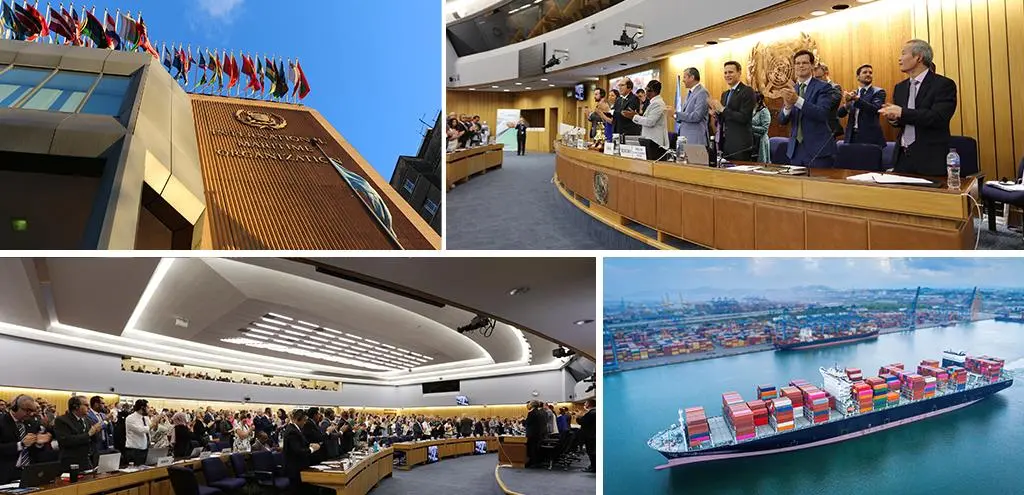
The member States of the IMO, meeting at the Marine Environment Protection Committee (MEPC 80), have adopted the 2023 IMO Strategy on Reduction of GHG Emissions from Ships, with enhanced targets to tackle harmful emissions.
The revised IMO GHG Strategy includes an enhanced common ambition to reach net-zero GHG emissions from international shipping close to 2050, a commitment to ensure an uptake of alternative zero and near-zero GHG fuels by 2030, as well as indicative check-points for 2030 and 2040. The Strategy was adopted unanimously.
2023 IMO Strategy on Reduction of GHG Emissions from Ships
The 2023 IMO Strategy on Reduction of GHG Emissions from Ships (the 2023 IMO GHG Strategy) represents the continuation of work by IMO as the appropriate international body to address greenhouse gas (GHG) emissions from international shipping.
Vision
IMO remains committed to reducing GHG emissions from international shipping and, as a matter of urgency, aims to phase them out as soon as possible, while promoting, in the context of this Strategy, a just and equitable transition.
Levels of ambition
Levels of ambition directing the 2023 IMO GHG Strategy are as follows:
1 carbon intensity of the ship to decline through further improvement of the energy efficiency for new ships
to review with the aim of strengthening the energy efficiency design requirements for ships;
2 carbon intensity of international shipping to decline
to reduce CO2 emissions per transport work, as an average across international shipping, by at least 40% by 2030, compared to 2008;
3 uptake of zero or near-zero GHG emission technologies, fuels and/or energy sources to increase
uptake of zero or near-zero GHG emission technologies, fuels and/or energy sources to represent at least 5%, striving for 10%, of the energy used by international shipping by 2030; and
4 GHG emissions from international shipping to reach net zero
to peak GHG emissions from international shipping as soon as possible and to reach net-zero GHG emissions by or around, i.e. close to 2050, taking into account different national circumstances, whilst pursuing efforts towards phasing them out as called for in the Vision consistent with the long-term temperature goal set out in Article 2 of the Paris Agreement.
Indicative checkpoints
Indicative checkpoints to reach net-zero GHG emissions from international shipping:
- to reduce the total annual GHG emissions from international shipping by at least 20%, striving for 30%, by 2030, compared to 2008;.
- to reduce the total annual GHG emissions from international shipping by at least 70%, striving for 80%, by 2040, compared to 2008.
Basket of candidate mid-term GHG reduction measures
The 2023 GHG Strategy states that a basket of candidate measure(s), delivering on the reduction targets, should be developed and finalized comprised of both:
- a technical element, namely a goal-based marine fuel standard regulating the phased reduction of the marine fuel’s GHG intensity; and
- an economic element, on the basis of a maritime GHG emissions pricing mechanism.
The candidate economic elements will be assessed observing specific criteria to be considered in the comprehensive impact assessment, with a view to facilitating the finalization of the basket of measures.
The mid-term GHG reduction measures should effectively promote the energy transition of shipping and provide the world fleet a needed incentive while contributing to a level playing field and a just and equitable transition.
Next steps
The 2023 Strategy sets out a timeline towards adoption of the basket of measures and adoption of the updated 2028 IMO GHG Strategy on reduction of GHG emissions from ships:
- MEPC 81 (Spring 2024) – Interim report on Comprehensive impact assessment of the basket of candidate mid-term measures/Finalization of basket of measures
- MEPC 82 (Autumn 2024) – Finalized report on Comprehensive impact assessment of the basket of candidate mid-term measures
- MEPC 83 (Summer 2025) – Review of the short-term measure to be completed by 1 January 2026
- MEPC 84 (Spring 2026) – Approval of measures / Review of the short-term measure (EEXI and CII) to be completed by 1 January 2026
- Extraordinary one or two-day MEPC (six months after MEPC 83 in Autumn 2025) – Adoption of measures
Target dates:
- MEPC 85 (Autumn 2026)
- 16 months after adoption of measures (2027) – Entry into force of measures
- MEPC 86 (Summer 2027) – Initiate the review of the 2023 IMO GHG Strategy
- MEPC 87 (Spring 2028)
- MEPC 88 (Autumn 2028) – Finalization of the review of the 2023 IMO GHG Strategy with a view to adoption of the 2028 IMO Strategy on reduction of GHG emissions from ships
Life cycle GHG assessment guidelines adopted
The MEPC adopted Guidelines on life cycle GHG intensity of marine fuels (LCA guidelines) for consideration and adoption. The LCA guidelines allow for a Well-to-Wake calculation, including Well-to-Tank and Tank-to-Wake emission factors, of total GHG emissions related to the production and use of marine fuels.
Interim guidance on the use of biofuels
The MEPC approved an MEPC circular on Interim guidance on the use of biofuels under regulations 26, 27 and 28 of MARPOL Annex VI (DCS and CII).
Marine Environment Protection Committee (MEPC 80)
The Marine Environment Protection Committee (MEPC) addresses environmental issues under IMO’s remit. This includes the control and prevention of ship-source pollution covered by the MARPOL treaty, including oil, chemicals carried in bulk, sewage, garbage and emissions from ships, including air pollutants and greenhouse gas emissions. Other matters covered include ballast water management, anti-fouling systems, ship recycling, pollution preparedness and response, and identification of special areas and particularly sensitive sea areas.
Related Articles
 ALTERNATIVE FUELS & LUBRICANTS
 GENERAL NEWS
 GENERAL NEWS