



High-Tech Cable Layer In Prospect
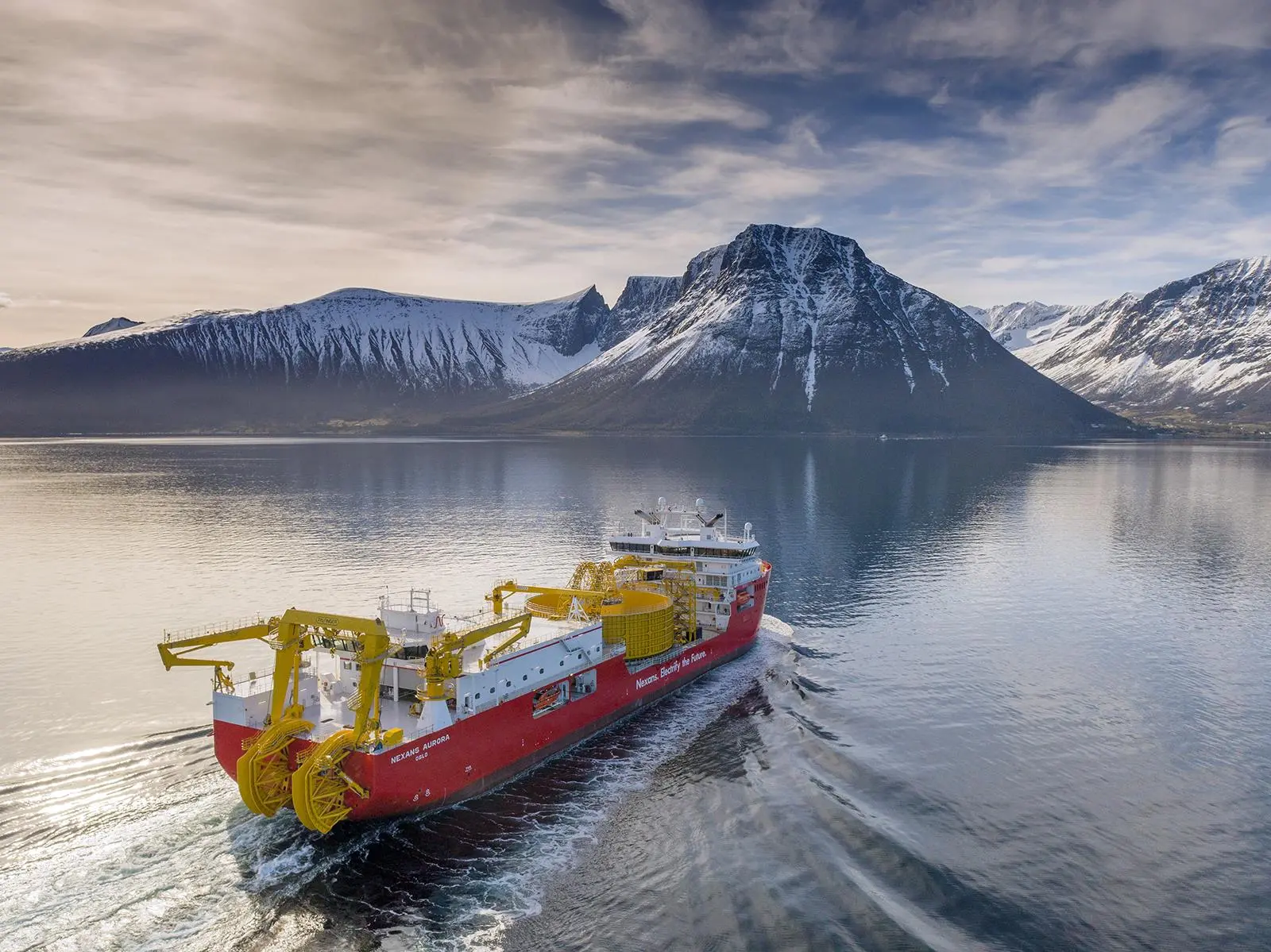
Although a shipyard contract award has yet to be announced, the Paris-headquartered group anticipates delivery in 2026. The addition to the current two-ship fleet will represent an advance on the capabilities offered by the company’s latest vessel, the 150m Nexans Aurora, completed by Ulstein Verft of Norway and introduced into service during 2021.
Equipped with three turntables, offering a 13,500t loading capacity, and hosting a large range of subsea equipment, including jetting and ploughing tools, the prospective newbuild will have the means of laying up to four cables simultaneously to meet specific customer requirements, especially on large-scale, time-critical schemes.
The investment will not only extend the group’s operational versatility, scope and geographical reach, but will also meet new environmental objectives, through the nomination of a sophisticated, hybrid power system and machinery able to run on a biodiesel mix.
Nexans chief operations officer and executive vice-president Vincent Dessale stated: “This new vessel will be the most technologically advanced cable layer ever deployed. Fitted with a range of high-tech cable installation and burial equipment, it will enhance the capabilities of our subsea cable operations to tackle projects on an unprecedented scale.”
The commitment to fleet expansion comes hard on the heels of two major contract wins for Nexans. The latest award, worth EUR1.43bn ($1.56bn), is a turnkey deal embracing the engineering, construction and installation of the cable systems for the Greece-Cyprus link of the EuroAsia Interconnector, featuring the longest and deepest high-voltage direct-current (HVDC) electrical cables ever laid.
This was preceded by success in attracting the EUR1.7bn ($1.86bn) deal with TenneT of the Netherlands whereby Nexans will be responsible for connecting three wind farms in the German Bight with the German mainland, using subsea cables manufactured at the group’s Halden plant in Norway and loaded direct to a cable layer.
A fundamental strength of the fleet’s diesel-electric Nexans Aurora is her high-throughput cable-handling spread, comprising a 10,000t split turntable with dual-product lay-lines, for load-out, transportation and seabed placement in long lengths. Besides the concentric carousel, reckoned at the time of the ship’s handover to be the largest on the market, she is fitted with a basket for 450t of fibre-optic cable.
Ulstein Verft subcontracted the hull and initial outfitting to Crist Shipyard of Poland and effected primary equipment fitting and machinery installation at its Ulsteinvik premises in western Norway. The ship embodies the know-how not only of the owner and builder, but also that of Norwegian consultancy Skipsteknisk and UK firm MAATS Tech, a specialist in the design and supply of cable and flex-lay equipment, and now in administration.
The operator’s other existing vessel, the 118m Nexans Skagerrak, dates from 1976. Purpose-built to handle and lay large-size cables, umbilicals and flowlines, the vessel carries up to 7,000t of cable on one turntable and offers extra operational flexibility through a shallow draught.
Related Articles
 METHANOL
 GENERAL NEWS
 HYDROGEN