



Russia to accelerate construction of ice-breakers and ice-class fleet
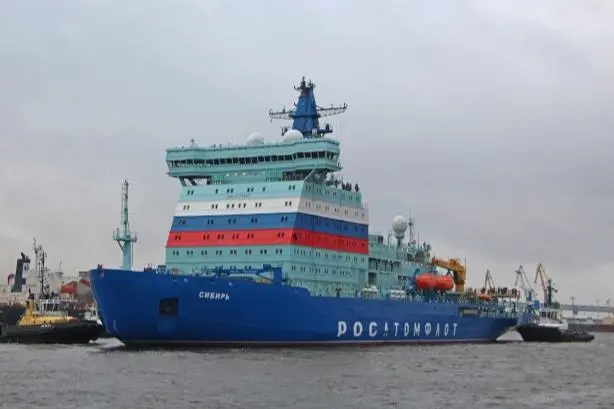
The current fleet capable of operating along the Northern Sea Route is insufficient, according to recent statements made by Alexey Chekunkov head of the Russian Ministry of Eastern Development. The solution lies in expanding the Arctic ice-class vessel construction programme.
One of the government priorities for the fleet renewal programme is the icebreaker fleet managed by the state corporation Rosatom (operator of the Northern Sea Route). Three of the group of six vessels have exceeded their operational life, which has been repeatedly extended until 2026-2027. In this regard, the renewal of this fleet is currently considered as one of the priority targets by the Russian government.
Domestic constraints on shipyard capacity and specialists have frustrated efforts to build the vessels domestically. In response, Russia plans to expand cooperation with India and China.
As part of these plans, there are plans to accelerate the construction of building of nuclear-powered icebreakers of Project 22220. Three nuclear-powered icebreakers have entered service, while the Chukotka and Yakutia are still under construction at the Baltic Shipbuilding Plant. The construction of one of them is scheduled for completion by the end of 2024, while the second one by 2026.
The icebreaker renewal programme represents the first step in a planned significant acceleration in the ice-class vessel construction programme until 2040. The plans include more than 50 new icebreakers and ice-class vessels, along with ports and terminals along the Northern Sea Route. The overall amount of investments is estimated at about 2 trillion rubles (US$20 billion) over the next 13 years, of which RUB600 billion will be provided from the federal budget.
It is planned, a particular attention will be paid for the building of super-heavy class icebreakers that can overcome ice up to four meters thick. Those ships will be built as part of another Leader project, which is being implemented at the Zvezda shipyard, where most of Russian LNG carriers are currently built.
With the construction of such icebreakers with a displacement of 70,000 tons, the problem of a shortage of ice-class vessels for Russia will be largely solved.
A separate question relates to the renewal programme for smaller Soviet-era ice-class vessels such as 50 Years of Victory, Yamal and Vaigach. There are ships whose technical capabilities allow them to enter river mouths and break ice. Russia is understood to be considering further extensions to the service life of these smaller vessels. There is a possibility that such decision may be taken in case of Taimyr and Vaigach by the end of the current year.
Although the replacement of the existing Soviet ice-class vessels in the Russian fleet by diesel icebreakers is being considered, it is unclear whether Russia possesses the necessary domestic capacities and competencies for the building of such ships.
Rising traffic along NSR
In the case of NSR, in the next decade the Russian shipbuilding sector will be primarily oriented on serving of its needs, as cargo traffic on this route is steadily growing. According to official statistics, 2022, 34 million tons of cargo were delivered along the NSR, and the same amount is planned to be delivered in 2023. It is expected that in 2024, cargo traffic along the route will more than double, to 80 million tons, and by 2031 – to 200 million tons.
Related Articles
 ALTERNATIVE FUELS & LUBRICANTS
 GENERAL NEWS
 GENERAL NEWS