



Investment Flow Starts At Belfast Yard
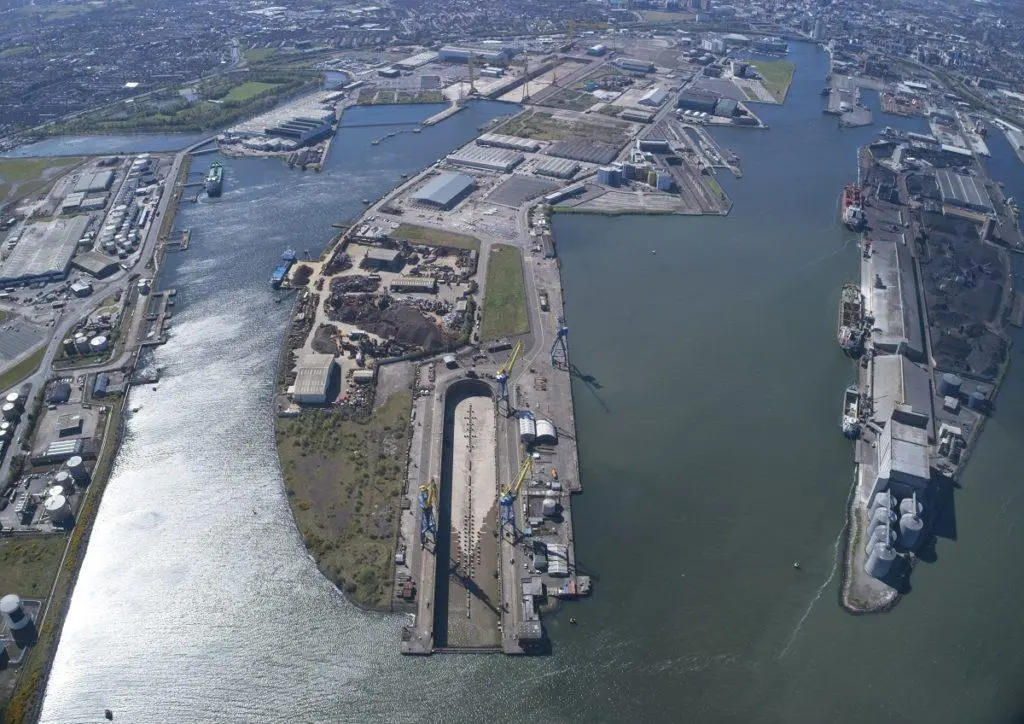
As well as advanced automation and robotic machinery, encompassing material movement, marking, plate cutting, panel lines, and welding, the enhancements to the Belfast complex will include a 5,000m2 extension to the fabrication halls. The programme will facilitate the automated output of panels of up to 16m2, and imbue the capability for the production of ‘mega’ blocks.
While the immediate objective of the infrastructural upgrade is the fulfilment of the order for the series of three 216-metre, 19-knot Fleet Solid Support (FSS) ships that will be deployed by the UK’s Royal Fleet Auxiliary (RFA), the expenditure will position H&W to capitalise on further newbuild, fabrication and heavy engineering opportunities.
“The improvements will give us the ability to take on larger projects at an accelerated pace, using the latest manufacturing technologies, requiring skilled people that will be trained to the highest standard,” said H&W chief executive John Wood. “
“This £77m investment is underpinning the transformation of the yard and will not only support FSS delivery but embed the latest technology across the group to increase our competitiveness in the European market and win new orders across our five markets of defence, commercial, energy, renewables, and cruise and ferry,” confirmed Mr Wood. H&W has earlier indicated that it is targeting a number of floating offshore wind projects for which fabrication is expected to commence between 2024 and 2030.
The company has also announced a new partnership relating to the future supply and production of marine battery systems. The pact with the Swedish specialist Echandia gives H&W exclusive distribution rights for battery sales to the maritime sector in the UK, Ireland and Australia. Furthermore, group subsidiary Harland & Wolff Technologies (HWT) will establish a UK assembly line for Echandia’s air-cooled, lithium-ion battery systems and provide service support for installations in the field.
The agreement follows the recent creation by H&W, Echandia, Macduff Ship Designers and Kongsberg Maritime of a consortium to develop and build zero-emission harbour and coastal tugs. The powering concept is based on fully battery-electric operation within ports, supplemented by energy from hydrotreated vegetable oil (HVO)-driven generators to allow for other than regular duties or coastal voyages.
Related Articles
 ALTERNATIVE FUELS & LUBRICANTS
 GENERAL NEWS
 GENERAL NEWS