



Japan Shows Mettle In Bulker Refinement
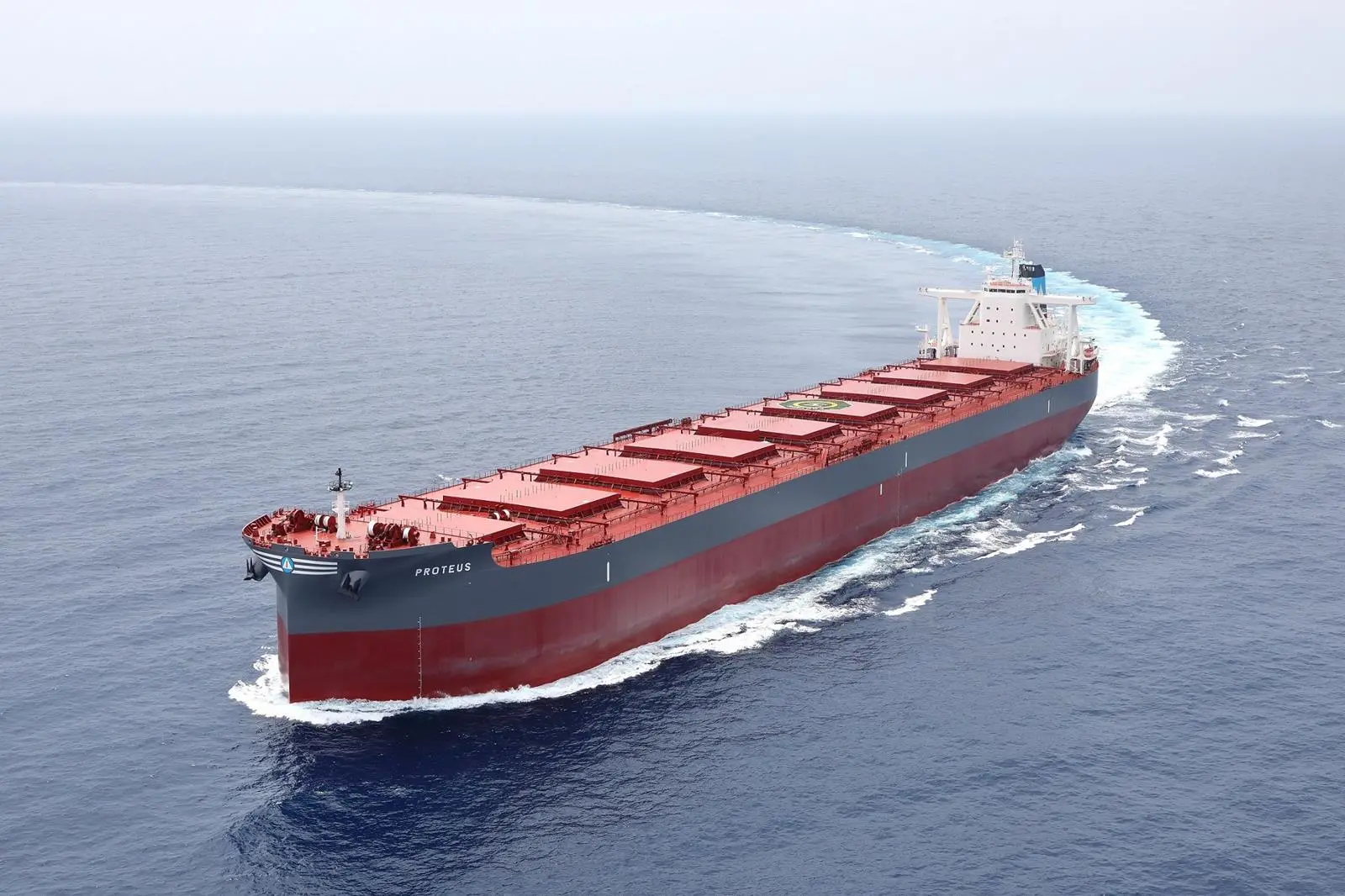
The 181,600dwt Proteus has given first form to the N181BC trader from JMU’s Ariake complex, offering an advance in coal and iron ore load capacity over the preceding Dunkirkmax series along with EEDI Phase 3 certification. At almost the same time, Namura delivered the 182,400dwt World Seafarer, a new EEDI 3 version in the same category, constructed at the Imari yard.
Both newbuilds are of some 292m in length overall by 45m beam, each embodying nine holds served by side-rolling hatch covers. Proteus is attributed with a total hold volume approaching 196,000m3, while ClassNK lists World Seafarer with a cargo capacity of 199,524m3.
Registered under the Bahamas flag with Ravenna Enterprises, Proteus is powered by an MAN 7S60ME-C10.6 diesel rated for 12,100kW at 82rpm, giving a ‘full and down’ speed of just over 14 knots. The engine was manufactured by licensee Hitachi Zosen and meets IMO Tier III NOx criteria by way of high-pressure SCR technology.
Hydrodynamic improvement measures adopted by JMU in the N181BC aftship include the proprietary super stream duct (SSD), SURF-BULB and advanced low viscous resistance fin (ALV-Fin). Furthermore, the design features the proven LEADGE-Bow.
Commissioned into the fleet managed by Tsakos Conbulk Services, the Namura-built World Seafarer is powered by machinery of the same bore but longer stroke from the MAN stable, in the shape of a seven-cylinder MAN G60ME-C10.5 specified at just 11,400kW on 72rpm. The engine came from Mitsui’s prolific Tamano works.
As a further addition to bulker tonnage under Majuro (Marshall Islands) registry, the vessel applies various Namura-developed energy-saving devices in way of rudder and propeller.
Access to Dunkirk’s inner Eastern Port and its mineral quays is through the Charles de Gaulle lock, which normally imposes a 45m breadth limit, a key criterion for the Dunkirkmax designation.
The industrial port accommodates one of ArcelorMittal’s primary steelmaking centres, such that the northern French port and its parameters figure prominently in the group’s raw material supply logistics. The long-term future of the steelworks, which mainly produces slab and hot-rolled coils, is assured as a result of recently-confirmed French government backing for a scheme to decarbonise the steelmaking process.
A direct reduced iron unit and two electric arc furnaces will replace two of the three existing blast furnaces and two of the three basic oxygen furnaces at Dunkirk. Natural gas will be gradually phased out as the new plant will be fed by hydrogen, biogas and electricity. The scheme will allow for the production of 4mt per year of ‘low-emission’ steel. It is too soon to speculate on how the substitution of DRI for iron ore fines as feedstock will impact the sourcing of raw materials at the coastal plant.
Related Articles
 METHANOL
 GENERAL NEWS
 HYDROGEN