



New Fuels Change Lifetime Equation For Equipment
Shipowners are looking to extend the viability of their existing assets, because as Hurtigruten Coastal Express CEO Hedda Felin says: “It’s more environmentally friendly to retrofit a vessel than to scrap and build a new one.”
In the first of three retrofits for the company, Kongsberg Maritime solutions have delivered a 23% cut in CO2 emissions on the 121-metre passenger vessel MS Richard. The vessel, built in 1993, underwent an extensive refit last summer at Myklebust Verft and has now completed its first year back in service.
The refit program included installation of two hybrid shaft generators, two SaveEnergy 1.120kWh lithium-ion batteries and two Bergen B33:45V engines. The vessel also has new tunnel thruster motors, a retractable azimuth thruster, new controllable pitch propeller blades, and a digital management systems.
“From a sustainability point of view, and from the economic point of view of keeping very robust ships in the fleet for 10 to 20 years longer, this was the right thing to do,” says Felin.
Geir Oscar Løseth, Kongsberg Maritime’s Vice President of Sales Aftermarket Advanced Offerings, said: “We can do the full turnover of a vessel in four or five months. An entirely newbuild takes much longer.” Taking a big-picture view, Lisa Edvardsen Haugan, president of Kongsberg Maritime, says: “Our role is going to be to guide customers through this transition, with advisory services as well as the products and solutions that will make sure regulations are met. But we won’t do that simply by coming up with new products and solutions. We also need to look into existing fleets.”
Another recent vessel upgrade, this time undertaken by Faroese shipowner Skansi Offshore, aimed to significantly reduce emissions and minimise maintenance costs by operating with fewer engines. With SEAM as system integrator, the platform supply vessel Kongsborg, built in 2013, now has a battery hybrid solution. SEAM’s e-SEAMatic® BLUE includes the company’s drives, electronics, and battery system installed in a dedicated pre-built deckhouse, complete with necessary auxiliary systems.
The shipowner anticipates savings of around 4-5% during sailing and 20-25% during dynamic positioning. Additionally, the hybrid system supports shore power.
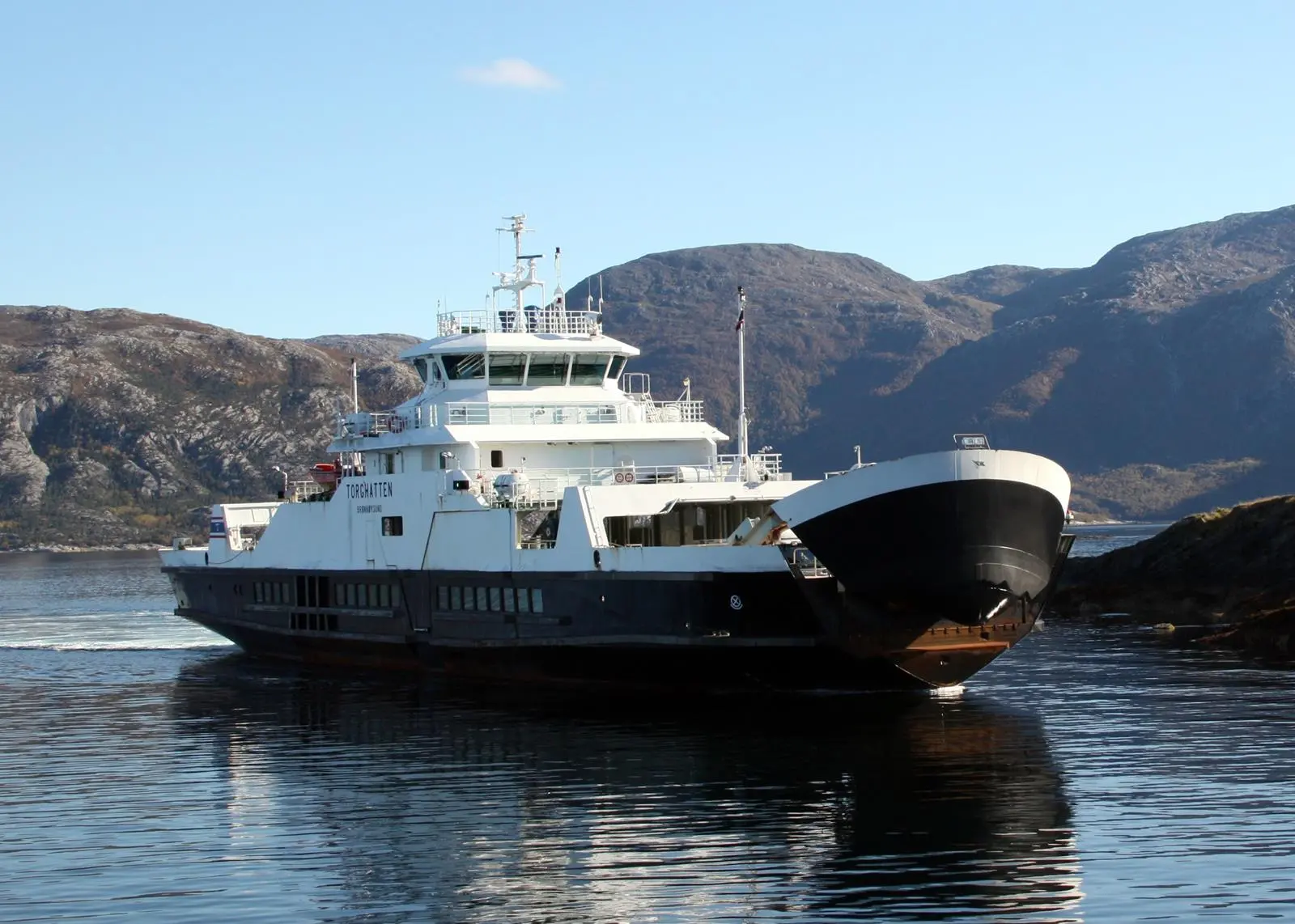
SCHOTTEL’s recent electrification project of a ropax ferry demonstrates the OEM’s view that modernising thrusters and engines and preventing operational wear, which can decrease efficiency and thus increase fuel consumption, are key strategies for decarbonisation. The MF Torghatten, operated by Norwegian ferry operator Torghatten Trafikkselskap, was recently retrofitted with two electrically driven SCHOTTEL EcoPellers type SRE 340 L CP (750 kW each). After little more than a year and a half in operation with the SRE calculations showed that the ferry’s energy consumption was down by 25%.
“The first step towards decarbonisation is always to produce sustainable high-quality products which can withstand even unforeseen strain for longer periods of time,” says Michael Heibel, Team Manager Sales, Modernization and Conversion at SCHOTTEL. “Since wear cannot be fully eliminated, proper maintenance always has to be observed. If a technology is at the end of its lifespan, can no longer compete with the efficiency of modern systems, or cannot accommodate a change to the operational profile of a vessel, a customised retrofit can be a cost-effective way of modernising existing vessels with a low carbon impact.” For Schottel, the electrification of propulsion systems combined with electrical storage systems holds the advantage that it makes them more independent from power-generating main engines and their respective fuels, allowing the engines to run at an optimum operating point.
Wolfram Frei, Head of Global Sales, Product Line Commercial & Fast Craft at ZF, says the company has prepared itself to deliver even more than their classical portfolio, like gearboxes and thrusters, and added electric motors and power electronics to its scope of supply. “When it comes to purely electric driven vessels, ZF will be able to support with a new range of special designed gearboxes. As the operation modes of electric motors are different to the ones of diesel engines, the specifications for gearboxes can be changed to a more efficient layout. The minimized losses will help to design the most efficient drive line of purely electric driven vessels.”
Frei notes that nearly all engine OEMs have started to modify their engines for the use of alternative fuels. “ZF is watching the performance changes of the combustion engines that may occur if they run with alternative fuels very closely and is constantly adapting its product portfolio so that it is a best fit for the engines’ performance.”
The cost of equipment and the cost of producing power has increased as a result of the need to adopt alternative fuels and/or electrification. This, says Emil Cerdier, Product Director at Berg Propulsion, has changed propulsion optimisation principles. “In the past it has been competitive to use a smaller propeller and a gearbox with lower gear ratio and instead use a larger main engine to meet operational requirements. Now the main engine or prime mover is more costly and therefore it is more affordable to select a larger propeller and a gearbox with higher gear ratio to improve propulsive efficiency. This means you still meet the operational requirements with lower main engine power.” It also ties in to concepts like hybrid systems or fully electric systems where less power can be online based on need for specific operations.
“I don’t think vessels will be built like they used to where you build them and they stay the same until it’s time to scrap them,” says Cerdier. “As regulations becomes more stringent over time or new energy sources becomes available/ competitive, equipment on vessels will need to be modified and upgraded in an efficient manner. The more you can prepare equipment selection to be future ready the less time and cost will be required at time of upgrade. This includes electrical integration system, driveline components as well as control systems.”
Variable speed gensets attracting interest
He is seeing more conversions and newbuilds using variable rpm engines. “In the past, a large number of vessels were designed with engines running at constant rpm and manoeuvring was done using a controllable pitch propeller. This way your shaft alternator will always run at a constant speed and provide fixed frequency power. At rated power, this provides good efficiency, but when operating in modes with lower power it means low propeller pitch and hence low propulsive efficiency. Therefore, it is attractive to be able to reduce engine rpm for a more fuel-efficient operation, but that also means you need a frequency converter connected to your shaft alternator.
“Another concept we see gaining a lot of interest is our Direct Drive Electric. Large permanent motors are installed directly on the propeller shaft line without the need for a reduction gearbox. For vessels with an operational profile better suited to an electric drive rather than diesel engines this concept can really maximize efficiency. Combined with our Twin Fin concept it also opens up further opportunities for improvements. Propellers can be made larger and with higher efficiency, it frees up space inside the vessel and provides a very robust and reliable system.”
Markku Miinala, Cruise and Ferry Segment Director at Steerprop, points out that achieving high propulsion efficiency has several benefits. For instance, in the case of double-ended ferries, optimal propulsion efficiency allows for the selection of smaller batteries. This, in turn, reduces the time needed for charging while at the harbour and lessens the power required from shore infrastructure. Often, the challenge lies in insufficient available electricity at the port or low charging capacity, leading to extended charging times. Smaller battery requirements also result in weight savings on the vessel and reduced space needed for equipment, generating savings across all components.
He says one noteworthy solution for retrofit projects is Steerprop’s contra-rotating propeller technology, which brings outstanding hydrodynamic efficiency and minimal mechanical losses. Steerprop’s use of permanent magnet electric motors further enhances efficiency and reduces the space required in the engine room. These advantages are especially high in ice-classed vessels compared to older, 10 to 15 years old propulsion systems. Steerprop’s case studies have shown potential energy savings of up to 49% in ice classed vessels and 35% in open waters.
By implementing retrofits with such technology, vessels can achieve minimal propulsion losses, leading to cost savings on the entire investment and lower operational costs going forward. Retrofits can be carried out on practically any existing propulsion system, and the energy needed for propulsion dictates the sizing of all other infrastructure, underscoring the importance of propulsion efficiency.
“Retrofitting the power and propulsion system can easily extend the operational life of vessels by decades, while paying special attention to propulsion efficiency reduces both emissions and costs,” says Miinala. “The electrification of vessel fleets presents a promising pathway toward a more sustainable and economically viable future.”
Holistic approaches
Andreas Söderberg, Vice President Business Development, Marine at Climeon, says the new fuels that are now introduced to the marine market will affect the waste heat flows and heat consumption onboard. For example, with the introduction of new fuels some of the large heat consumers such as HFO heating, can be removed. This spare waste heat can then be used to produce electricity with the company´s ORC waste heat recovery system. The specification and design of the company’s ORC waste heat recovery system is based on the concept of utilising heat from already existing cooling systems and waste heat recovery from exhaust. i.e. connections to piping systems are needed but no other changes are necessary to the fundamentals of the normal vessel systems.
Climeon’s low-temp ORC technology enables the use of all low-temperature heat sources with a temperature higher than 80°C to produce carbon-free electricity for operations onboard the vessel. This in turn reduces the demand on fuel powered generators, lowering fuel consumption and decreasing emissions from the vessel. “By nature, the ORC process simply relies on thermal energy and a cooling source to operate, so the fuel choice will not deter this process. Independent of the fuel source, engines in use produce heat which will always require cooling and therefore supply our ORC waste heat recovery technology with the thermal energy it needs to produce carbon-free power for the vessel.”
Turbo machinery considerations
Dino Imhof, Global Head of Application Engineering at Accelleron, says that for turbochargers there needs to be flexibility designed in to cope with future fuel requirements. “That also means we need the flexibility in service so that we have different kinds of maintenance options. And then, of course, the trend is that we combine it with our data enabled service. So, as we don’t know exactly today how it’s operating or what fuel is being used, we need to design the equipment to use up the lifetime of the components.”
Earlier this year, Accelleron unveiled its next generation of turbochargers for two-stroke engines, the X300-L series. The platform-based and easy-service concept is complemented by Accelleron’s Turbo Insights digital technology, and Imhof says it offers shipowners the flexibility to respond to uncertainty around future fuels and how they will operate their vessels in the future.
The benefits of the X300-L series, which currently comprises the ACCX365-L and ACCX370-L models, stem from its platform-based compact design, making it easy to service and easy to adapt for different requirements that might evolve. A new turbocharger design means that the entire rotor subassembly can be exchanged in a single port call using a new or refurbished cartridge.
“The next generation is already prepared for whatever comes. We will be able to adapt very quickly, and it also answers flexibility on the engine arrangement.” The key is modularity, he says. “You cannot undertake traditional product development as in the past. You have to build in a modular platform architecture. So that, instead of a product, you build a platform, and you enable your platform to cope with the different requirements easily.” That’s a new challenge for engineers, he says, as component development is now decoupled from product development.
Meyer Werft, looking ahead to 2100, has more challenges in store for engineers. The group has envisaged a futuristic cruise ship modelled on the aerodynamics of a rock penguin. The energy concept on board: the use of wave energy through horizontal wings on the hull, wind and solar energy and fuel cells.
Tim Krug, Head of Concept Development Group at MEYER Group, says: “From today’s point of view, we sometimes come up with extreme approaches, but it is equally important to think them through and develop answers from them.”
Related Articles
 ALTERNATIVE FUELS & LUBRICANTS
 GENERAL NEWS
 GENERAL NEWS