



World-Class Training Ship Raises US Profile
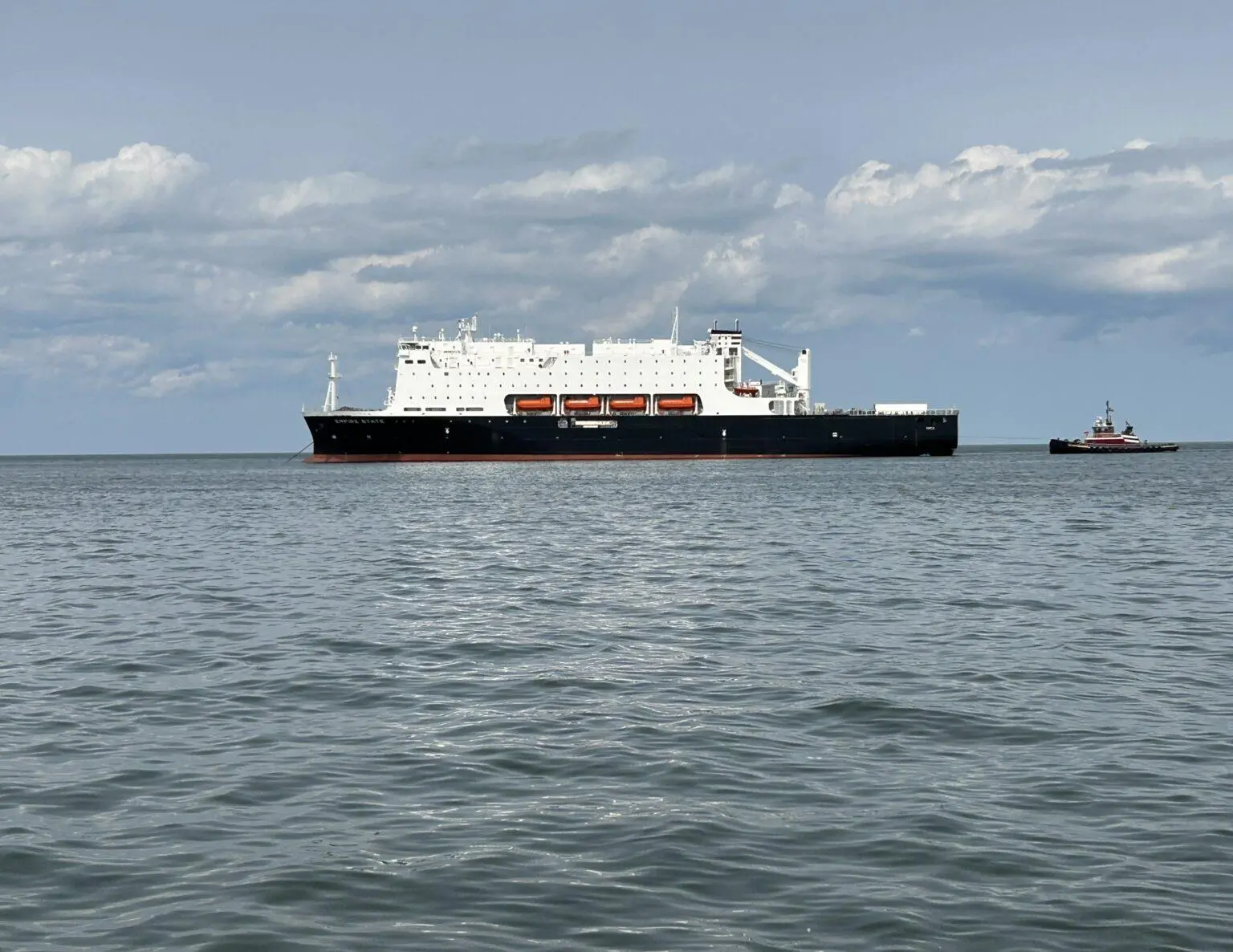
Allocated to the State University of New York (SUNY) Maritime College in the Bronx, the diesel-electric Empire State has superseded her steam turbine-powered predecessor of the same name, the oldest in the Maritime Administration (MARAD)-owned fleet of six training vessels assigned to academies throughout the USA.
Her September arrival in New York signalled the start of deliveries of the five-ship series implemented under the National Security Multi-Mission Vessel (NSMV) programme, destined to transform at-sea training of US seafarers while also providing logistic support and humanitarian aid platforms in the event of major emergency situations.
Second-of-class Patriot State, destined for the Massachusetts Maritime Academy, is scheduled to be completed in 2024. Keel-laying for State of Maine, to be based at Castine with Maine Maritime Academy, and steel-cutting for Lone Star State, assigned to Texas A&M Maritime Academy, took place earlier this year. Construction of the fifth and last in the series, Golden State, the new ship for California Maritime Academy, will commence shortly, with a view to 2026 handover.
The preliminary design was developed by Herbert Engineering Corporation of California and taken forward to the detail stage by the South Korean company DSEC, which has been involved in a number of the latest US ‘Jones Act’ newbuild projects. MARAD appointed TOTE Services as vessel construction manager (VCM) and the Jacksonville-domiciled firm duly awarded an initial two-ship build contract to Philly Shipyard, authorised in April 2020, at a time when the shipbuilder’s work flow had run dry. Subsequent ordering tranches resulted in a five-ship commitment to the yard on the Delaware River.
The project is the first government-sponsored shipbuilding programme in the USA to utilise the VCM model, which places reliance on the commercial sector for the selection and oversight of the shipyard contractor, and which utilises commercial best practices for the design and construction of government-owned vessels. The NSMV application has fostered increased interest in the wider potential of the VCM approach in state sector shipbuilding programmes as a way of reducing costs and accelerating delivery times.
Each of the state-of-the-art, 160-metre NSMVs has been laid out for up to 600 cadets, and will provide direct exposure to the latest maritime technology to ensure the requisite competence in operating and maintaining commercial and sealift vessels as licensed deck and engineering officers. In training mode, each vessel will board as many as 160 crew and faculty staff, while there is also provision for 1,000 people to be accommodated on humanitarian aid and emergency relief missions.
Besides eight classrooms, workshops, auditorium, simulator, laboratory and other training spaces, a full-scale training bridge is located below the main navigation bridge. Abaft the extensive, five-deck superstructure, the design provides garaging for ro-ro consignments and storage for containers, served by a sideport ramp and 35t deck crane. The ro-ro and lo-lo outfit is geared to the logistical requirements of disaster scenarios.
Hull lines optimisation using computational fluid dynamics (CFD) techniques and model tests was carried out at SSPA Sweden’s Gothenburg premises and proved effective in reducing the required propulsion power by approximately 10% in relation to the concept design.
The choice of power plant was a core consideration not only from vessel design and performance standpoints, but also in the context of a training platform that would provide the maritime schools with a modern engineering and propulsion package. The longevity of the existing MARAD training ships, and the persistence in the USA of marine steam turbine installations, gave added importance to the investment in a powering system that would reflect the evolution and future development of the country’s commercial fleet.
In fact, such is the age profile of the vessels that will be supplanted by the NSMV generation that their outdated technology limits the training value and scope, and compromises the ability to meet the latest environmental requirements and imbue the associated operational know-how.
DSEC entrusted GE Power Conversion with the overall power and propulsion solution in each of the newbuilds, which is based on a multi-engine, diesel-electric installation and a driveline culminating in a single, fixed-pitch screw. GE’s contract scope as the single-source vendor included the integration of the diesel engines, generators, switchboards, transformers, main propulsion drives, propulsion motors and auxiliary support systems.
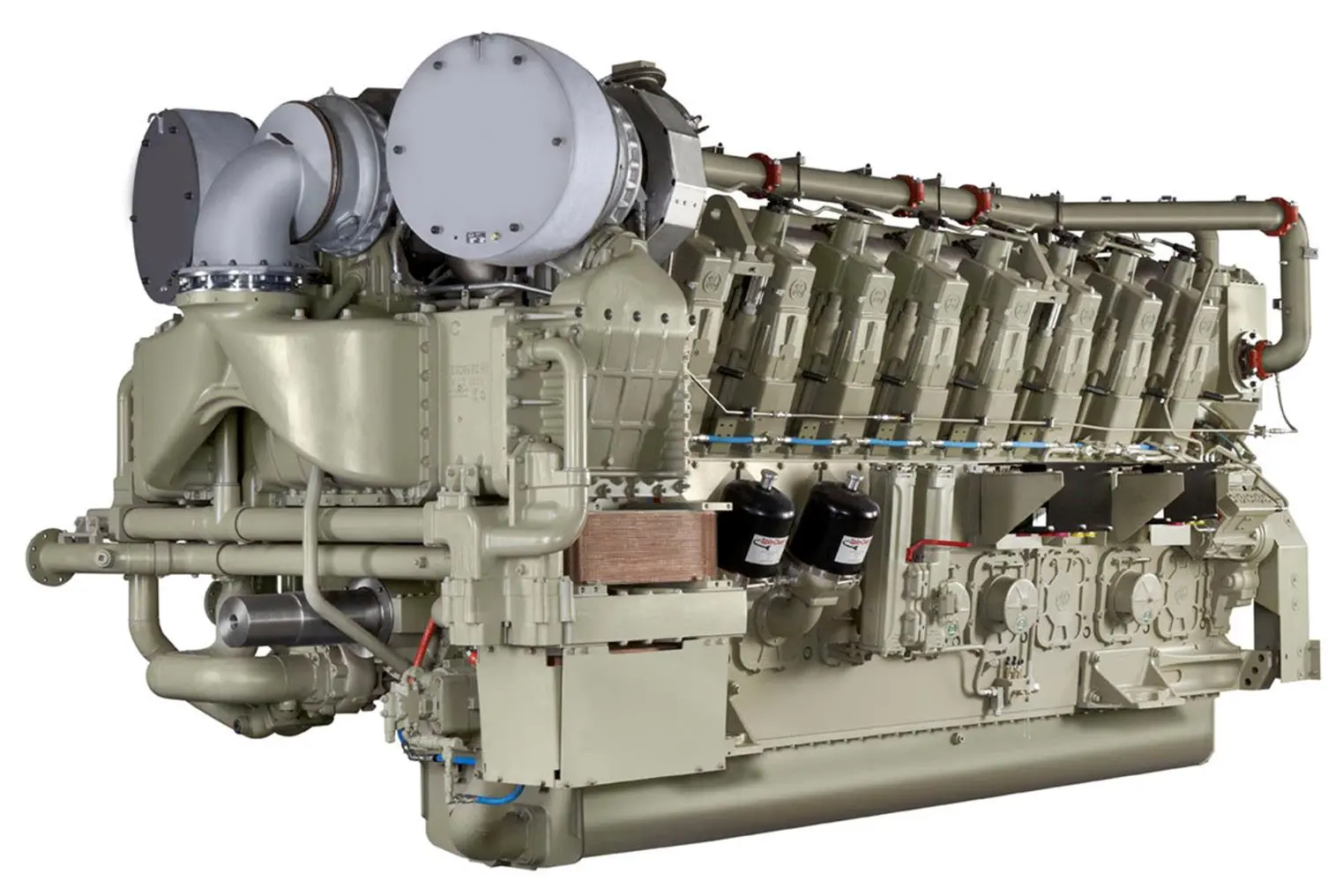
Each NSMV has been specified with four main generator sets driven by 16-cylinder, vee-form versions of the US-developed 250-series, four-stroke engine. The prime movers were packaged into genset aggregates by Cummins. This unique 250 engine design originated in the GE Group, but became part of the Wabtec portfolio after the latter subsumed GE Transportation in 2019.
Pairs of gensets are located in dual engine rooms and energy is delivering through two main switchboards and transformers to the electric propulsion motors and all other shipboard consumers. The 4.5MW propulsion motors are tandem units that sit in series connected to a single shaft turning a fixed-pitch propeller. The installation of the motors in contiguous, watertight rooms exemplifies the high degree of system redundancy incorporated throughout the newbuilds.
The Wabtec 16V250MDC model for shipboard duty has a nominal maximum continuous rating (MCR) of 4,200kW at 900rpm crankshaft speed, rising to 4,700kW in the 1,000rpm variant. The match points for a fixed-pitch propeller installation, as adopted in the NSMVs, are lower than those for controllable pitch propeller applications.
Proven across the rail, stationary power generation and shipping markets, the 250 design is a rugged class of four-stroke machinery. The latest iteration for marine applications is distinguished by the ability to meet IMO Tier III and EPA Tier 4 emission limits through purely engine-internal measures, obviating the need for aftertreatment through selective catalytic reduction(SCR). The technology thereby yield savings in space, costs and maintenance relating not only the catalytic reactor but also the dosing system, associated storage tank and ongoing replenishment.
Furthermore, as the original developer, GE asserts that the Tier 4 engine avoids the requirement for the tight control of the exhaust gas temperature that has to be ensured with SCR systems so as to prevent clogging from ammonium hydrogen sulphate issuing at lower temperatures.
Emissions abatement in accordance with stipulated requirements is achieved through a raft of measures including cooled exhaust gas recirculation (EGR), high pressure common-rail fuel injection, increased peak cylinder pressure enabled by two-stage turbocharging, and an advanced Miller timing cycle. The marine engine version is said to have benefited significantly from the development and validation of the EPA4-compliant locomotive engine, and Wabtec claims that the tighter environmental criteria have been met without compromising fuel efficiency.
Given the essential educational and vocational remit of the newbuild project, another beneficial aspect of the particular choice of machinery is that cadets will be exposed to Wabtec’s ‘clean diesel engine technology’.
The adoption of two separate main machinery spaces, in distinct fire zones with a dividing, watertight bulkhead, affords ample training opportunities for cadets, as each vessel will typically operate at no more than 12 knots on training voyages, necessitating only two main aggregates in one engine room to be fired-up. With machinery shut down in the other, ‘idled’ space, training can be conducted under better circumstances for the students, potentially to include the opening-up of engines for training purposes.
In addition to a stern thruster of approximately 900kW, the ship has a retractable, combi-type bow thruster serving as a tunnel thruster in the up position and as an azimuthing unit in drop-down mode. Sized at 1,450kW, the thruster also confers an emergency ‘take-home’ propulsion capability at up to six knots in favourable conditions.
Posting its 2023 first-half results, Philly Shipyard forecast that the five-ship NSMV series would be loss-making, impacted by increased costs of labour, turnkey suppliers and overheads. COVID-driven labour shortages, resulting in schedule delays and compression, have exerted a fundamental, adverse influence.
However, experience honed with the complex NSMV project should have a positive bearing for the shipbuilder in attracting future work in target fields. Furthermore, the NSMV contract model, enabling commercial best practices to be applied in the design and construction of government vessels, and realising cost savings and logistical benefits, stands to be replicated for other government shipbuilding programmes. In particular, the process could better address the challenges of future sealift fleet requirements.
Dilatory performance and cost escalation experiences with multiple US Navy shipbuilding programmes in recent years have led to much attention being drawn to what is widely perceived as a creditable achievement to date with the VCM methodology embraced by NSMV project.
Besides the $1.6bn training ship contract, the orderbook at the Philadelphia yard comprises three 3,600TEU, LNG dual-fuel container liners for Matson Navigation and a subsea rock installation vessel to the account of Great Lakes Dredge & Dock Co.
The workload has been augmented by a six-month feasibility study for consultancy Gibbs & Cox covering preliminary designs for two hospital ships. These would be replacements for the two existing vessels operated by Military Sealift Command on behalf of MARAD. Philly has retained VARD Marine to supply engineering and technological input.
NATIONAL SECURITY MULTI-MISSION VESSEL(NSMV) newbuild programme
| Vessel | Allocation | Delivery |
|---|---|---|
|
Empire State |
State University of New York(SUNY) Maritime College |
Sep 2023 |
|
Patriot State |
Massachusetts Maritime Academy |
2024 |
|
State of Maine |
Maine Maritime Academy |
2024 |
|
Lone Star State |
Texas A&M Maritime Academy |
2025 |
|
Golden State |
California Maritime Academy |
2026 |
MAIN PARTICULARS
Empire State
| Length overall | 160.0m |
|---|---|
|
Length bp |
154.0m |
|
Breadth |
27.0m |
|
Depth, to main deck |
16.8m |
|
Draught, scantling |
7.5m |
|
Draught, design |
6.5m |
|
Decks |
10 |
|
Deadweight |
8,487t |
|
Cadets |
600 |
|
Crew + faculty staff |
160 |
|
Propulsion/power system |
Diesel-electric |
|
Main generator engine power |
4 x 4,200kW |
|
Electric propulsion motors |
2 x 4,500kW |
|
Speed, 15% sea margin, 4 main engines |
18kts |
|
Speed, 15% sea margin, 2 main engines |
12kts |
|
Range @18kts |
11,000+ miles |
|
Manoeuvring thrusters |
1,450kW(bow) + 900kW(stern) |
Related Articles
 ALTERNATIVE FUELS & LUBRICANTS
 GENERAL NEWS
 GENERAL NEWS