



Clarksons research identifies divergent trends in vessel segments
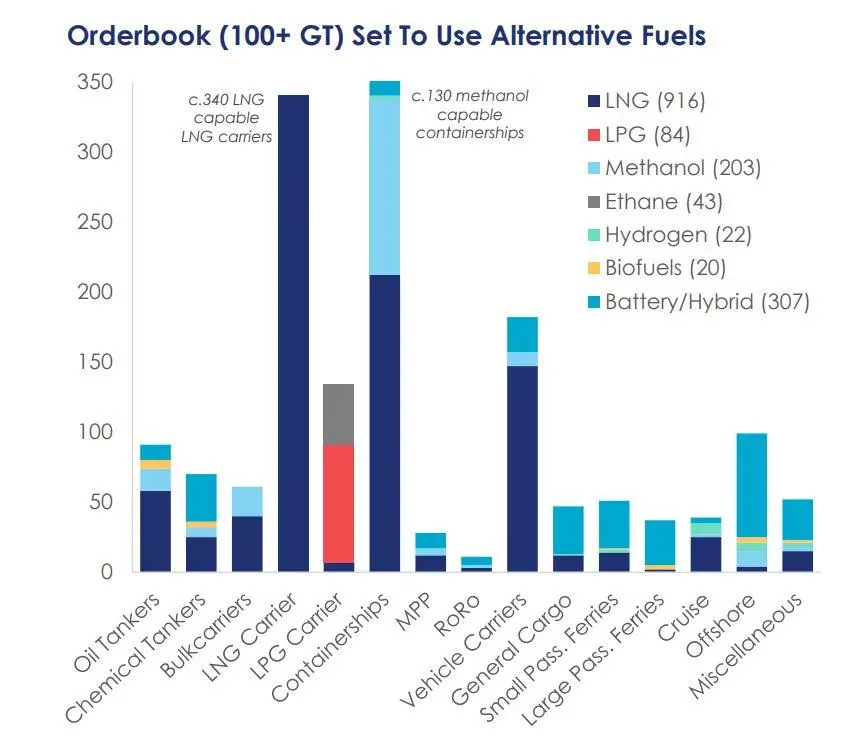
The Clarksons data identified 539 newbuild orders for alternative fuel capable vessels, equivalent to 33.8 million GT.
LNG dual fuel orders remained the single largest category of orders for alternative dual fuel propulsion placed in 2023, with 220 orders placed. The increase in the number of LNG carrier orders to 68, the majority of which were placed in relation to QatarEnergy’s worldscale NFE project, buoyed the overall volume of LNG-capable vessel orders. It is worth noting that LNG remained the largest alternative fuel order category, even excluding LNG carrier orders, with Clarksons recording 152 orders for non-LNG carriers specified with LNG capable propulsion in 2023.
Beneath the revival in LNG orders, the year was noteworthy for a significant increase in methanol-capable shipping, which has increased to account for 125 vessels in 2023. The rise in methanol-capable tonnage has been concentrated among larger sized vessel types, increasing its relative weight in the annual order evaluation.
The first four orders for ammonia-capable vessels have introduced a new category into the alternative fuel capable categories. The number of ammonia-capable vessels are set to increase rapidly in 2024, The Motorship notes, citing previous MAN ES research from H1 2023.
Overall, orders for alternative fuel capable vessels now account for 48.8% of the orderbook on a GT basis, of which 37.8% are LNG capable, while methanol capable orders account for 8.2% of the current order book.
Devil in the detail for hybrids
Assessments of alternative fuelled engine orders based on gross tonnage metrics necessarily accentuate the impact of larger vessel orders on the overall orderbook. However, it is interesting to note that among smaller sizes of vessels, such as general cargo, offshore and the passenger vessel segment, battery-hybridisation has become increasingly common among vessels specified with alternative fuels.
This trend, along with the continuing shift towards LPG and ethane-fuelled propulsion in the LPG carrier segment, points towards the increasing fragmentation of the maritime fuel environment towards the end of the decade. The single most important data point for the entire fuel transition remains the availability of bunkering or charging infrastructure globally. On that metric, LNG retains a significant advantage, with 188 active bunkering locations and a further 82 under development, compared with just 10 active methanol bunkering locations and a further 11 under development.
Related Articles
 ALTERNATIVE FUELS & LUBRICANTS
 GENERAL NEWS
 GENERAL NEWS