



Russia plans to accelerate the domestic shipbuilding activities
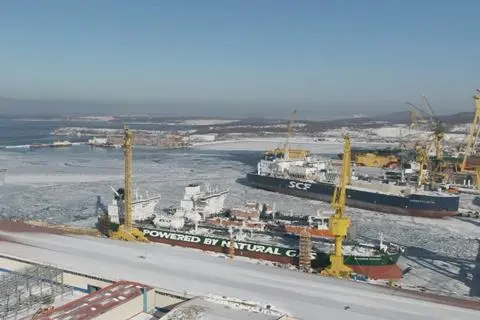
In line with plans to strengthen internal logistics, the plans focus on the expansion of the domestic river fleet. Implementation of these plans will be part of the existing long-term state strategy in Russia for the construction of up 1,000 civil ships until 2035. Of these, 152 will account for large-tonnage and medium-tonnage vessels.
Sanctions, cash shortages and inadequate shipyard capacity
The Motorship notes that the impact of ever tightening sanctions on Russia may significantly complicate the achievement of these goals. In particular, the introduction of secondary sanctions on international financial institutions on 22 December by US President Biden (Executive Order 14114) is understood to have had a chilling effect on the willingness of foreign banks to risk secondary sanctions.
Domestic financial constraints are also likely to impact the plans. A shortage of funds in the state budget has obliged the Russian state to use some reserve funds, particular those of the National Welfare Fund (NWF), one of Russia’s largest public funds.
It is planned that at least 260 ships will be built over 2023-2027, drawing on NWF finance. About half of them will account for cargo ships, while at least five of them will be large-capacity vessels.
The implementation of these plans could be complicated by the current shortage of shipbuilding capacities in Russia, which in recent years has become one of the major problems for the Russian shipbuilding sector.
According to Andrei Kostin, chairman of the Russian shipbuilding monopoly the United Shipbuilding Corporation, there are lots of orders for the construction of all types of ships in Russia, although the current shipbuilding capacities of the country do not allow to implement these plans in full.
Baltic Shipyard identified as potential shipyard location
Andrei Kostin comments: “Unfortunately, we are not able to compete these orders in full, as there is not enough capacity, there is not enough technology to implement them.” Therefore, according to him, there is a need to establish at least two more large-scale shipyards within the territory already in the short-term, one of which is likely to be located in the North-Western region of Russia, in the St. Petersburg region, while the second is likely to be located in the Far East.
In general, according to Kostin, as part of state plans, the ongoing reform and modernisation of the Russian shipbuilding sector is scheduled to be completed by 2030. These plans will be fixed in the updated shipbuilding strategy in Russia, which is expected to be presented by spring 2024.
In addition to river fleet, the planned new shipyards will focus on the building of new icebreakers, nuclear-powered ships and nuclear powered submarines along with fishing fleet. It is planned, future shipyards will operate in close cooperation with the existing Russian Center for Shipbuilding and Ship Repair Technology, one of country’s leading research instiuttions in the field of shipbuilding and on-board equipment.
There is a possibility that one of such shipyards will be built on the basis of the Baltic Shipyard – one of Russia’s largest shipyards, where a large-assembly assembly shop will be built, with the main production site is planned to be located on Kotlin Island, located near the mouth of the Gulf of Finland.
Northern Sea Route capacity expansion plans
In the meantime, according to recent statements, made by Deputy Minister of Industry and Trade of the Russian Federation Viktor Evtukhov, despite the initial state plans for the building of 1000 civil ships by 2035, these figures could be higher, as the Ministry of Transport of Russia has recently announced an additional need for another 440 ships, lifting the target to close to 1,500 vessels. He envisages 71 more ice class vessels capable of carrying cargo along the Northern Sea Route, an increase on the previously announced 32.
For the Northern Sea Route, there are plans for construction of a series of 60-megawatt nuclear icebreakers, along with three ships with a capacity of 120 megawatts each , the first of which should be in service in 2027, while others probably by 2030.
Most of independent Russian analysts in the field of shipbuilding business consider these plans as too optimistic, which will be complicated by extremely limited opportunities for the use of modern technologies and equipment in Russia and its shipbuilding sector at present, as well as a shortage of qualified personnel . Finally, Russia simply has a lack of appropriate “competence” in the construction of most types of modern ships, especially high-tech and/or simply large-tonnage ones.
There is a possibility that this problem could be partially solved as part of the recent announcement of Russia’s Prime Minister Mikhail Mishustin to allocate 14 billion rubles for the development, modernisation and production of the necessary ship and on-board equipment for the Russian shipbuilding.
Related Articles
 ALTERNATIVE FUELS & LUBRICANTS
 GENERAL NEWS
 GENERAL NEWS