



Berg Propulsion lands Louis Dreyfus Armateurs contract
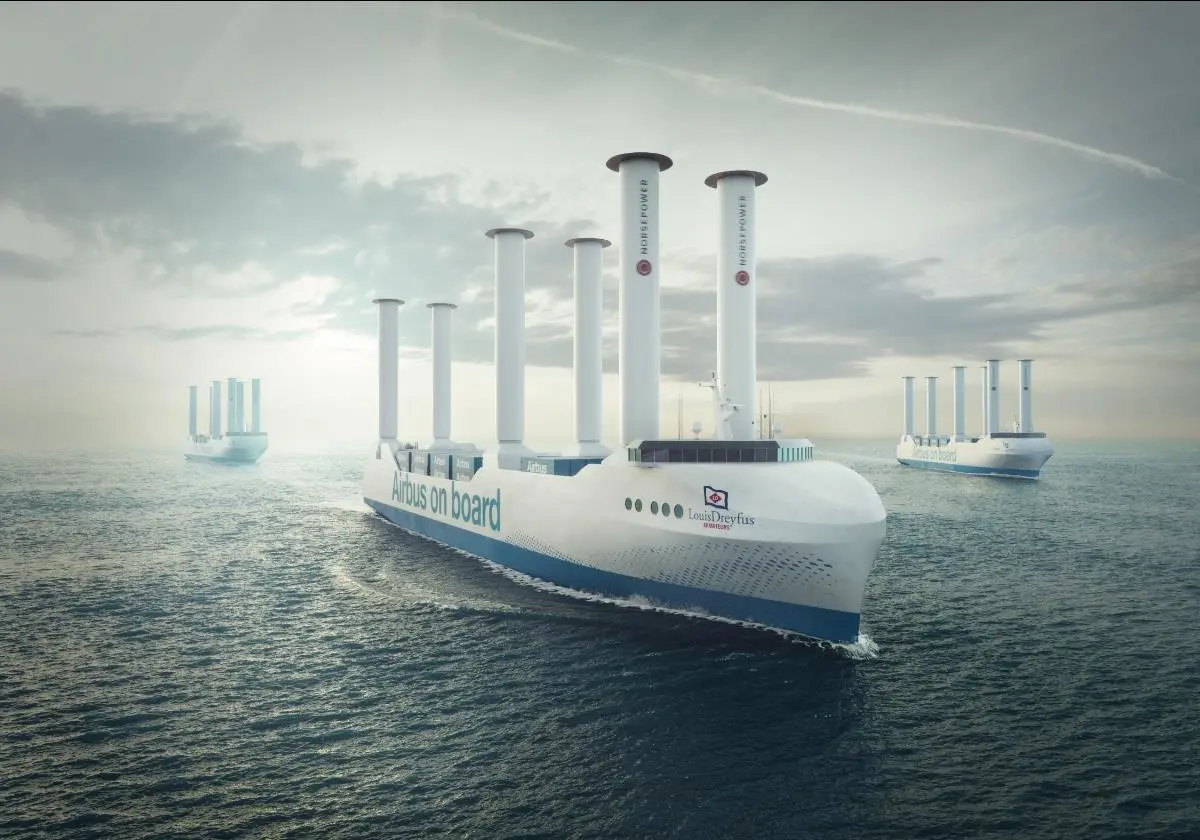
Built in China’s CSSC yard by Wuchang Shipbuilding, from 2026 onwards these LDA vessels will carry Airbus A320 Family jetliner subassemblies from Saint-Nazaire, France to the assembly line in Mobile, Alabama. The ships have been designed by Deltamarin with the aim of halving fuel burn and CO2 emissions in transatlantic operations compared to a 2023 baseline.
Wind power drawn from six Flettner rotor-sails on each ship’s deck will aid the reduction in emissions, compounded by weather routing optimisation software in place to maximise wind-assisted time and minimise drag. In conventional mode, the ships will run on dual fuel methanol engines.
Berg’s integrated power management and propulsion systems will allow for always optimizing propulsion performance with LDA specifying the supplier’s extensive engine-agnostic propulsion package for newbuild ships. BERG is also supplying state-of-the-art controllable pitch propellers with feathering capability.
Arthur Barret, head of engineering, project & innovation department at LDA, said: “We must ensure that the solutions supporting our vision are the smartest available and that we can rely on our technology partners throughout a ship’s lifetime. Berg’s integrated propulsion system enables us to minimize fuel consumption and emissions.”
Amrita Singh, account manager at Berg Propulsion, explained that the Berg hybrid solution allows main engines and electric motors to drive propulsion either independently or simultaneously so that the most efficient power option is used as a vessel’s operational needs change.
“The system works with alternative power sources, including wind. It’s key when integrating sails that they work seamlessly with propulsion controls so that adjustments can be made to thrust in any given weather and sea condition. In Berg’s solution, Dynamic Drive is integrated into the MPC800 control system, which delivers this capability without the operational complexity of additional hardware,” said Singh.
“The propulsion package includes a range of ‘modes’, whose selection optimizes performance across the ship’s various operational requirements,” explained Mattias Dombrowe, business manager – electrical system integration at Berg Propulsion. “As well as mechanical with PTO or electric modes, propellers also operate in boost mode to achieve full speed when required. When the rotor sails are in service, one or both of the propellers can be feathered to optimize wind-assisted operations.”
Crew continuously optimise efficiency using the flexibility available to the propulsion control unit, rather than being limited by the predetermined relationships between engine load and specific fuel oil consumption, added Dombrowe.
Related Articles
 UNCATEGORISED
 UNCATEGORISED
 UNCATEGORISED