



Rotor Sail’s design for minimal structural alterations in fitting
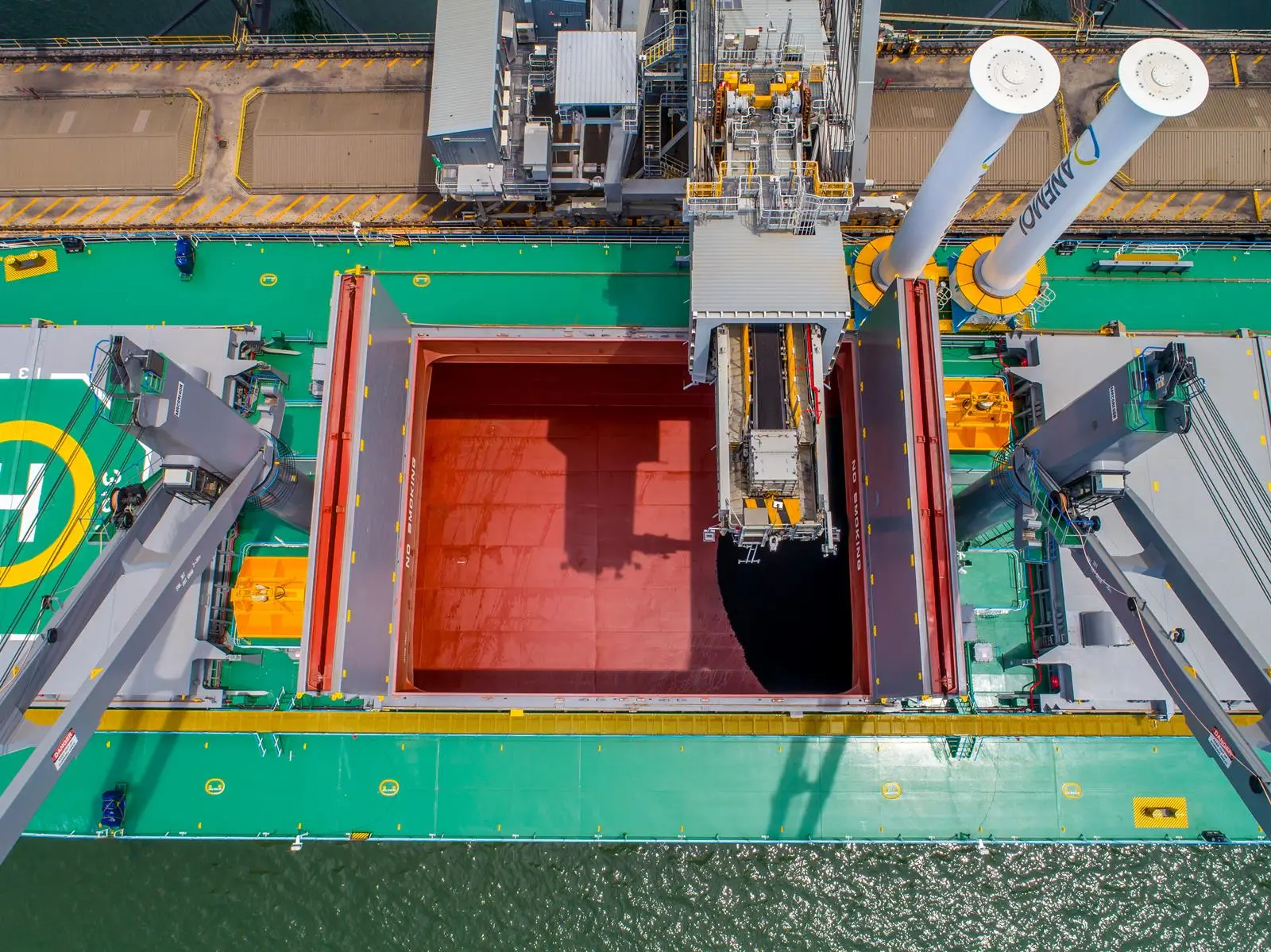
As ship owners continue to look for ways to reduce green-house gas emissions and the impact on the planet, harnessing the power of wind has become one of the best ways in which owners and operators can make meaningful efficiencies today.
The IMO has set carbon reduction targets, calling for CO2 emissions to be reduced by an average of at least 40% by 2030, with an overall aim to achieve net-zero greenhouse gas emissions by or around 2050. The introduction of the Carbon Intensity Indicator (CII) and the Energy Efficiency Existing Ship Index (EEXI), which will become increasingly stringent in the years to come, is compelling ship owners to seek both substantial and incremental efficiency improvements to ensure their vessels remain within acceptable rating boundaries.
Whilst there are four main technology types in the wind-propulsion sector today, Rotor Sails are the most adopted and are the market leader in the sector. “What makes Rotor Sails the most technologically advanced of those options is that they produce a lot of thrust for a relatively small device that can save a significant amount of fuel” said Luke McEwen, technical director at Anemoi Marine Technologies, the UK-based developer and provider of Rotor Sails for the global shipping industry.
Anemoi’s biggest Rotor Sail currently on the market is 35 m tall and 5 m wide, a fraction of the size of a 360m long bulk carrier that weighs 500,000 tonnes when fully loaded, and very compact compared to the 120m length of modern wind turbine blades.
“Being a small piece of equipment is possible because Rotor Sails generate a huge amount of aerodynamic lift for their size. You don’t get something for nothing but with a Rotor Sail, if you put a small amount of power in, you can generate 8-10 times the power back through renewable energy,” McEwen added.
Utilising an aerodynamic phenomenon termed the ‘Magnus Effect’, these cylinders generate forward thrust for the vessel, enabling it to reduce power from its main engines, reduce fuel consumption, and curtail its carbon emissions. Data from contemporary Rotor Sail systems has demonstrated that this technology can achieve fuel savings of up to 30% on routes with good wind conditions.
Rotor Sails are also straightforward to install. They do not require large-scale modifications to the vessel’s structure during drydocking, rendering them ideal for retrofitting, and each Rotor Sail can be installed in a single crane lift and connected to the foundation on the ship’s deck. Crucially, this technology is viable for nearly all vessel types and can be equipped with bespoke deployment systems, including folding the sails from their vertical position or, as developed by Anemoi, moving them on a rail system along or across the deck, to minimise disruption to cargo loading and unloading operations, and avoid low-clearance bridges.
“Rotor Sails are relatively plug-and-play so that makes them easy to install. The most important element of installation is in the sail’s foundations. A taller wind-assisted device will want to tip over more, so you need a bigger and stronger foundation that typically means installing reinforcement under the deck. That means installing scaffolding and getting steel support beams through small hatches in the deck. It’s a hugely expensive undertaking to reinforce the deck from below. For the majority of Anemoi’s installations, this work is not required, instead our foundation designs generally only require steel work above the deck,” McEwen explained.
Bulk carriers and tankers boast ample deck real estates, an invaluable asset for accommodating multiple Rotor Sails in an optimised arrangement that capitalises on prevailing wind patterns, thereby maximising fuel economies. The generous space also facilitates the installation of larger and a higher number of Rotor Sails, further amplifying their performance impact. Anemoi’s data illustrates that a 310,000 dwt Very Large Crude Carrier (VLCC) sailing the Bonny-Ningbo route, when equipped with five Rotor Sails, could potentially slash annual fuel consumption and emissions by over 13% – a staggering reduction equating to more than 1,600 tonnes of fuel and approximately 5,000 tonnes of carbon saved per annum.
The benefits of Rotor Sails for bulk carriers have been recently exemplified through the installation of three sails, mounted on Anemoi’s patented rail deployment system, aboard the 82,000 dwt Kamsarmax vessel TR Lady last year.
“Preliminary data from the vessel’s maiden voyage from China to Australia indicates that it could potentially realise annual fuel and emissions savings of approximately 10%, directly attributable to the Rotor Sails” remarked McEwan. Anemoi are continuing to meticulously evaluate the performance of the vessel and Rotor Sails with verified data expected in due course.
In a landmark development, Anemoi announced in November 2023 its collaboration with Brazilian mining giant Vale to install five Rotor Sails aboard the world’s largest ore carrier, the 400,000 dwt Very Large Ore Carrier (VLOC) Sohar Max. This initiative represents a significant stride towards reducing the carbon footprint associated with the maritime transportation of iron ore by enhancing the vessel’s energy efficiency.
Vale’s fleet of Valemax vessels typically trades on deep-sea routes between Brazil, China and the Middle East, which are particularly well-suited for wind propulsion. As a result, the installation of Anemoi Rotor Sails is expected to bring significant fuel and emission savings with an expected 6% fuel reduction and cutting CO2 equivalent emissions by up to 3,000 tons per ship per year.
Anemoi’s Rotor Sails are equipped to deal with external forces a ship faces when at sea. “In particularly strong seas, our Rotor Sails are simply designed to turn off to prevent excess amounts of force impacting a vessel,” according to McEwen. He goes on to explain that this is different to many other types of sails which would have to be folded away in a storm, requiring greater intervention by the crew.
At present, Anemoi has 21 Rotor Sails in production, but with escalating demand, the company is ramping up its capacity to an annual production rate of 50 Rotor Sails per year.
February 2024 was a landmark month for the company. First, they were awarded funding for a £1.9m project from the UK Government’s Clean Maritime Demonstration Competition (CMDC) Round 4 to develop and test its 3.5m Rotor Sail design. Then, they were awarded Approval in Principle by the Republic of the Marshall Islands (RMI) Maritime Administrator following a review of two bespoke configurations of Anemoi’s wind-propulsion technology.
150 years ago, vessels were optimised for wind propulsion. Now, everything from the hydrodynamics, the design, the size, the type of engine, to the propeller and everything in between, is designed for a motorship. To ensure efficiency on modern vessels, Rotor Sail designs have had to take that into consideration.
“Anemoi has already done this so that owners and yards do not have to,” McEwen describes. “For example, the control system is designed to work with the existing engine management and power management systems, propeller, hull, rudder and autopilot to avoid any need to modify them to work with the Rotor Sails.”
Anemoi’s system is designed to sense the rudder angle and feed that data into the control system. McEwen explains, “If you were to put all your Rotor Sails near the bow or stern then that will tend to push the ship sideways requiring more steering to compensate. So, we take the rudder angle into consideration in the control system and adjust the speed of the Rotor Sails to balance out exactly as a sailor would do on a pure sailing boat.”
As he aptly puts it, “in a way, sailing knowledge is coming back to shipping as a result of wind technology.”
That analogy is also backed up by what we are seeing across the industry. In late March 2024, there were 37 wind propulsion-installed vessels along with 11 wind-ready ships according to the International Windship Association. Their combined total was 2.5 million dwt.
In the preceding 12 months to March 2024, there were 22 installations and wind-ready ships delivered compared to eight in the year before.
Aside from green fuels, it is easy to see why many shipowners are embracing alternative propulsion methods, such as Anemoi’s Rotor Sails, as the industry continues its global decarbonisation journey.
Wind-assisted propulsion systems are strong contenders for significant emission reductions, and the unique deployment systems of Anemoi which limit the impact on cargo operations are helping give wind propulsion the place it deserves.
Related Articles
 EMISSIONS REDUCTION TECHNOLOGY
 EMISSIONS REDUCTION TECHNOLOGY
 EMISSIONS REDUCTION TECHNOLOGY