



Accelerating the shipping energy transition through decisive emissions policies
The essence of an industry analysis shows that cost parity could be reached between sustainable shipping fuels and fossil fuels by 2035 as decisive emissions policies and regulatory pressure ramp up.
According to recent research from a Wärtsilä report published on sustainable shipping fuels, regulations like the EU Emissions Trading Scheme (ETS) and FuelEU Maritime Initiative (FEUM) could cause a near-doubling of the cost of using fossil fuels by 2030. Furthermore, despite sustainable fuels forecasted to remain three to five times more than today’s fossil fuels, the cost gap between sustainable and fossil fuels could close with the introduction of further regulations.
Current regulations are already providing financial incentive to reduce emissions. The EU ETS rewards operators using zero-carbon or near-zero fuels with lower payments. Likewise, once it enters into force from 1 January 2025, FEUM will require vessels to implement stepped reductions in the greenhouse gas intensity of fuels used onboard.
While this looks promising for reaching 2050 decarbonisation targets, the question of identifying some practical methods of reducing costs and accelerating the shift towards sustainable fuels remains essential to the shipping industry’s responsibilities. To support the fuel transition to the greatest degree possible, there are several options available to stakeholders.
The pathway to decarbonisation
Along with projecting a cost parity, our “Sustainable fuels for shipping by 2050 – the 3 key elements of success” report highlights the myriad of pathways that have opened up as the sector rapidly seeks to achieve a lowering of greenhouse gas emissions. Industry analysis, such as this report, is helping to provide further clarity surrounding these options.
“Individual operators can transform uncertainty and risk into competitive advantage and lower operational costs by investing in efficiency and fuel flexibility,” the report states.
There is an understandable focus on the part of operators on energy efficiency and fuel flexibility improvements of their vessels, both for meeting emissions mandates such as the IMO’s Energy Efficiency Index for Existing Ships (EEXI) and Carbon Intensity Indicator (CII) as well as easing the application of alternative fuels in the future.
Investing in fuel flexibility, in particular, lays the foundations for operators to meet increasingly stringent emissions targets while allowing manoeuvrability when it comes to accessing different fuels in the face of ongoing disruptions in the energy sector.
Managing costs requires early investments in new onboard technology for new forms of energy and working in tandem with new regulations makes this more lucrative in the long-term.
Commercial availability
Energy efficiency and fuel flexibility are both central to forming total resilience as more fuel options come to market. These considerations are more essential as the technology capable of setting the stage for widespread fuel flexibility is rapidly becoming viable commercially.
In 2023, the Wärtsilä 25 dual-fuel LNG engine range became the first commercially available engine of its kind capable of using ammonia.
Two years ago, the Wärtsilä 32 Methanol, Wärtsilä’s first newbuild methanol engine, and the MethanolPac fuel supply system were announced. More recently, Wärtsilä announced it will introduce additional engines to its portfolio of engines capable of operating with methanol fuel. On the ammonia front, it was announced in February this year that two medium gas carrier newbuildings for Belgian firm Exmar LPG would use Wärtsilä’s new ammonia fuel supply system (AFSS).
Alongside expanding alternative fuel offerings across Wärtsilä’s engine portfolio, developing the required onboard fuel supply and storage solutions exemplifies how technological capabilities in fuel flexibility are being successfully implemented by vessel owners industry-wide.
A costly transition
While business optimism and new technologies being made available on the market are important, the industry is still waiting on the widespread availability of zero and near-zero carbon fuels that can effectively supplant fossil fuels.
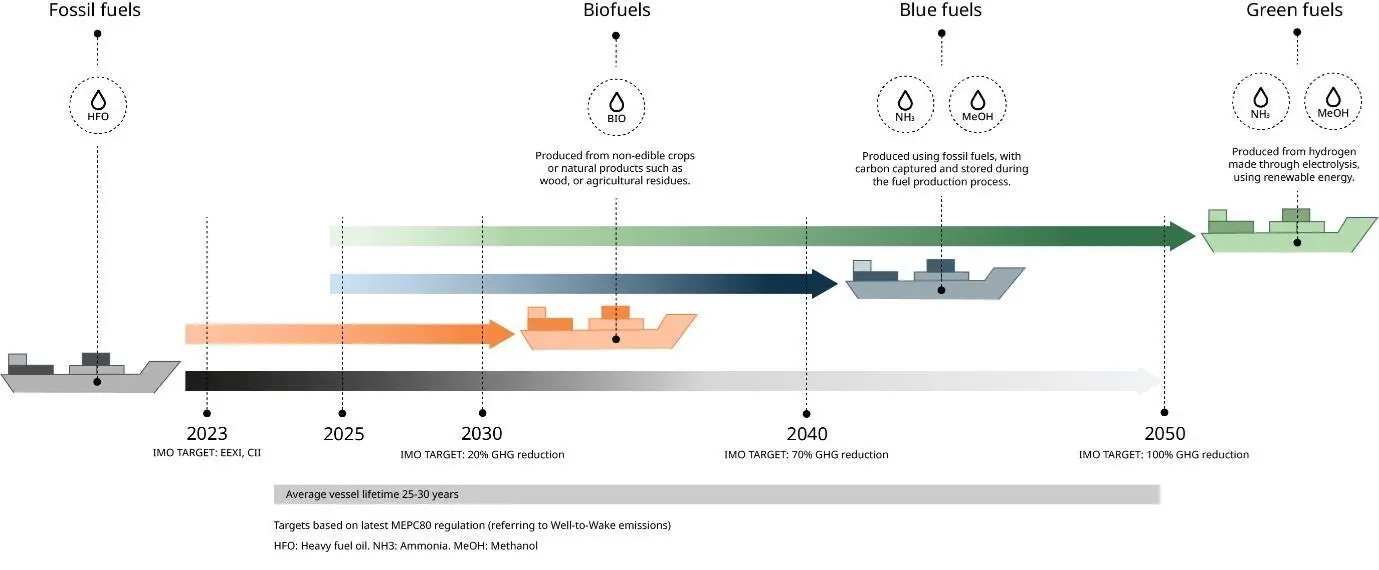
Despite long-term aims to reduce fossil fuel use in shipping, there is no immediate alternative that is widely commercially available. Therefore, incremental improvements are key. Our report shows that, alongside LNG, biofuels will serve a similar purpose in the 2030s. During this time, ‘Blue’ fuels including blue ammonia and methanol – derived from fossil fuels but with carbon capture – will then act as bridging fuels. By the late 2030s and early 2040s ‘Green’ fully synthetic variants of fuels produced using renewable energy – including green ammonia and methanol – will become prominent, offering the opportunity of zero, or near-zero, emissions fuels on a well to wake basis.
Sustainable fuels roadmap to 2050 (Source: Wärtsilä )
However, this process will require significant investment. According to the 2023 UN Review of Maritime Transport, to sufficiently increase production, fuel distribution and bunkering infrastructure, an investment of up to US$5 trillion in near-zero fuels and propulsion technologies by 2050, as well as an annual US$8 billion to US$28 billion liquidity injection.
The purpose of this investment is to fully decarbonise by 2050, requiring the industry to replace around 270 million tonnes of heavy fuel oil with alternative fuels on an annual basis.
Despite a lack of availability, demand is increasing, as evidenced by the existing orderbook for vessels adopting new fuels. Proactive operators are recognising the financial incentive to ensure onboard vessel infrastructure is ready as cleaner fuels become more viable and costs of traditional fuels rise. To ensure that alternative fuel supply availability meets growing demand, supporting clean fuel production projects or directly investing in supply are other ways in which large ship operators can maximise their flexibility.
The dedication is evident across the sector. However, it’s not enough to ensure that one’s own vessel, or vessels, are capable of using new fuels. The industry needs to think of the bigger picture.
Collaboration is key
Actions within a company’s own trajectory can only go so far, which is why industry collaboration is central to making these aims a reality. As synergy between ship operators can be more effective than isolated efforts, so will cooperation between governments, regional authorities and industry regulators. This kind of cross-sector interactivity will be crucial.
Based on the analysis found in the sustainable fuels report, pooling purchasing power will reduce overall fuel prices and minimise supply chain costs for individual companies. Intra-industry collaboration also allows smaller companies, which make up a significant portion of the fleet, to access knowledge they may not otherwise have. For example, we have been supporting operators through feasibility studies and execution planning, along with new product implementation. Reducing uncertainty and sharing expertise, means larger and smaller firms can help facilitate fuel flexibility.
Learning and working across other industries is also important. The agriculture sector, for example, will see considerable demand for blue or green ammonia as a fertiliser ingredient, and an emerging seaborne trade for ammonia as a hydrogen carrier that can decarbonise heavy industry. Ensuring clarity for fuel producers on what the future energy landscape will look like will incentivise investment and highlight shipping as both a consumer and enabler of clean fuels.
Working alongside regulators helps cement a future policy framework for alternative fuels. Certainty and stability in shipping through methods such as carbon pricing, fuel standards and fossil phase-out timeframes, will create a cordial environment for clean fuel production investment.
Successfully decarbonising shipping requires alternative fuels. While the trajectory looks as if tightening regulations and emissions policies are becoming more decisive and will ultimately lead to a cost parity between sustainable and fossil fuels, the sector must act collaboratively and proactively. The quicker one acts, the sooner and potentially, more to capitalise. This means investing in fuel-flexible technology, understanding the cost of the transition and fostering collaborative efforts within and across industries is imperative.
Related Articles
 METHANOL
 MONITORING, CONTROL & DIGITALISATION
 MONITORING, CONTROL & DIGITALISATION