



Slow steaming: A strategy with unintended consequences
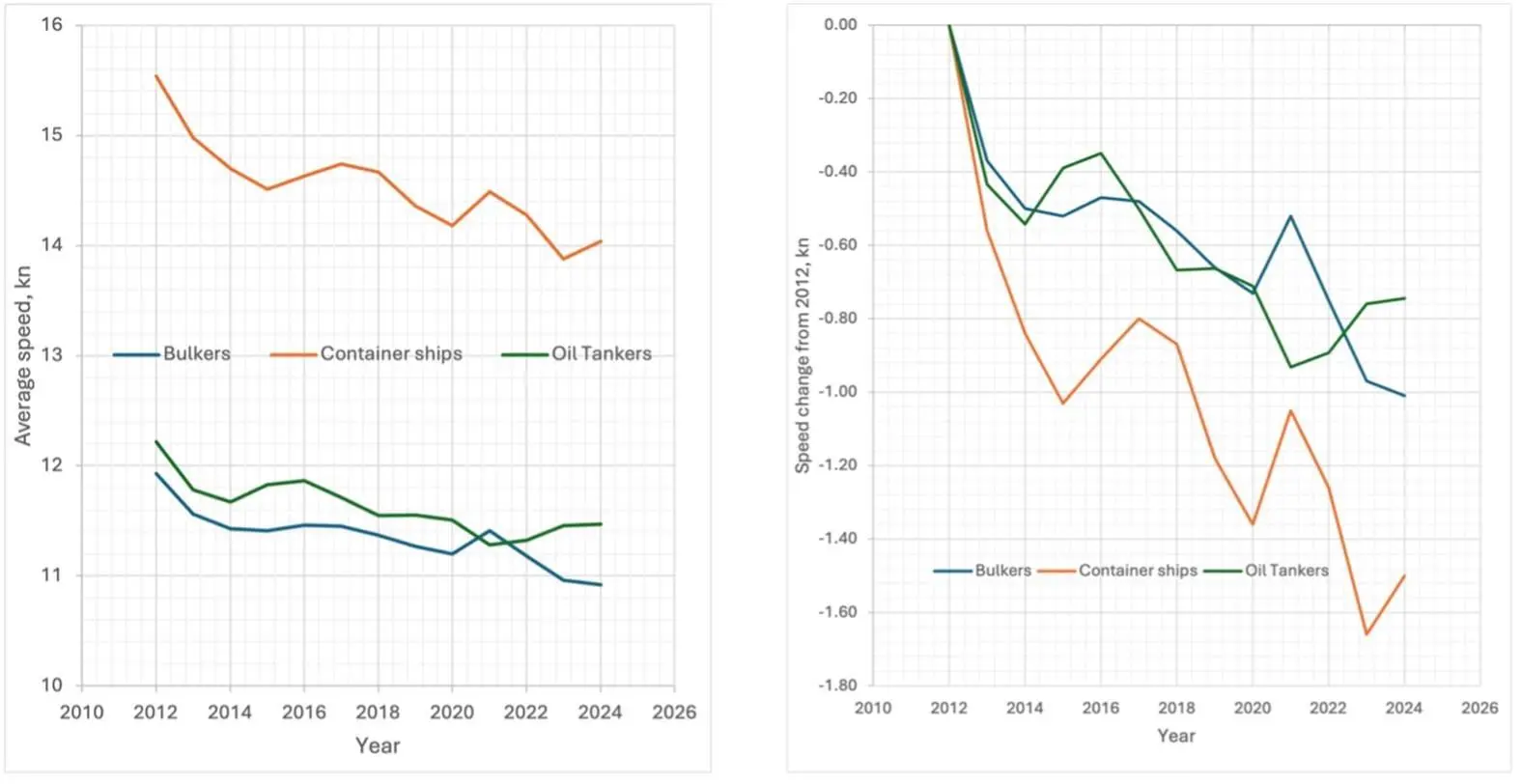
Slow steaming, the practice of operating vessels at reduced speeds, can influence vessel efficiency in various ways, depending on a ship’s original design, hydrodynamic performance, and operational profile. Houlder’s analysis of Clarksons’ data (Figure 1) reveals a marked decline in average service speeds across multiple vessel types—oil tankers, bulkers, and container ships—from 2012 to 2024. Container ships experienced the greatest slowdown, with an average speed reduction of 1.50 knots (-11%) by 2024, followed by bulk carriers (-9%) and oil tankers (-6%).
While slow steaming can reduce power consumption and GHG emissions, it may also deviate significantly from a ship’s design parameters, impacting both performance and maintenance costs. Iebum Shin, data analytics lead at Houlder, cautions that “simple retrofits such as hull modifications or propeller optimisation could determine whether slow steaming delivers marginal or substantial benefits.”
Shin further emphasises the importance of a ship-specific analysis to assess the real savings from speed reductions. The variation in speed reduction rates (Figure 2) across different vessel types highlights the need for a tailored approach when considering slow steaming as a long-term strategy for GHG emission reduction.
Although slow steaming has gained popularity due to its apparent simplicity and lack of immediate capital expenditure, Houlder stresses that slowing down may not be a low-cost option. Unseen CAPEX, such as turbocharger modifications or engine de-rating, may be required to mitigate the effects of operating outside a ship’s design specifications. Furthermore, the anticipated savings in operating expenses may not materialise due to increased engine wear and maintenance requirements, including cold corrosion and fouling of exhaust systems.
Rupert Hare, CEO of Houlder, highlights the broader financial implications of slow steaming: “If market freight rates do not rise to compensate for reduced annual cargo capacity, shipowners could face additional costs from extended charter durations or lost cargo revenue. Improving a ship’s efficiency without significant cost or reducing speed offers a competitive advantage.”
Hare also notes that while slow steaming can reduce emissions in some cases, it may impede long-term sustainability efforts. A slower fleet would need to expand to maintain cargo-carrying capacity, potentially increasing overall GHG emissions. Moreover, slow steaming could delay investment in energy-efficient technologies, optimised operations, and alternative fuels, which are crucial for meeting IMO targets.
In light of these concerns, Houlder recommends that shipowners reassess their assumptions around slow steaming. Using advanced computational fluid dynamics and digital twin technology, owners can better understand the operational “sweet spots” of their vessels and move towards a more sustainable and efficient future.
Related Articles
 ALTERNATIVE FUELS & LUBRICANTS
 GENERAL NEWS
 GENERAL NEWS