



Cruise ship study demonstrates how methane slip changes with engine load
Methane has a higher hydrogen-to-carbon ratio than diesel, so LNG emits significantly less CO2 when combusted in a low-pressure dual-fuel engine. It also produces negligible amounts of particle emissions, NOx and sulphur – small enough to meet Tier III requirements. However, concerns have been raised regarding the slip of unburned methane which can offset some of the environmental benefits of LNG use.
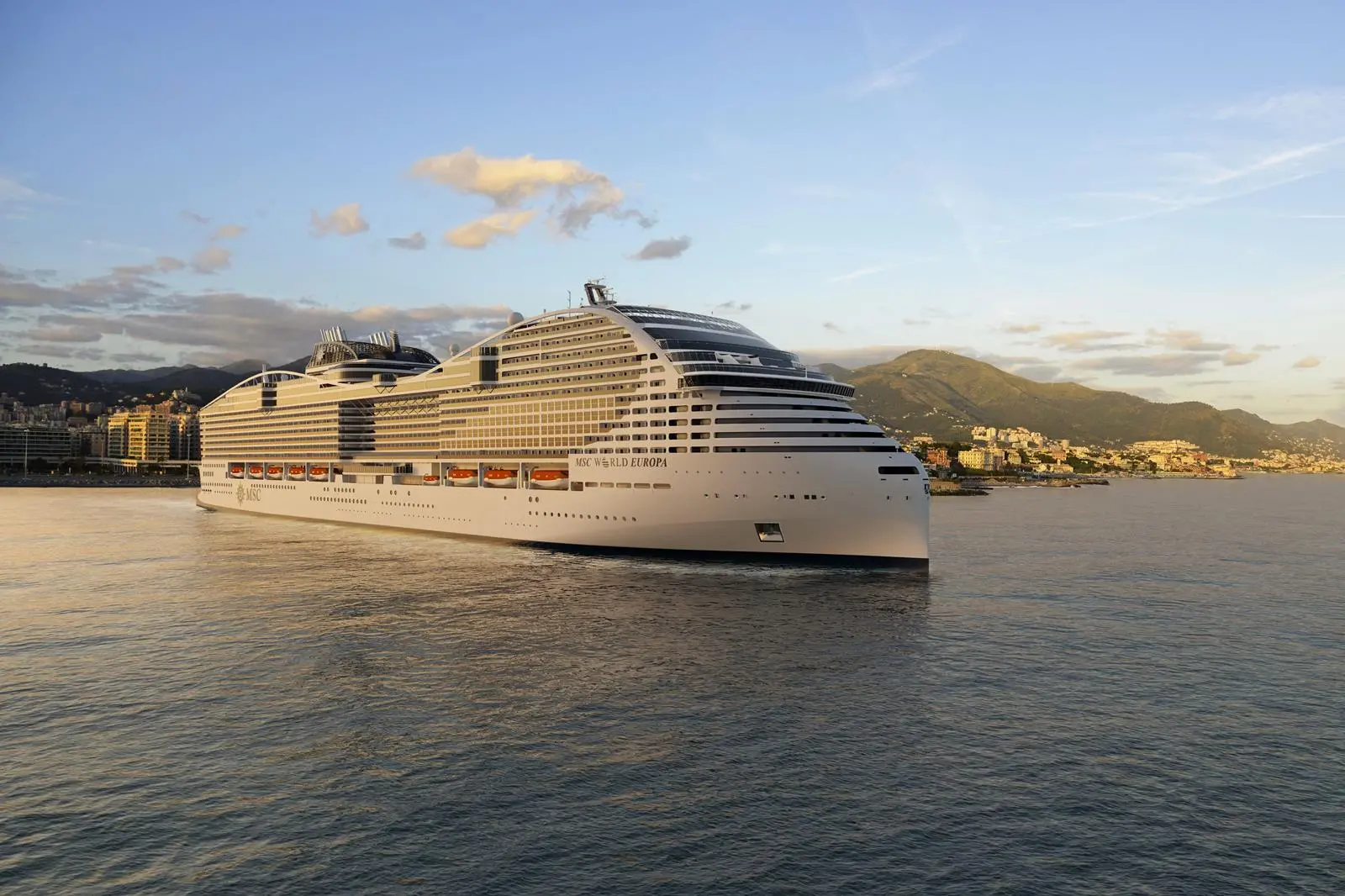
A recently published study out of the Green Ray project, methane slip and other emissions from newbuild LNG engine under real-world operation of a state-of-the art cruise ship, documents emissions from a Wärtsilä 46DF, 14-cylinder, 600 rpm, 4-stroke low pressure dual-fuel engine with output of 16,030kW and shows how methane slip varied significantly according to engine load.
The engine was one of five installed on the 215,863gt MSC World Europa, built in 2022. Emission measurements were taken during steady engine loads and during a week of normal operation as the vessel sailed at sea and whilst entering, leaving and moored in port. In addition, an “actual operation” cycle was determined based on eight months of engine data at 1Hz time resolution received from the vessel manufacturer while the ship sailed in the Mediterranean.
In port, engine load was typically 50–60%, but for short periods it dropped to 30% load. MGO was also used for short periods. During arrival and departure loads ranged from 20-44%. At sea, engine load was typically 70–82%. Load conditions below 20% were rare.
The study demonstrates how the operational pattern of the engine can contribute to methane reduction efforts. “Regarding methane slip, we found that at load conditions of 50% and above, low methane slip values lead to 13-15% lower total CO2eq with LNG compared to MGO while at lower load conditions the situation is vice versa,” said study co-author Dr Kati Lehtoranta of VTT. “Since the real-world load profile of the engine (over eight months) shows that most of the vessel operation time (approximately 90%) is at engine load higher than 40%, benefits can be achieved.”
Methane slip fluctuated when engine load changed rapidly during arrivals and departures but was considered stable during steady engine operation. Overall, engine loads of 10–15% only contributed 1% of the total methane slip, whereas engine loads of 40–85% contributed 89%.
“Since the methane slip is found to strongly depend on the engine loading, the operation profile of the engine plays a key role when thinking of methane slip formation. Other vessel types with different operational profiles than the cruise ship in current study will most probably result to different methane slip values,” said Lehtoranta.
The researchers calculated a weighted emission factor for methane based on the real-world load profile, resulting in 2.8 g/kWh (1.7% of fuel use) for the MSC World Europa. This represented a 45% lower methane slip than the default value of 3.1% of fuel defined in the FuelEU Maritime regulation.
In the IMO’s draft guidelines for GHG intensity of marine fuels, the corresponding value is 3.5%, but suggestions have been made to increase this after measurements taken from drone studies indicate that emissions ranged between 1-14% with a median of 6.05% of fuel consumed. Conversely, values below those of the MSC World Europa (1.6 g/kWh) have been reported for the novel combustion concept developed as part of the Green Ray project which was tested on a Wärtsilä 31DF engine installed on the ropax ferry Aurora Bothnia.
Exhaust gas from the engine on the MSC World Europa was measured before and after the installed SCR. The purpose of the SCR is to reduce NOx emissions during MGO operation, and the urea injection to the catalyst was only applied during MGO operation. However, the measurement program demonstrated that the catalyst in the SCR was capable of oxidising formaldehyde in the exhaust gas resulting from LNG combustion without urea needing to be added.
“In this case, as is the case for many cruise ships, there is no bypass line for the SCR, so when operating with LNG the exhaust anyway passes through the SCR, but no urea is used. This was found to be beneficial since the toxic formaldehyde produced because of the incomplete combustion of LNG was found to be reduced by the SCR only and no formaldehyde exited to the air,” said Lehtoranta.
For LNG operation, particle emissions were generally low. At engine loads 54–80%, PM emissions were 4-6.5 mg/kWh, increasing to 9.9 mg/kWh at 25% load and 56 mg/kWh at 12% load.
Black carbon (BC) emissions were 0.37–0.44 mg/kWh at high engine loads, increasing to 0.94 mg/kWh and 2.1 mg/kWh at lower loads.
In contrast, during MGO operation, BC emissions ranged from 7.3 and 39 mg/kWh. Engine loads of 10% led to a four-fold increase in PM, and overall, BC typically contributed 1–4% of the total GHG emissions. This increased to 15% at the lowest engine loads.
Lehtoranta and her colleagues conclude: “Comparing total GHG emissions including CO2, methane, and black carbon indicated that LNG use brings benefits at 54% load and above, but at lower loads, the benefits in terms of CO2 and BC are undermined by the uncombusted methane.”
The study was undertaken as part of the Green Ray project and is published in the open access journal Atmospheric Environment X.
Related Articles
 EMISSIONS REDUCTION TECHNOLOGY
 EMISSIONS REDUCTION TECHNOLOGY
 EMISSIONS REDUCTION TECHNOLOGY