



Chinese self-reliance reaches new level
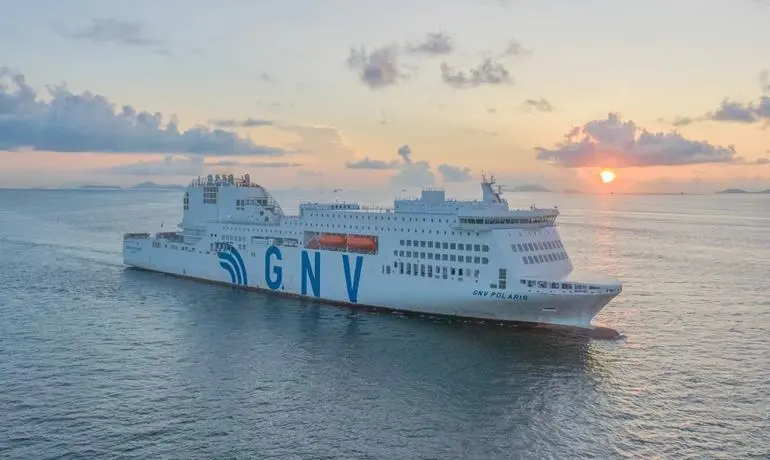
Whereas export production in the sector has hitherto relied extensively on foreign design and technological input, the latest delivery to European principals is distinguished by its predominantly Chinese origination.
Ordered by Geneva-based MSC Group on behalf of Italian affiliate Grandi Navali Veloci (GNV), contractor Guangzhou Shipyard International (GSI) was entrusted with the development and design of the series. Chinese self-reliance expressed in the project also includes the interior architecture, interior materials and furnishings, as well as the widest recourse to locally manufactured and designed equipment. First of four contracted to GNV’s account, the 218-metre GNV Polaris has put down a marker for Chinese marine technologies in a number of spheres.
The 45,900gt GNV Polaris accordingly ranks as the first large-scale export vessel in her category incorporating Chinese intellectual property (IP) rights. China’s competitiveness relative to other shipbuilding nations has therefore assumed a new intensity, whereby independent know-how complements all the other elements that have brought its industry to the fore on the world stage.
The design drawn up by Shanghai Merchant Ship & Research Institute (SDARI) in conjunction with the shipowner’s stipulations and parameters provides the GNV Polaris with capacity for 1,500 passengers and a total 3,100 lane-metre ro-ro payload on three fixed decks, corresponding to 600 cars or 200 HGVs/trailers. The follow-on and subsequent vessels incorporate increased provision for passengers and a somewhat lower vehicular intake.
While suited to, and intended for, deployment across GNV’s Mediterranean network, GNV Polaris has initially been assigned to the Genoa/Palermo route, which the legacy Grimaldi organisation promoted with fast, innovative ro-ro tonnage as far back as 1970 by way of the Grandi Traghetti sisters Freccia Blu and Freccia Rosa. A veritable sea highway, extending the length of Italy’s western shores, the service provides a dependable north/south domestic transportation option.
Next generation
The incoming generation of four ships, comprising an all-diesel first pair, and an LNG-capable second pair, will realise not only a hike in fleet productivity and capacity, but also a big gain in environmental standard. GNV Polaris, which is equipped with comprehensive exhaust gas treatment plant plus a cold-ironing facility and silicone antifouling, promises a carbon footprint reduction of up to 30% relative to existing company tonnage.
GNV Polaris is installed with four diesel-only MAN medium-speed, in-line engines of the 48/60CR series. Each nine-cylinder four-stroke turns out just over 10,000kW, to give a power concentration in excess of 40,000kW, delivered through twin-input, single-output gearboxes to twin controllable pitch propellers for a speed of 25 knots at some 83% maximum continuous rating.
The plant is arranged in two compartments, within the B/5 fore-and-aft bulkheads and separated by a centreline bulkhead, and thereby Safe Return to Port (SRtP)-compliant.
Notwithstanding the otherwise domestic sourcing of the vessel’s technical equipment and interior outfit, the Augsburg plate on the propulsion trunk engines is affirmation of German engineering export prowess. The four MAN gensets, though, were produced under licence by Shaanxi Diesel Heavy Industry. Besides the diesel-alternator aggregates, the ferry is equipped with a steam turbogenerator set, of 900kW output capacity, that makes full use of waste heat from the main engines. The heat recovery system was developed by China Shipbuilding Industry Corporation’s (CSIC) No711 Institute of Shanghai (SMDERI).
The vessel is fitted to allow connection to the local grid when berthed, so as to ensure a continuous supply of electrical power for shipboard needs without having generators running.
The huge funnel casing aft is a dominant feature, and design signature, of the newbuild class. Its exceptional size is a factor of the need to accommodate both NOx catalysers and SOx scrubbers and silencers as well as an exhaust gas energy recovery system and all associated pipework. The SOx afterteatment solution tackles not only the exhaust lines from the four main engines but also the streams produced by the gensets and auxiliary boilers.
While the corporate bid for an elevated, long-term environmental standard is the determinant of the engineering specification, the nature of the arrangements on GNV Polaris are apposite to the IMO’s categorisation of the Mediterranean Sea as a SOx Emission Control Area (ECA) effective from 1 May 2025.
The third and fourth newbuilds in the programme will differ in propulsion machinery from GNV Polaris and second-of-class GNV Orion through the owner’s decision to opt for LNG dual-fuel engines, entailing a slightly larger bore size. Design modifications involve giving up underdeck space so as to house the LNG fuel storage, using two C-type tanks.
Drawing on experience gained over the past 20 years in the production of ro-pax vessels, predominantly for clients in the export market, GSI has paid particular attention to levels of comfort and habitability aboard GNV Polaris and subsequent newbuilds. The standards applied have been such as to comply with RINA class notations COMF-VIB-B and COMF-NOISE-B. The result is that noise in the cabin areas is less than 55dB, and no more than 60dB in the public spaces, when the ship is sailing at full service speed.
Local knowledge
In the context of technology pertinent to shipboard comfort and ro-ro security, local content includes the retractable fin stabilisers, developed by CSIC’s No704 Research Institute. Growing industrial self-reliance as regards the outfitting of the passenger spaces is expressed in the manufacture of lifts and escalators by the shipyard contractor’s subsidiary GSI Elevator Electromechanical Equipment.
The array of RINA accreditations also includes the society’s Biosafe Ship notation, which embraces a whole range of systems, components and operative procedures aimed at preventing and controlling possible onboard infection outbreaks. The vessel is equipped to provide complete isolation wards and quarantine areas that meet the latest biosecurity standards, and the design of the air conditioning and ventilation arrangements is tailored accordingly.
GNV Polaris is thought to be the first ro-pax built in China to RINA’s Biosafe criteria. The certification was earlier secured by GNV for two of its existing ferries and by MSC Cruises as an additional class notation for the French-built MSC Grandiosa.
Ro-ro handling is effected via the stern only, using two axial ramps of different widths that span almost the full breadth of the transom. The larger portside ramp feeds the main deck and the fixed ramp leading to the upper vehicle deck, whereas the narrower starboard ramp gives access to the main deck garage and the lower hold. Fore and aft of the centreline casing that rises through the ro-ro decks, there is adequate space for commercial vehicles to turn and exit via the stern.
The original building cost for all four vessels was about EUR500m ($515m), on the basis of a common specification, but the figure increased to some EUR600m ($618m) due to changes subsequently stipulated for the ships to follow GNV Polaris. Besides the nomination of dual-fuel power for the third and fourth ferries, second-of-class GNV Orion will have nearly twice as many cabins as the lead ship and an increased passenger complement.
Nominally owned by Compania Naviera Allegro, GNV Polaris is operated and managed by Grandi Navali Veloci of Genoa. The latter had been established by Aldo Grimaldi in 1992, and was identified from the outset with high-grade vessels of the cruise ferry genre, produced by the now defunct shipbuilding firm of Cantieri Nuovi Apuania at Marina di Carrara. In 2010, GNV came under the control of the MSC Group.
The second of the newbuilds, GNV Orion, is fitting out in China in preparation for spring 2025 handover and anticipated entry alongside GNV Polaris on the Genoa/Palermo run. The LNG-capable, third and fourth ships, GNV Virgo and GNV Aurora, are due in 2026 and their allocated route has yet to be confirmed.
Besides the immediate impact of the first pair on the service linking northern Italy with Sicily, the introduction of new tonnage will benefit other Mediterranean routes through vessel rotation and cascading, the GNV network having been much expanded in recent years.
By the nature of the fleet investment programme, GNV and its parent organisation are helping to force the pace of change in Italy, where the authorities have come under criticism for a perceived dilatory approach to the development of the national port LNG supply infrastructure and at-berth electrical power availability.
Related Articles
 NEWS
NEWS
 ALTERNATIVE FUELS & LUBRICANTS
 ALTERNATIVE FUELS & LUBRICANTS