



The potential and the pitfalls of consistent winds
There’s a lot of enthusiasm around the potential for harnessing the world’s consistent wind patterns. bound4blue, for example, says this: “Routes that benefit from steady wind patterns, such as the trade winds, are ideal for maximizing the performance of wind propulsion systems like our eSAIL®. These systems operate at their best when consistent wind conditions are present.”
Gavin Allwright, secretary general of the International Windship Association, cites the historical use of trade winds: The classic North Atlantic circle is a well known example, where ships would travel from North European ports heading south to Portugal, then plugging into the trade winds to the Caribbean and Southern part of the United States further moving up the Eastern seaboard of the States to the Maritimes in Canada and then heading East on the winds back to Northern Europe.
“It is through harnessing these natural green ‘wind’ corridors at sea, especially the trade winds and other prevailing wind systems, that we can deliver decarbonisation at a far quicker pace.”
Today, Allwright is calling for greater consideration of wind potential in the green fuel corridors that are being established. Wind power can reduce fuel consumption which in turn reduces the burden on new fuel supply and bunkering infrastructure, derisking investment.
Winds of change
Different sail types perform differently, with none of them very effective in head winds and variable performance in tail winds. “There’s no way a sail could contribute to the thrust if the ship heads into the wind,” says Hasso Hoffmeister, senior principal engineer at DNV. “So you would either avoid this, switch off or idle the sail, but it gets more favourable the more beamy the wind is.”
Fundamental to determining the benefits of a sail system for a ship’s operation is the sail area to vessel displacement ratio. “If the ratio is high, it’s a powerful sail installation on perhaps a light vessel, and if the ratio is low, it’s a small installation on a big vessel which might not have great effects. In this case, following any trade winds might be less beneficial because the effect is too small,” says Hoffmeister.
Uwe Hollenbach, senior principal consultant at DNV, notes that vessels sailing coastal routes may have less opportunity to take advantage of route optimization than those sailing ocean routes. However, he notes positive results gained onboard the roro SC Connector as a good example of how the wind can still be used to great effect.
The vessel is fitted with two Norsepower rotor sails which are 35 metres tall and 5 metres wide. The vessel’s master, Captain Artur Sylwestrzak, explained a while back: “The rotor sails are a key aspect for our timing. We operate on a fixed schedule. I can only influence the length of my route and the speed. In one instance I had to sail around some very bad weather. Although I extended my route by some 80 miles, I was able to arrive on time, with a very large portion of my propulsion energy coming from the wind.”
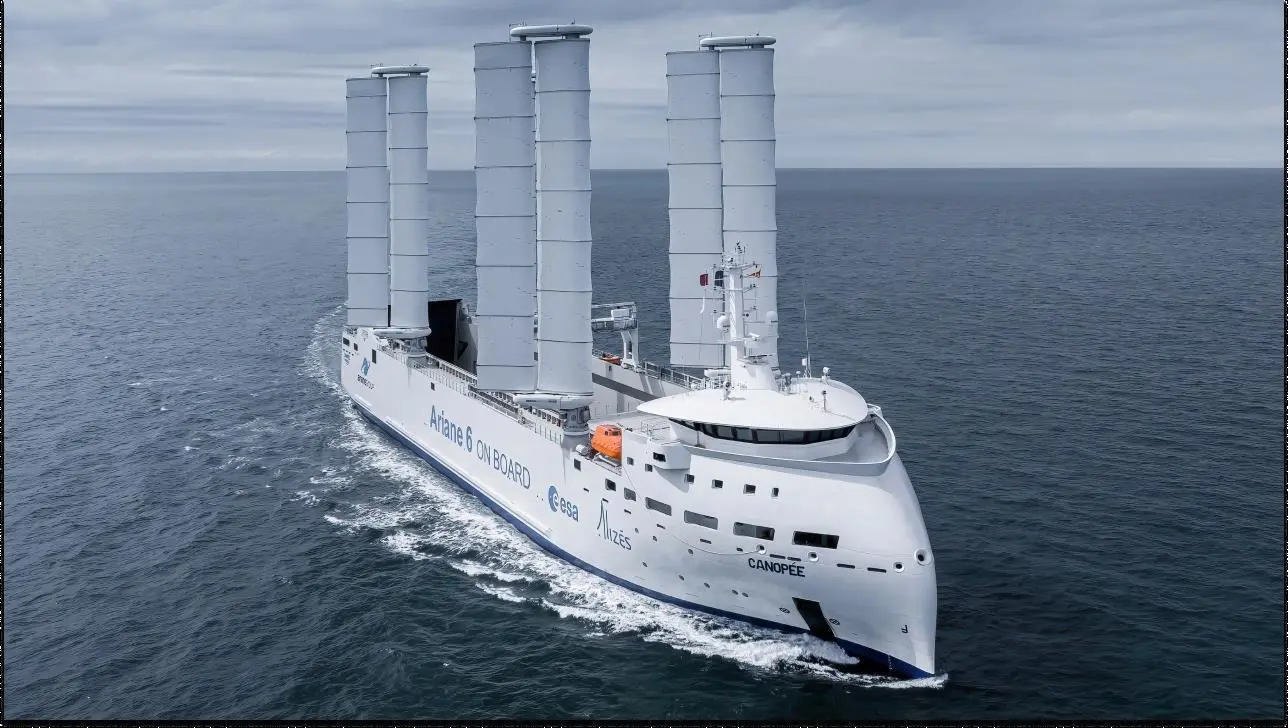
Canopée is considered the world’s first hybrid wind-powered commercial cargo vessel. It was built to meet Ariane Group’s logistical requirements for transporting Ariane 6 launcher parts from European ports to Pariacabo port in French Guiana. The vessel was fitted with wingsails from OceanWings in 2023 and has been benefiting from consistent wing patterns, but as Romain Grandsart COO of OceanWings explains, there is seasonal variation. Crossing the Atlantic Ocean, trade winds are oriented from North East to South West, but they are only available from around November to April. The vessel is also able to take advantage of the North Atlantic low pressure system. “So, it really depends on the time of the year, on the sailing routes you have. And this is why we invest in weather routing software to be able to advise the crew members in real time on the best possible sailing routes.”
The benefits of weather routing software are significant. A simulation study by NAPA has shown that voyage optimisation can add an additional 10% to the fuel savings gained by Sumitomo Heavy Industries Marine & Engineering tankers sailing various routes across the Atlantic between New York and Amsterdam with a rotor sail from Norsepower. This is addition to the 19% that the sails provide, on average. NAPA’s studies continue with the aim of strengthening the business case for investing in wind-assist technology at a time when the industry is under increasing pressure to decarbonize.
Related Articles
 NEWS
NEWS
 ALTERNATIVE FUELS & LUBRICANTS
 ALTERNATIVE FUELS & LUBRICANTS