



Fueling the future: Alfa Laval powers ahead with ammonia innovation
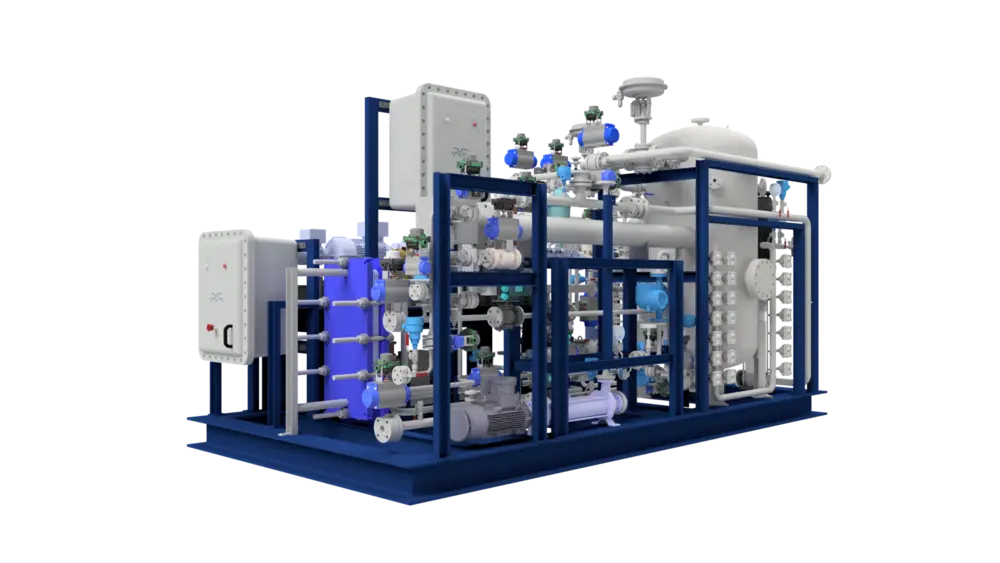
A significant part of Alfa Laval’s strategy is its joint development agreement with Winterthur Gas & Diesel (WinGD), a Swiss-based leader in two-stroke engine manufacturing. Signed in 2022, this partnership aims to develop solutions for alternative fuels, including ammonia and methanol. Unlike a traditional supplier-customer relationship, this agreement fosters co-innovation, allowing both companies to pool resources, expertise, and funding to pioneer next-generation marine fuel solutions.
“We are delivering the first engine running on ammonia fuel together with our fuel supply system,” said Davide Rossin, head of R&D at Alfa Laval. The company has provided WinGD with test rigs to validate ammonia injection systems, ensuring the technology meets stringent safety and operational standards.
Alfa Laval’s ammonia fuel supply system is already making its way to market, with early adopters such as Eastern Pacific Shipping integrating the technology into newbuild vessels. The company is working within a complex supply chain, where its systems are acquired by integrators, who then supply shipyards that ultimately commission vessels for shipowners.
“We have real contracts for real vessels, and our first fuel supply systems will be delivered early next year,” Rossin confirmed.
Technical challenges and safety measures
The transition to ammonia fuel presents significant technical challenges. Ammonia is toxic, corrosive, and has lower energy density compared to traditional marine fuels like diesel. Alfa Laval has tackled these challenges head-on by designing systems that ensure safe handling, secure containment, and effective vent treatment.
“Safety is our top priority,” Rossin emphasised. “We have designed our system to comply with all regulatory safety standards, minimising operator exposure to toxic risks.” The company has received approvals from classification societies such as Lloyd’s Register and China Classification Society (CCS), reinforcing the system’s adherence to industry safety benchmarks.
To address ammonia’s storage requirements, Alfa Laval has incorporated double-walled piping and advanced ventilation systems to prevent leaks and safely manage ammonia vapors. The low energy density of ammonia necessitates larger storage tanks, affecting ship design. While this is less of an issue for newbuilds, retrofitting existing vessels remains a challenge that Alfa Laval is actively exploring.
Crew training and ammonia future
Recognising that ammonia requires specialised handling, Alfa Laval is heavily invested in crew training. “We provide training for our test engineers, commissioning engineers, and service teams to ensure safe operation,” Rossin said. In addition to training ship operators, the company is developing guidelines for the use of personal protective equipment (PPE) specific to ammonia handling.
While ammonia’s potential for reducing carbon emissions is widely acknowledged, concerns remain about its cost and availability. Green ammonia, produced using renewable energy, is currently expensive, with some estimates as high as €8,000 per ton. However, Rossin remains optimistic: “The landscape will change, and ammonia will become a viable option not just technically, but also economically.”
Alfa Laval continues to develop solutions for multiple low-carbon fuels, including methanol and LPG Alfa Laval’s journey in alternative fuels: from methanol to ammonia, via LPG | News | Motorship, positioning itself as a leader in the maritime energy transition. As regulations tighten and the push for decarbonisation intensifies, the company’s ammonia fuel supply system is set to play a pivotal role in shaping the future of shipping.
Related Articles
 AMMONIA
 AMMONIA
 AMMONIA