



Innovation marks a year of firsts for new propulsion systems
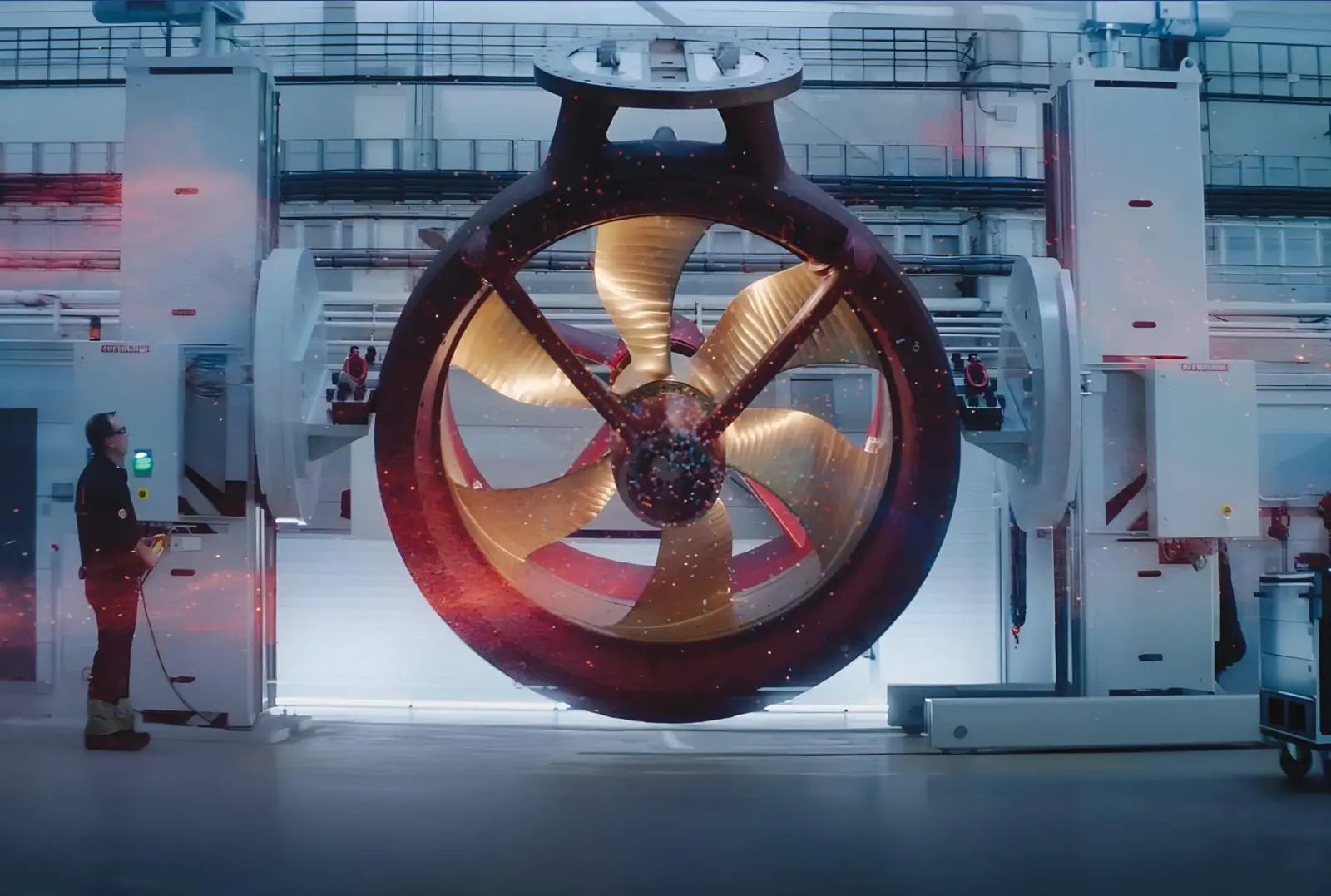
Originally developed for use in ice, podded propulsion systems have since been most closely associated with cruise ships and yachts although in recent years ice-class tankers, LNG carriers and a number of smaller cargo ships have also been fitted with them. While there are several manufacturers of podded systems, arguably the best known is ABB and its Azipod ranges.
Since the first cruise ships installation in 1998 on Carnival Cruises’ Elation, around 160 cruise ships have been fitted with Azipods including Celebrity Xcel which became the latest vessel to debut in November this year. The vessel is fitted with two Azipods and also features four Brunvoll tunnel thrusters to aid manoeuvring.
Offshore vessels serving either or both the oil and gas or offshore wind sectors have been the major customers for thruster manufacturers with ferries of all sizes also being a large market segment. Just as with ships generally, there has been a regular increase in the size and power of both pods and thruster units with new ‘largest ever’ products providing manufacturers with headline grabbing opportunities. That said, there are also less frequent but highly innovative developments that allow for a growth in interest from existing and new clients including seeing pods or thrusters as an alternative to conventional propeller systems when upgrading existing ships.
As well as the increased manoeuvrability conferred by pods and thrusters, they have the added advantage of generally being more efficient than a traditional engine, shaftline, propeller arrangement. This does make them attractive in light of current and future emission regulations as well as from the obvious economic aspect.
Larger, newer and quieter models and milestones reached
This year has seen the introduction or announcements of additions to various manufacturer’s portfolio of products and also some notable milestones. Kongsberg Maritime, which through its acquisition of part of Rolls-Royce in 2019 inherited a wide portfolio of thruster series, has notched up ten years of rim-drive permanent magnet thruster development and passed the 100-order mark sealing its market position in offshore and expedition cruise sector.
A little over a year ago, Kongsberg expanded the range of azimuthing rim-drive thrusters with the RD-AZ 2300, a new 2.3m diameter unit that sat between the existing 1.9m and 2.6m variants. This year has seen the initial references for the model which comes in power ranges from 1,100-2,000kW. An even larger model, the RD-AZ 3300 is being contemplated coming in a 2,600 – 3,500kW range that would be aimed at the larger CSOV segment where Kongsberg’s technical product manager, Kjartan Røyset said the company sees increasing interest in more powerful units.
Kongsberg is also looking at increasing the tunnel thruster rim-drive range with two new models the RD-TT 2300 and RD-TT 2600 added at the upper end above the RD-TT 2000 which is the most popular of the sizes currently available. The largest of the new models would be rated at 2,700kW and with a thrust of 410kN. Development is planned for mid-2026 and many of the components would be the same as those used in the corresponding diameter azimuthing thrusters. The target segments are larger offshore vessels and cruise ships. References are likely to include Bibby Marine’s eCSOV hybrid vessel now under construction in Spain.
Kongsberg is keen to highlight that the rim-drive thrusters carry DNV’s Silent R notation and have what they claim is the lowest underwater radiated noise (URN) levels of this class of product. This makes the units especially suitable for cruise vessels and offshore where regular vessel operations are likely to have a significant impact of marine fauna.
Also debuting new products and setting records is Finland-based Steerprop. The company was in at the start of azimuthing and podded propulsion systems and has a quarter of a century experience in the technology on mechanical azimuth propulsors for several ship types. This year it announced the first reference for its Next Generation CRP (Contra Rotating Propellers) azimuthing propulsion units with two ice- classed variants to be fitted on a research vessel being built at Lloyd Werft in Bremerhaven.
The Next Generation units which come in a range of power options up to 15MW are the result of a two-year R&D project which set out to re-imagine the design of its azimuth propulsor ranges. The new units are more hydrodynamically and mechanically efficient than the earlier types and come with pressurised lubrication as standard and extended condition monitoring capability.
Janne Martikainen director, technology and product management at Steerprop, told motorship that for the new ship, the company was asked to add far more monitoring sensors than would normally be used as the owner of the research wanted to measure and monitor propulsor performance under various conditions during operations.
As an ice-breaking variant, the two 14 CRP LM units on the research vessel have stubbier propeller blade profiles and a shorter fin than the open-water models. They have a nominal rating of 750 kW although they can also operate at 1000 kW under open water conditions and are designed to Ice Class 1A standards.
Steerprop also claimed a record this year for what it says are the largest ever mechanical azimuthing thrusters to be fitted to a vessel. The two SP 160 PULL ARC azimuth propulsors each deliver 9 MW of power through a 4.8-meter diameter propeller. The specifications require holding a steady 3kt through multiyear ice of up to 1.8m thick with 20% snow cover. They will be fitted to the new Polarstern for the Alfred Wegener Institute, Helmholtz Centre for Polar and Marine Research.
As with Kongsberg, underwater radiated noise is a concern for Steerprop and it says the two units meet the most stringent URN requirements ever applied to a vessel of this class. They feature a noise-optimized gearbox design and an integrated permanent magnet propulsion motor. Together these reduce radiated noise at its source, making the system ideal for acoustic research and minimally invasive marine operations.
Another product making its debut this year is ZF Marine’s new POD 4900 podded propulsor which has been selected for a 30m superyacht along with an mtu engine from Rolls-Royce Power Systems. The POD 4900 is compatible with engines up to 1,500kW at 2,450rpm and for vessels with a typical speed range of 20 to 35 knots.
Depending on vessel type and size, the POD 4900 system can be installed in a twin, triple, or quadruple layout. Its large gear reduction ratio (2.434-2.612) allows for larger counter-rotating propellers helping to increase its efficiency – up to 20% in comparison to shaftline propulsion systems in the same power range.
Related Articles
 PROPULSION
 GENERAL NEWS
 GENERAL NEWS