



Bulk carrier installation demonstrates risks and benefits of OCCS
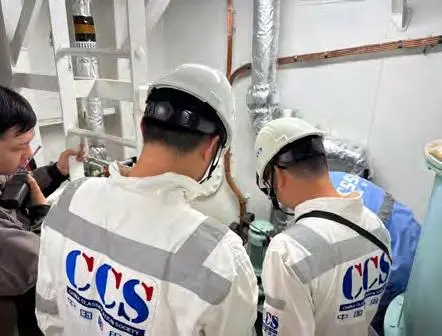
In April 2025, MEPC 83 meeting officially approved the development plan for the regulatory framework for onboard carbon capture and storage (OCCS). Concurrently, with continuous breakthroughs in onboard carbon capture technology, China Classification Society (CCS) expects the technology to enter a period of large-scale promotion around 2030 to become one of the primary technologies for deep decarbonisation in the shipping industry.
Niu Song, from CCS’s Shanghai Rules & Research Institute, say that faced with these increasingly stringent requirements, the emission reduction potential of traditional energy-saving measures (such as high-efficiency propellers and low-resistance hull designs) is approaching a bottleneck. Meanwhile new alternative fuels (methanol, ammonia, hydrogen) face practical obstacles including insufficient infrastructure and high retrofitting costs. “Against this backdrop, onboard carbon capture technology has emerged as an innovative solution to meet the industry’s rigorous demands.”
CCS has undertaken OCCS approval services for multiple ship types, including LNG carriers, VLCCs, VLGCs, bulk carriers, PCTC and large container ships. Based on traditional energy power systems, onboard carbon capture technology generally utilises the chemical absorption method to capture carbon from exhaust gas, says Wang Xinglong from CCS’s Jiangsu Branch. Its principle relies on temperature changes in the absorbent liquid to absorb and release CO2, thereby separating it from the exhaust. Onboard processes consist of four stages: CO2 capture, separation, compression/liquefaction, and storage/unloading.
First, CO2 is captured from the ship’s exhaust gas entering the absorption tower. It is then separated in the desorption tower, followed by compression, liquefaction, and purification. The purified and liquefied CO2 is then transferred to storage containers. The captured and stored liquid CO2 can be directly transhipped to a CO2 carrier at the port or unloaded at a specialised port. It can be supplied to processing plants as a raw material for chemicals such as alkali and alcohol, used for geological or biological purposes, or made into dry ice for seabed storage in designated sea areas.
An OCCS typically includes exhaust gas bypass valves, CO2 fans, heat exchangers, absorption units, separation units, compression units, refrigeration units, liquefaction units and storage units.
“During installation on board, attention must be paid to the impact on structural strength and ship stability,” says Wang. “Notably, the design of the intake and exhaust piping must prevent excessive back pressure on the ship’s engine in the event of an accidental failure of the carbon capture system.”
Potential challenges
The installation, operation, maintenance and integrated application of OCCS face multiple risks. These include technical issues such as system compatibility and equipment reliability, safety hazards like high-pressure storage, fire and explosion, cryogenic frostbite and toxic substance leakage, as well as operational concerns regarding energy efficiency loss and high maintenance costs. “According to IMO statistics, maritime accidents caused by equipment failures account for over 30% of the total. As an emerging technology, the risk characteristics of OCCS are not yet fully understood, necessitating systematic risk assessment services from professional institutions,” says Wang.
CCS has established a comprehensive risk assessment system and a full-chain, lifecycle risk assessment technical service system covering OCCS equipment R&D, ship type design, application/retrofitting, and onboard liquid CO2 unloading. CCS’s “Lifecycle & Multi-dimensional” risk assessment framework covers four stages—design, construction, operation, and maintenance—and comprehensively identifies interaction risks between OCCS and the ship’s original systems:
Design Stage: Focuses on assessing the impact of OCCS on general arrangement, structural strength, ship stability, power systems and compatibility risks with integrated systems.
Construction Stage: Focuses on construction risks such as equipment installation precision, pipeline connection reliability and system commissioning safety.
Operation Stage: Focuses on operational risks including CO2 capture efficiency stability, temperature/pressure control of CO2 storage tanks and waste heat utilisation efficiency.
Maintenance Stage: Regularly assesses maintenance risks brought about by equipment aging, component replacement and system upgrades.
Additionally, from a risk dimension perspective, CCS categorises OCCS ship type risks into four major classes: Technical Risk, Safety Risk, Environmental Risk, and Economic Risk. Technical risks include system failures and energy efficiency degradation; safety risks cover fire/explosion and toxic substance/CO2 leakage; environmental risks involve pollution; and economic risks include equipment return on investment and maintenance cost overruns.
In September 2025, the society issued the classification certificate and OCCS class notation for the newbuild Shandong Xinsheng. Built by Jiangsu New Hantong Ship Heavy Industry for Shandong Ocean Group, the vessel is a fourth-generation Kamsarmax bulk carrier with a chemical absorption-based OCCS. CCS undertook full-process technical support and risk assessment services for the project. “Through comprehensive assessment of general ship design, carbon capture system integration, and waste heat utilisation, CCS assisted the smooth advancement of the construction plan for a series of 12 ships,” says Wang.
Class assessment
At the design Stage, CCS assessed the impact of OCCS on ship stability and structural strength, optimising storage tank layout. At construction, CCS formulated equipment installation inspection standards and conducted pipeline tightness tests to prevent construction risks. For operations, CCS established a dynamic risk monitoring model to assess carbon capture efficiency and energy efficiency loss, proposing recommendations for optimized operating parameters.
“Through CCS’s risk assessment services, this ship type successfully met EEDI and NOx emission design requirements. The carbon capture system achieves food-grade purity CO2 recovery, which can be reused as a chemical raw material after ship berthing, realizing the unity of environmental and economic benefits,” said Wang.
Fu Xiaming, of the CCS Shanghai Rules & Research Institute, explains the implications for EEDI. “Processes such as CO2 separation, compression, and liquefaction storage all consume energy. Therefore, capturing CO2 from ship exhaust is an energy-intensive process, and energy on board is basically derived from ship fuel, resulting in additional CO2 emissions. Only when the total amount of captured CO2 is greater than the additional CO2 emissions generated by the operation of the capture system itself will the application of this technology on ships present emission reduction benefits.”
To more intuitively reflect the CO2 capture capacity of the carbon capture system on board, CCS has introduced the concept of Ship Carbon Dioxide Net Capture Rate. This is calculated as the ratio of the amount of CO2 captured by the ship per unit time to the total amount of CO2 generated on board during the same period.
For EEDI calculations: Carbon emissions generated by the electricity consumption of the exhaust gas carbon capture system can be calculated based on the total power consumption under rated conditions multiplied by the average carbon intensity of the ship’s power grid supplying the system. For carbon emissions generated by using fuel-fired boilers for heating, it can be calculated based on the fuel consumption rate and carbon conversion coefficient of the fuel-fired boiler serving the system under rated conditions.
For CII calculations: The total annual CO2 emissions from the combustion of all fuels on the ship can be calculated based on annual IMO DCS data, and then the annual amount of CO2 captured, unloaded, and stored by the OCCS is subtracted to obtain the ship’s actual annual emissions.
CCS’s Fu points out that a ship’s capacity for storing CO2 is related to the total amount of CO2 that can be captured during a voyage, thereby affecting its actual CO2 capture capacity. “When using tank volume to calculate the storable CO2 capacity, factors such as CO2 purity, density, and filling limits must also be considered. The design of CO2 storage tank volume can be estimated based on the total fuel consumption, its carbon conversion coefficient, and the ship’s CO2 capture rate. For the value of total fuel consumption, a conservative approach is to take the total fuel stored on board; if it is assumed that the captured CO2 on board can be completely unloaded after calling at a port for each voyage, the total fuel consumption required for a typical voyage can be used.”
Jian Yanjun, of the CCS Shanghai Rules & Research Institute, sees stages in the future uptake of OCCS starting with the retrofitting of existing ships. “For existing vessels struggling to meet emission requirements, onboard carbon capture systems will be the primary technology to help them gradually reduce CO2 emissions.”
Second is LNG/LPG-powered vessels, particularly LNG carriers. The coupled utilisation of cold energy from LNG/LPG fuel with OCCS, along with waste heat recovery technologies, can significantly reduce the energy consumption of CO2 capture and compression.
Third is vessels navigating routes with convenient CO2 unloading capabilities. These ships can unload the captured CO2 in a timely manner, reducing the time the vessel spends “sailing under load,” which is equivalent to indirectly improving the operational efficiency and emission reduction impact of the OCCS.
Finally, there is the development of emerging industries for the resource utilisation/storage of CO2.
“At the current stage, the onboard carbon capture industry chain has entered a period of rapid growth,” says Yanjun. “However, for its widespread commercial promotion, four major hurdles—technical, economic, infrastructure, and policy—must still be overcome. The most urgent tasks include perfecting the standard system, accelerating the construction of port facilities and expanding channels for the subsequent storage and utilization of CO2.”
Related Articles
 EMISSIONS REDUCTION TECHNOLOGY
 EMISSIONS REDUCTION TECHNOLOGY
 EMISSIONS REDUCTION TECHNOLOGY