



Ammonia engine clears key milestone
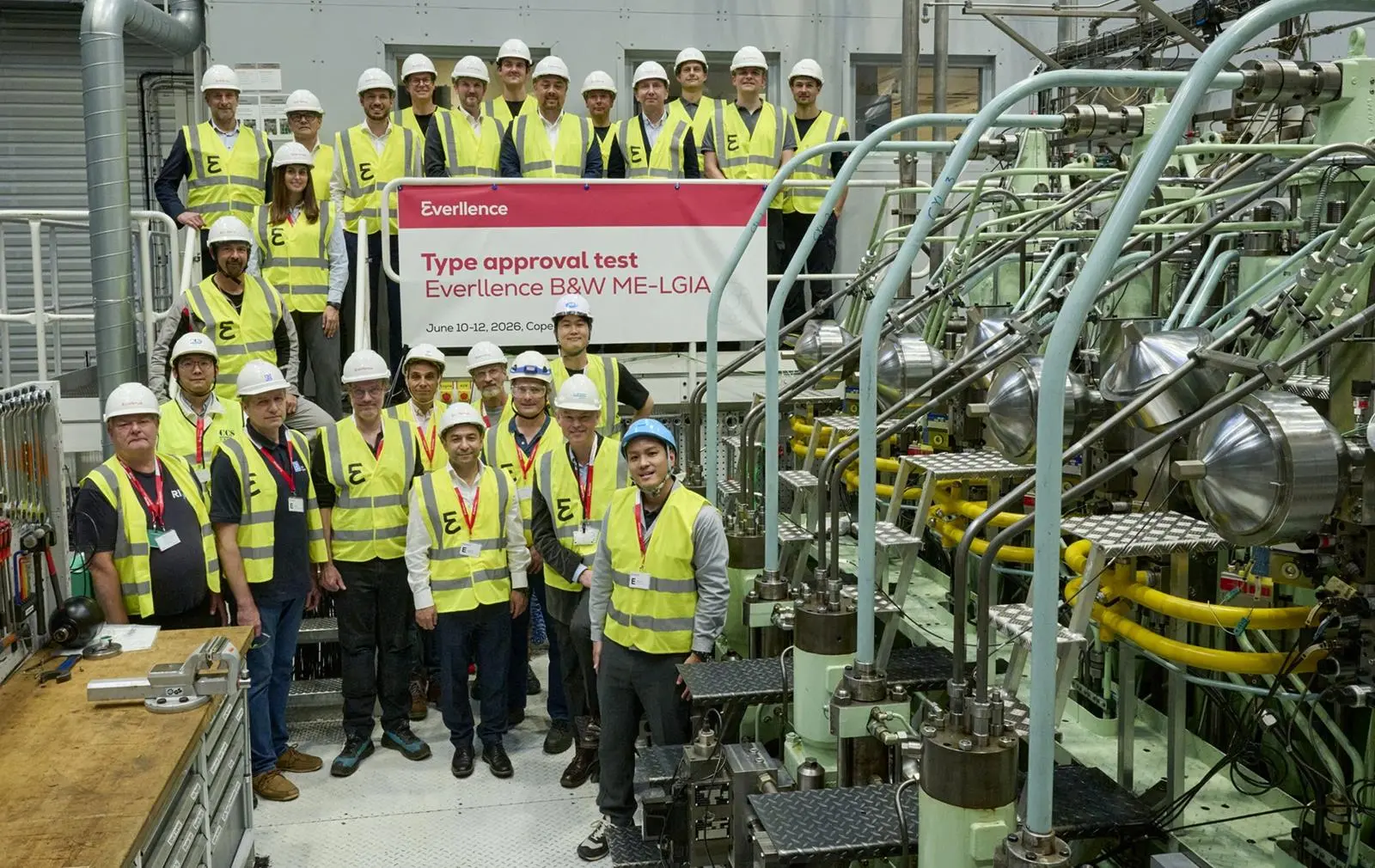
The testing programme took place at the company’s Research Centre Copenhagen from 10 – 12 June 2026, under the supervision of eight classification societies.
Completion of the TAT confirms the engine’s readiness for onboard installation ahead of sea and gas trials, which will represent the final stages before operational service.
“The TAT is yet another important step as we definitively move from concept development to seagoing engine operation,” said Bjarne Foldager, head of Two-Stroke Business at Everllence.
“It confirms the Everllence B&W ME-LGIA as ready for on-board installation and is the last test before actual sea and gas trials.”
Foldager added that the engine ‘sets new benchmarks in zero-carbon propulsion and digitally connected performance’ and highlighted the strong industry interest the project has attracted since its inception.
READ MORE: Ammonia engine passes key milestone
The ME-LGIA engine was first announced in 2019 and officially launched to the market during a two-day event in Copenhagen in November 2025. Based on the diesel combustion principle and Everllence’s dual-fuel liquid gas injection technology, the engine has been developed to support the maritime industry’s transition towards lower-carbon and ultimately zero-carbon operations.
The approval testing also provides valuable experience for the development of international regulations governing ammonia-fuelled vessels.
Ole Pyndt Hansen, senior vice president and head of Two-Stroke R&D at Everllence, said: “It is vital that rules and guidelines are in line with reality to optimise safety onboard vessels.”
He noted that the first ammonia-powered ships expected to enter service during 2026 would provide important operational data to support the ongoing development of International Maritime Organization regulations.
The ammonia TAT also marks the final approval test to be conducted at Everllence’s Copenhagen research facility before the company relocates operations outside the city in late 2027.
Related Articles
 2-STROKE & 4-STROKE
 2-STROKE & 4-STROKE
 2-STROKE & 4-STROKE