



Motorship Conference – from beyond 2009 to pre-1904 in two days
The 2009 Motorship Propulsion and Emissions Conference, held on 26-27 May in Copenhagen, Denmark, was judged by all to have been a resounding success.
In such uncertain times it was remarkable that the event attracted far more delegates than even the organisers had anticipated. Over 150 delegates attended the event, and many had to be turned away as the venue was oversubscribed.
Conference chairman John Aitken, secretary general of SEaAT (Shipping Emissions Abatement and Trading) presided over a full programme of over 30 presentations in eight sessions. The range of topics spanned the whole ship, from bow profile to propeller form, taking in associated subjects such as monitoring and bunker fuels – and, of course, the impact of the latest regulations. The keynote address, given by Torben Skannild, BIMCO secretary general, concentrated on the conference’s main themes, of ship efficiency and low emissions, two topics that go hand in hand.
The need to limit costs in a tight financial climate combined with ever-tightening atmospheric emissions limits proved attractive to ship owners and others in the industry. The timing of the event was auspicious, to say the least. There is the certainty of more ECAs (emission control areas) which will affect all ships, in respect of their sulphur emissions. Less definite is how the regulatory authorities will respond to the strong probability that shipping will have to control carbon emissions following the UN climate change summit later this year, also in Copenhagen. But the various possibilities need to be discussed, and prepared for.
Naturally, most of the papers fitted around these themes. One of the highlights was a session dealing with after-treatment of exhaust gases. This is still a controversial area, with some key industry bodies and figures preferring the ‘simple’ route of distillate fuels with very low sulphur content, while others are lined up behind exhaust gas scrubbers, believing that expansion of refining capacity to meet increased demand for distillates is not a practical solution. The growing numbers of potential suppliers of exhaust gas scrubbers is testament to the fact that shipping will be forced to take some action, whatever the oil suppliers do. And those after-treatment systems are being joined by a promising new concept, from Ecospec of Singapore, which combines clever chemistry with low-frequency sound treatment.
A highlight outside the conference hall were a superb conference dinner, in the historic surroundings of the Royal Copenhagen Shooting Society.
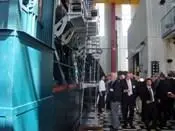
The conference finished on an ideal note, with lunch and a tour at the Diesel House museum, courtesy of MAN Diesel. This included two historic engines being started and run; the 1932 B&W eight-cylinder double-acting two-stroke, which was the world’s most powerful engine for some 30 years, and the first B&W Diesel engine, a single-cylinder four-stroke dating from 1904.
So an event which looks to the near future finished with a reminder of the not-so-distant past.
The next Motorship Propulsions and Emissions Conference will be held in Hamburg, Germany, in April 2010.
Related Articles
 ALTERNATIVE FUELS & LUBRICANTS
 GENERAL NEWS
 GENERAL NEWS