



Wärtsilä introduces the new 20DF engine
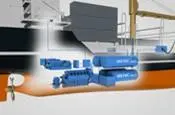
Wartsila has extended its dual-fuel technology to the lower power range with the launch of the new environmentally advanced Wärtsilä 20DF engine.
It offers ship owners and operators a compact unit that brings all the advantages of fuel flexibility to auxiliary applications, such as generating sets or as the prime mover in smaller vessels. The new Wärtsilä 20DF medium-speed engine utilises gas as a main fuel for marine operations and makes gas a practical and attractive option at a time when prices for liquid fuels are uncertain, and when environmental requirements are becoming increasingly stringent.
The tightening emission regulations under the IMO Tier II & III and ECA zone implementations together with volatile fuel prices mean that ship owners and operators are facing serious challenges. Solutions for complying with new environmental rules while maintaining cost-efficient operations vary, but only one, i.e. natural gas, appears to fulfil all the requirements.
With the launch of the Wärtsilä 20DF, Wartsila is extending the benefits of dual-fuel (DF) technology to cover the entire power range. Based on the well proven and reliable Wärtsilä 20 diesel engine introduced in the early 1990s, fuel flexibility means the engine can be optimized for constant speed generating sets, as well as variable speed mechanical drives, for main engine applications.
Installed alongside Wärtsilä 34DF or 50DF main propulsion machinery, a 20DF generating set completes the multi-fuel engine room concept. Compact and light, the new engine is intended for use in those vessel types where the Wartsila 20 is currently installed.
As well as being an ideal mechanical-drive prime mover in smaller applications, such as small cargo vessels, ferries or tug boats, it is also an excellent choice for harbour generating set applications in a wide range of vessel types. The 20DF (146/176 kW per cylinder) is manufactured in configurations of 6, 8 and 9 cylinder in-lines giving
maximum mechanical outputs of, respectively, 1,056, 1,408 and 1,584 kW. The engine speed is 1,000 or 1,200 rpm for use with 50 or 60 Hz applications.
Fuel flexibility enables owners and operators to opt for the most suitable fuel, taking account local environmental restrictions, fuel price variations, and fuel bunkering availability. A unique feature of the dual-fuel engines is their ability to run on natural gas, marine diesel oil (MDO), heavy fuel oil (HFO) and bio-fuels, thereby providing maximum flexibility in fuel choice.
In marine applications, fuel flexibility also represents a significant safety feature. In the case of an interruption to the gas supply, Wärtsilä DF engines automatically switch to diesel operation without any loss in speed or power output. Single-fuel installations do not have this additional level of operational safety.
When a DF engine is running in gas mode, CO2 emissions are reduced by approximately 20% since natural gas has a lower carbon content than liquid fuels. The lean-burn combustion process employed means that NOX emissions are reduced by approximately 80%, while SOX emissions are completely eliminated as natural gas does not contain any sulphur. The production of particulates is practically non-existent as natural gas has virtually no residuals.
Lean-burn combustion technology results in extremely-low emission values and very-high engine efficiency. In this process, the combustion of a lean air-gas mixture is initiated by injecting a very small amount of MDO as pilot fuel. To obtain the best efficiency and lowest emissions, each cylinder is individually controlled to ensure operation at the correct air-fuel ratio, and with the correct amount and timing of pilot fuel injection.
Wärtsilä has further developed UNIC, a special electronic control system that copes with the demanding task of controlling the combustion in each cylinder, while ensuring optimal performance in terms of efficiency and emissions under all conditions. Stable and well-controlled combustion also contributes to less mechanical and thermal load on the engine components.
In gas mode, Wärtsilä DF engines are already compliant with the forthcoming IMO Tier III regulations without the need for any secondary exhaust gas purification systems. In liquid fuel oil mode, all Wärtsilä DF engines are fully compliant with the IMO Tier II exhaust emission regulations set out in Annex VI of the MARPOL 73/78 convention.
Related Articles
 ALTERNATIVE FUELS & LUBRICANTS
 GENERAL NEWS
 GENERAL NEWS