



Marinette expands to enhance LCS programme
The expansion will provide enough indoor space to simultaneously house two complete LCS hulls and parts for two additional ships. The building enhancements also allow greater use of Marinette Marine’s proven modular construction process, which will enable the Lockheed Martin team to construct LCS more cost effectively.
The ground-breaking is the latest in a recent series of investments made by the shipyard’s parent company, Fincantieri, as part of its five-year, $100 million plan to modernize its U.S. shipbuilding operations and support the LCS program. In 2009, Marinette Marine installed higher-capacity overhead cranes, plasma-cutting tables and pipe-bending machines to increase efficiency and capacity. In 2008, Lockheed Martin also became a minority partner in the shipyard, while continuing to share its project management and lean manufacturing techniques to meet the LCS program’s cost and schedule goals.
“
This groundbreaking represents a significant milestone in the transformation of Marinette Marine to the premier mid-tier shipyard in the United States,” said Giuseppe Bono, Fincantieri’s chief executive officer.
“
The building expansion will allow us to fully complete a large ship such as LCS completely indoors at an even higher degree of completion and quality.”
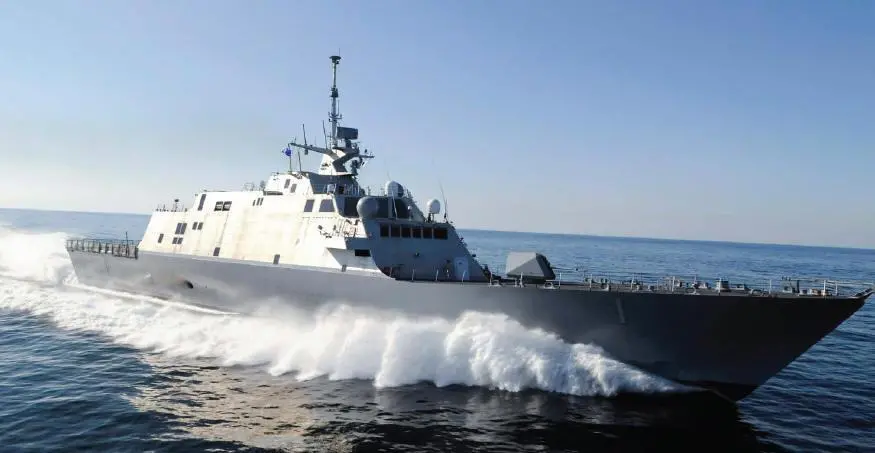
Marinette Marine constructed and launched the nation’s first LCS, USS Freedom. Commissioned by the U.S. Navy in 2008, USS Freedom was deployed two years ahead of schedule and recently completed three successful drug interdictions. The shipyard is also constructing the Navy’s third LCS, Fort Worth (LCS 3).
“
Fort Worth is on cost and on schedule, with 90 percent of its modules under construction and more than 30 percent of the ship complete,” said Dan Schultz, vice president and general manager of Lockheed Martin’s Ship and Aviation Systems business.
“
The improvements underway at Marinette Marine increase the team’s capacity in meeting the U.S. Navy’s need for an affordable, survivable LCS. We’ve already seen a 30 percent reduction in labour cost from our first ship.”
Related Articles
 ALTERNATIVE FUELS & LUBRICANTS
 GENERAL NEWS
 GENERAL NEWS