



Global FPS installation report released
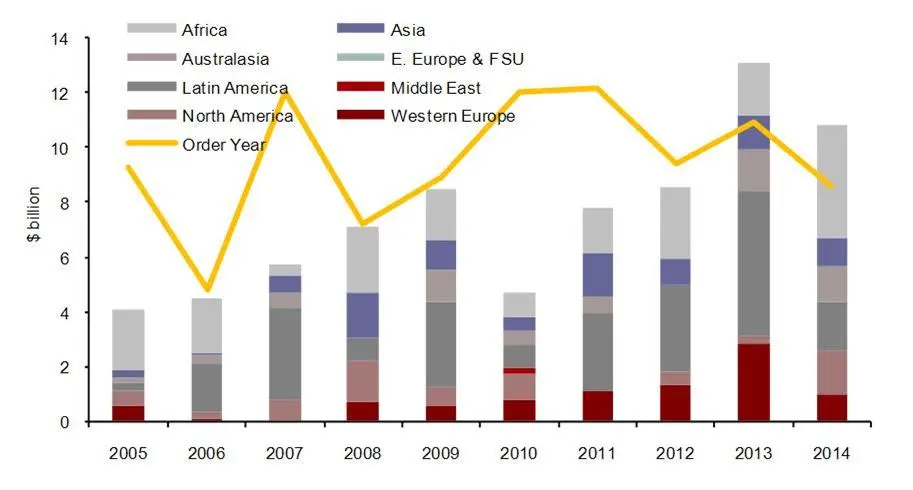
The World Floating Production Report 2010-2014 demonstrates that following a tough period of downturn the sector is now poised for strong long-term growth, identifying the industry’s move into ever deeper waters, a growing need to exploit marginal fields and an increasing emphasis on ‘fast-track’ and/or phased developments as key drivers.
In addition, Douglas-Westwood’s latest World Floating Production Report forecasts Latin America’s market share will be equivalent to almost a third of global Capex over the forecast period. Africa is the next largest region, followed by Western Europe. Together, all three regions are predicted to share almost three quarters of predicted Capex between 2010 and 2014.
The report suggests it is unlikely that the Deepwater Horizon incident and subsequent oil spill will impact on FPS installations at a worldwide or North American level within the timeframe of the report. Steve Robertson, Director at Douglas-Westwood, explains: “According to our data, only 11% of total number of FPS installations forecast to take place over the next five years will do so in North America.
The ban on deepwater drilling by floating semi-submersible drilling rigs and drillships will, of course, lead to a delay in the development of some current and future offshore reserves but we do not believe that this ban will ultimately affect any of the North American FPS projects that are forecast to come on-stream during the 2010-2014 period. Similarly, given the lead times of most projects, we acknowledge that whilst there could be a wider (global) impact, it is not expected to impact developments forecast to occur over the period to 2014.”
Lead author Lucy Miller continues: “It is our view that the long-term prospects for the offshore and FPS sectors are robust. Floating solutions will continue to be required to bring on-stream new offshore reserves and, despite the recent troubles in the US GoM, deepwater developments are essential for the industry to bring on-stream new reserves to satisfy global demand.”
Related Articles
 ALTERNATIVE FUELS & LUBRICANTS
 GENERAL NEWS
 GENERAL NEWS