



Piston seals for cleaner engines
This resulted from the gland box design and the inability of the original equipment manufacture (OEM) scraper/seal rings to prevent the under-piston detritus from finding its way into the engine sump; also the transmission of system oil through the housing, to end up being deposited in the under-piston area.
Since then, the designers have modified and altered many aspects of the piston rod sealing/scraper system but rods, bearings, piston crowns and practically all of the close tolerance areas in an engine can still suffer from varying degrees of failure due to loss of lubricity of the system oil. The company’s Ernest S Terry says that once contamination has reached this stage, the oil cannot be recycled or reused in any way. However some ships do add this contaminated oil to the fuel oil to burn instead of carrying it as ballast. CIMAC and other organisations have looked at burning this contaminated oil to prevent pollution but expert opinion is still not certain as to the after affect of burning this contaminated oil and caution is advised.
Currently the average loss of system oil is around 10 litre/cylinder/24 hours of operation. Some engines use less and others considerably more. With the current high cost of system oil, even moderate use of oil can be expensive – for example, a sevencylinder engine using an average 10 litre/cylinder/24 hours over a 290 day operational period will use 20,300 litres. Engineers state that this loss is not all down to the piston rod/gland box, however many believe this to be source of the greatest volume of oil loss of any engine.
Analysing some failures it appears that hardening of piston rods has not made a significant difference to oil usage or to contamination of system oil with cylinder oil/fuel oil, and the configuration of rings within the housing can create a convoluted wear pattern on the piston rod allowing a flow path up to under piston and down to sump. Terry says that during operation the system oil is not scraped off as effectively as it should be, due to the holding effect of the system oil within the designed scraper rings drains and the blocking effect of the tension springs around the periphery of the individual rings. The tension springs can act like a pump either directing oil back to the rod in motion or alternatively acting as a barrier preventing oil flow back to engine sump.
Where all rings were all bronze the waste of material was in the region of 80% of the total ring dimensions, to overcome this and use less costly materials a number of systems use cast iron Lamella ring arrangements, pointing out that with hardened rods cast iron can be used without damage to the rods. Even with hardened piston rods wear up to 0.80mm hasbeen noted in a fairly short operating period, with this wear and wear of the scraper/seal rings the leakage up to the under-piston and down to the sump accelerates with operational use.
Even with changes of design and materials, the amount of oil returned to the sump is restricted by the blockage of the drain holes/slots restricting the volume of oil returning to sump plus of course the under-piston detritus will find its way into the housing through worn rings and the end gaps between each ring segment.
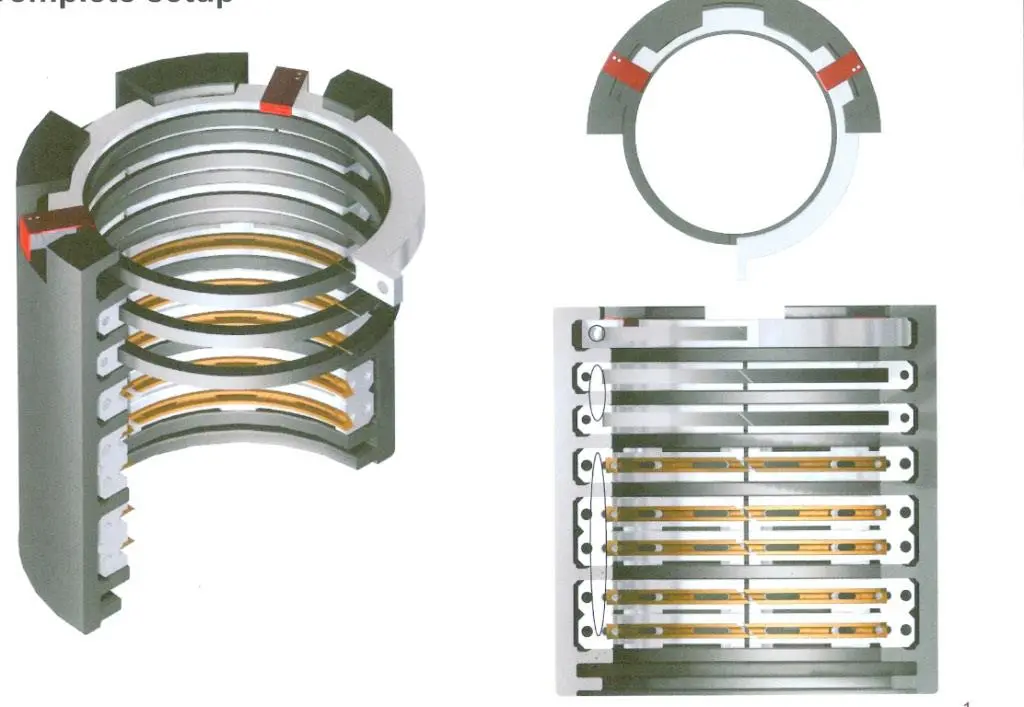
Marine Sealing Services has looked at the design of all current systems including polymer seal/scraper systems over the past decade and has designed one system using conventional materials, and another in a totally different configuration that uses the motion of the piston rod to scrape off the maximum amount of oil to a low pressure zone formed by the carrier ring design that holds the scraper rings. All of the scrape-off points are free flowing with no zones of blockage allowing quick oil return to the sump. One version of the system uses tension springs, and the other uses a pre-loaded Belleville Spring system, which offers much lower restriction to flow, so oil return will be in the region of 70% better than conventional systems. The upper section is a continuous ring wiper seal that prevents flow from the under piston area to sump or flow from the system oil into the under-piston area. By maintaining a tight area the system oil should remain cleaner preventing oil loss, and will maintain a clean engine system which will help to keep emissions to atmosphere to design levels. The system is designed to retro-fit into any two-stroke crosshead diesel engine.
Terry says that the company has a licensee in Switzerland that has been involved with development of this system, but this licensee’s heavy workload means that he is seeking further licensees elsewhere.
New licensees will be involved in the next stage, a gas-tight system designated ‘wrap & outsert’, designed to prevent cross contamination of oils used in two-stroke diesel engines. This new system will become necessary should ships start using gas generators on board to improve combustion. It will maintain a clean system oil state that will help stabilise operational temperatures during the voyage.
Related Articles
 PROPULSION
 GENERAL NEWS
 GENERAL NEWS