



Laser technology provides ‘green’ alternative to scrapping components
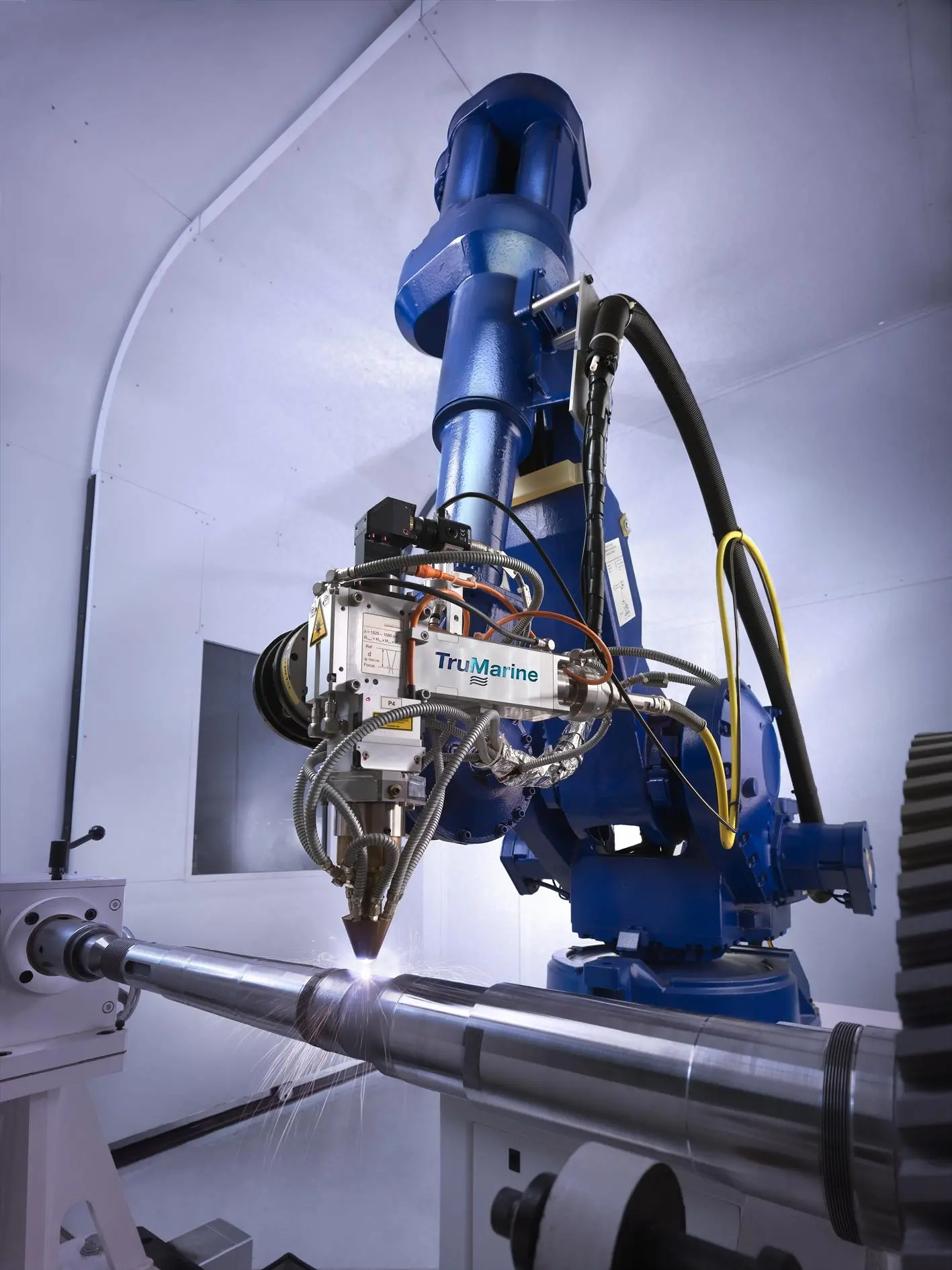
Tru-Marine’s says that its forte in developing new repair technologies has enabled it to undertake repairs to turbochargers that were previously uneconomic to consider, where damage made the parts suitable only for scrap. Damaged components that would have been discarded can now be recovered to original quality by means of the LAAM (laser aided additive manufacturing) method.
The company describes LAAM as “an interdisciplinary technology that sees a wide range of industrial applications for its merits of achieving high quality repair, improved efficiency and compatibility for tailored surface properties.”
The fundamental principle of laser cladding is to apply a laser beam, which acts as a heat source, to an additive deposition, to produce a good metallurgical bond with the component under repair.
Depending on the make and type of turbocharger, Tru-Marine says that it has created proprietary process conditions that require optimisation of the beam quality, the type and utilisation efficiency of the additive deposition as well as the substrate geometry and metallurgical properties. The company believes that laser cladding represents sustainable technology, by virtue of reusing materials as well as reducing down-time and wasted by-products. Further economic benefits arise from the reduction of heavy capital expenditure associated with new replacement parts, and from prolonging the lifespan of modified parts.
In the case of turbochargers with thin shafts, these, according to Tru-Marine, were often impossible to repair because of distortion caused by the huge heat input required for traditional methods of thermal repair. Laser cladding is said to provide a solution for such thin shafts, and is additionally effective for restoring the new generation of turbochargers, manufactured using super alloys.
Tru-Marine says that laser cladding is suitable for all makes and types of turbocharger components, regardless of material composition and component size. These include:
- rotor shaft bearing journals;
- rotor shaft disc labyrinths; and
- piston ring grooves
Certified by Det Norske Veritas, laser cladding is claimed to offer an efficient and cost-effective remanufacturing process that offers the advantages of:
- high bonding strength that withstands extreme operational conditions;
- improved resistance to corrosion, erosion, wear and fatigue;
- low dilution of the base material;
- smaller heat affected zone;
- minimal distortion of turbocharger component;
- high speed precision; and
- quick turnaround time.
The laser cladding facility is available at Tru-Marine’s Singapore facility, where the company says that to date, it has successfully repaired turbochargers of the RH, NA, TCA, VTR, TPL and TPS types.
The company’s aim is to keep turbochargers running smoothly.
Related Articles
 PROPULSION
 GENERAL NEWS
 GENERAL NEWS