



UK trimaran design for Atlantic record
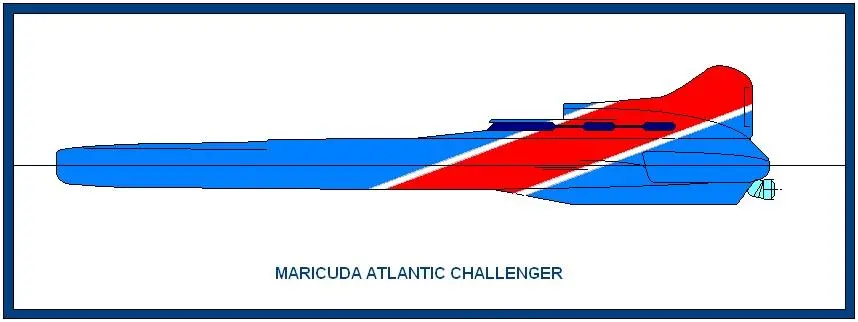
The current Atlantic record was set by the Italian superyacht Destriero in 1992 when she crossed the Atlantic in 2 days 10 ½ hours. She averaged 53 knots on that crossing, which made the Atlantic record look impossible to beat.
The Maricuda Atlantic Challenge (MAC) is based on an advanced trimaran design developed by Maricuda Marine Technology from Christchurch, England. The vessel features a very thin central hull with minimal sponsons located right aft for stability. Further stability is generated by the aft tail fin that rises up from the engine air intake pod above the pilothouse in aircraft fashion.
In order to maximise the performance at very high speeds the Atlantic challenger will be fitted with an advanced ride control system based around quick-acting hydraulic flaps. As well as the aft fin, Maricuda claims a number of novel patented features on the hull to improve the performance in a seaway.
Compared with Destriero’s 60,000 hp, the new boat will have a more modest 40,000 hp produced by a single Rolls-Royce gas turbine. The power plant is, like the military MT30, based on the Trent aero engine, and it is planned that the drive will be split between two water jets also from Rolls-Royce. It is likely that a pair of small diesel engines coupled to water jets will be fitted in the sponsons for low speed and harbour manoeuvring.
Maricuda is claiming that speeds up to 70 knots will be possible from this power unit even with the heavy fuel load required for the Atlantic crossing. This will enable the 3000 mile record route across the Atlantic from the Ambrose lighthouse off New York to the Bishop Rock lighthouse off Lands End in Britain to be completed in less than two days. Devonport Dockyard in Falmouth has been signed up to help develop the hull construction and to build the vessel.
In order to qualify for the coveted Hales Trophy for the Atlantic record, this Atlantic challenger has been developed for both commercial and military purposes as well as offering the possibility of creating an extraordinary superyacht. There is generous space inside the hull for carrying cargo or for accommodation and this, combined with the very high speed capability in adverse sea conditions, could open up new possibilities for cargo and passenger ferry routes, or in military applications for rapid transit of arms and personnel.
This record attempt is provisionally scheduled for the summer of 2013 but the team at Maricuda still has to raise the considerable funding required for this project. It is hoped that the appeal of setting a new record and having a vessel that will set new standards in ocean performance will be attractive both to commercial sponsors and to private individuals.
Related Articles
 ALTERNATIVE FUELS & LUBRICANTS
 GENERAL NEWS
 GENERAL NEWS