



Large-scale coating removal with environmental benefits
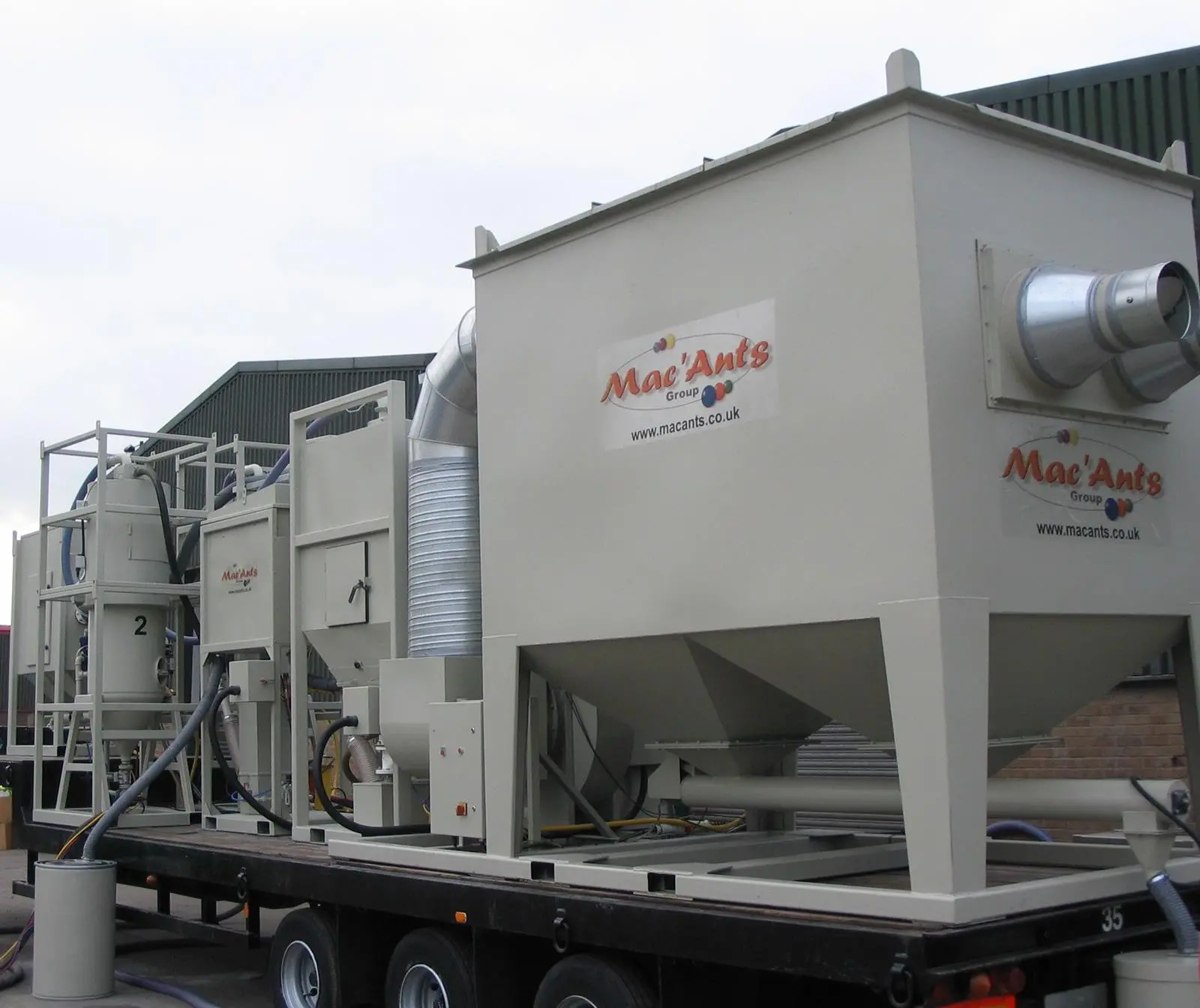
The development is based around a series of modular units that can be delivered to site by road, and located alongside the work area. Capacities and sizes can be varied to suit project requirements. The company’s Auriga System is described as “the heart of a plastic media stripping room made mobile”. It handles the air from a contained or ‘shrouded’ area that encapsulates the working surface, and which, in turn, leads directly to extraction, collection and recycling units – also modular elements of the system. Because the system uses plastic media and operates at significantly lower pressures than conventional blast systems, the company claims that only 3-5 tonnes of waste would be produced rather than the 30 tonnes produced by conventional systems, with the media remaining useable for longer, and with lower noise and dust levels
A typical system would feature a 10,000 ft3/min dust collector to handle the airborne dust generated by four media stripping nozzles. Operators work on the face as normal while pressure regulation for optimum application and system functionsare handled by a PLC controller. The working environment within the enclosed area is maintained via an extraction air system with operating pressures such that work and media recovery can be successfully conducted remotely from the equipment location.
“The design of the system allows for a dramatic reduction in waste disposal requirements,” comments Mac’Ants Director Kent Martin. “Media is recovered using a high capacity vacuum generator and, in turn, a rescreening and airwashprocess before returning tothe pressure vessels for re-use in the blasting and stripping process,” he continues. “This recovery takes place either during or at the end of each blasting shift, and clearly means that consumable material costs are kept to a minimum. Ultimately, the dust and spent media are collected into a central point for safe disposal – importantly with no manual intervention necessary.”
Martin points out that the benefit for the user is enhanced by the fact that no operatives are subjected to potentially hazardous dust, which is discharged automatically into a sealed drum for onward disposal or recycling.
“Because we are effectively taking the full blasting operation to the point of use and the system is designed as a self-contained unit, we believe the concept will offer an added benefit where possession times are limited,” adds Martin. “Moreover, because it is designed to operate with either plastic or plastic-hybrid media, their acknowledged benefits in terms of performance and environmental gains can also be enjoyed.
“We believe the benefits of the system will be recognised by end users and contractors alike in shipyards – indeed in any area where large structures need to be stripped and cleaned. It has effectively redefined the optimum means of achieving excellent results for the industry, and makes the use of plastic media for onsite work viable and efficient,” Martin concludes.
Related Articles
 EMISSIONS REDUCTION TECHNOLOGY
 ALTERNATIVE FUELS & LUBRICANTS
 ALTERNATIVE FUELS & LUBRICANTS