



New safety system for OSV rescue craft
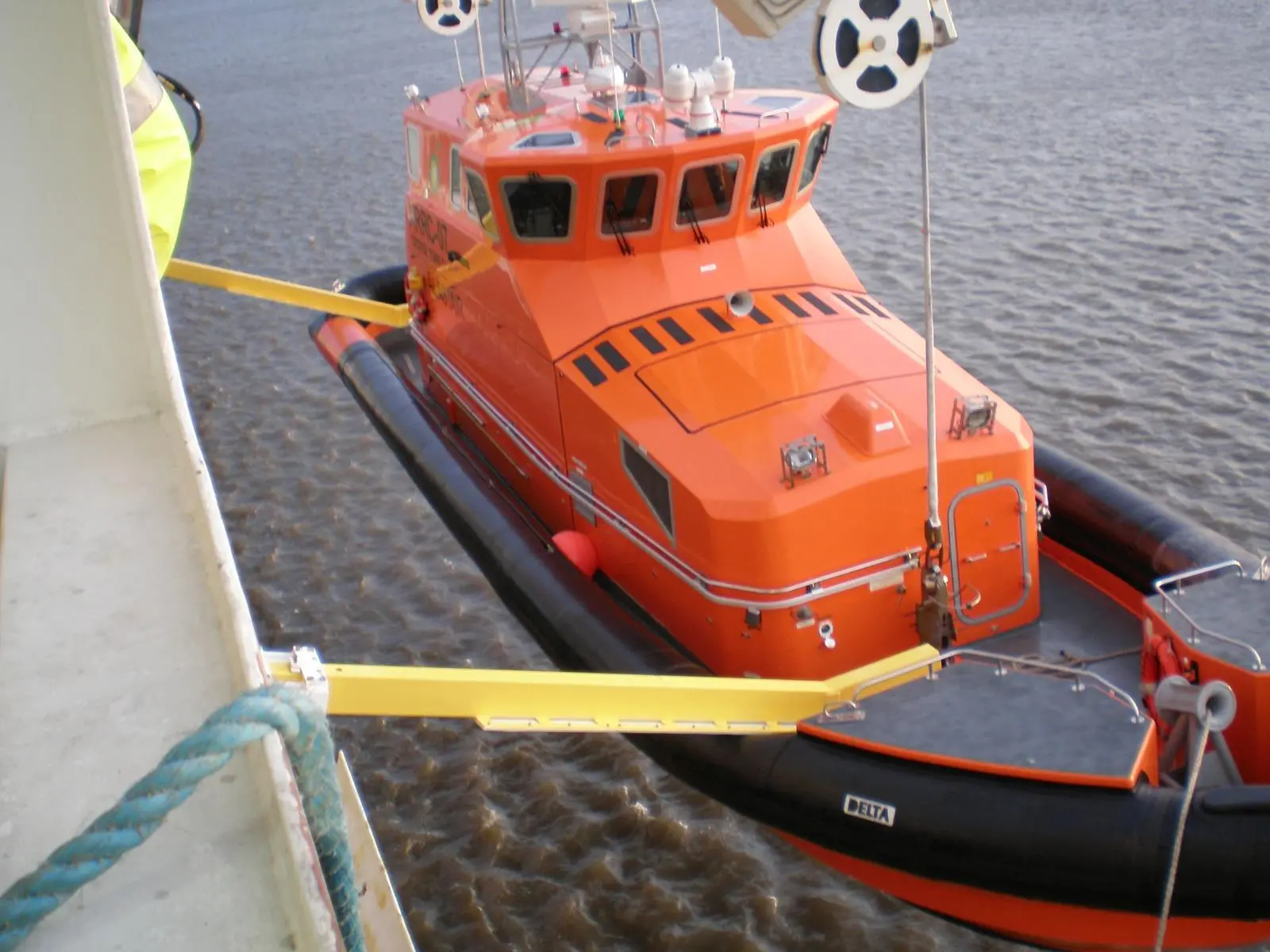
Each RSV carries two 19m 30 ton autonomous rescue recovery craft (ARRCs). These are launched via specially designed davit systems enabling rapid deployment in seas of up to 7m. The company says that unlike normal lifeboat davits, the RSV ARRC davits are in regular use, and need to withstand considerable wear and be easy to maintain in particularly harsh operating environments. The ARRCs are fully crewed during deployment and recovery, so the davit mechanisms have to control movement while suspended during rolling of the mother ship.
The passive damping systems developed by SE Hydraulics with support from Parker are claimed to prevent harmonic oscillations from occurring by using two mechanical arms or fingers per ARRC. These arms form an integral part of the launch system and face outwards onto the inflatable sponson of the ARRCs, providing resistance to the rolling motion and rising and falling as each ARRC is deployed or recovered.
The multi-role Regional Support Vessels are used as part of BP’s North Sea operations to deliver essential supplies to offshore rigs, to remove waste, and to provide critical safety cover. Each RSV is 93m in length, has a crew of 25 and is normally on station in one of three marine regions in the mid and northern North Sea, with the fourth vessel being in port or in transit. The ARRCs can accommodate up to 26 casualties and six crew members, and with a range of 400 nautical miles at 20 knots can operate totally independently of the mother ship.
Chris Blevins, director of SE Hydraulics, explains that, “There is a self-contained passive damping systems for each of the two ARRCs on every regional support vessel. We have used Parker hydraulic components throughout, with each mechanical arm being controlled by a directly connected and vertically mounted pair of cylinders, linked back to twin accumulators mounted within a compact hydraulic and electrical control module on a lower deck. This design allows pressure to rise and fall in a carefully controlled manner, with the force on each side of the cylinder, and therefore on the position of the arm, being regulated by the accumulators to provide a balancing resistance against the rolling action of the ARRCs as they are suspended in the davit falls”.
One of the claimed advantages of the system is that once the damper arms are deployed no external power is required to maintain damping forces, as system pressure is maintained by energy stored in the accumulators. As a result, if the main vessel power fails while an ARRC is suspended from the davit falls, the arms will continue to provide damping force until power is restored, so the ARRC crew are protected from any build up in oscillations that would otherwise occur.
The first of the damping systems, fitted to the Caledonian Vigilance, have now been operating successfully since for over two years in the extremely harsh conditions of the North Sea. “As far we know, there have been no problems and no downtime, with the exception of routine maintenance”, explains Blevins. “This is largely due to the quality and reliability of the Parker products used, with components such as specially protected hoses and stainless steel fittings providing excellent resistance to salt water corrosion and the robust handling that inevitably occurs in such demanding working conditions”.
Related Articles
 ALTERNATIVE FUELS & LUBRICANTS
 GENERAL NEWS
 GENERAL NEWS