



The quest continues for the better propeller
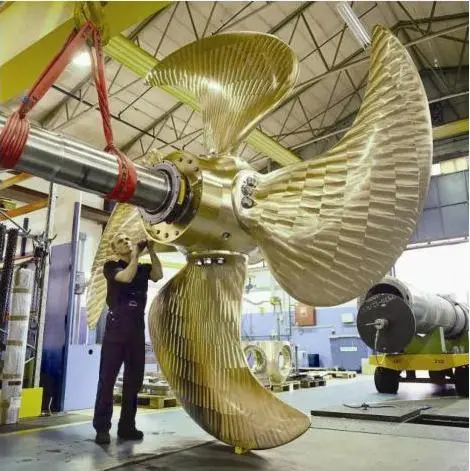
Wärtsilä and IHI of Japan reached agreement early in 2009 for a co-operation agreement under which IHI contra-rotating propeller (CRP) systems would be offered as pat of Wärtsilä’s diesel-electric propulsion packages. Wärtsilä says that this will provide a 10% improvement in propulsion efficiency for all sizes of ships up to large LNG carriers.
As the potential for improving propeller propulsive efficiency aft-ship optimisation is far greater than that for improving diesel-engine fuel-oil economy, MAN Diesel says that it is devoting more resources to its CP propeller programme and associated aft-ship systems in recent years, with the aim of improving total propulsive efficiency by 8-10% within the next 3-5 years.
MAN claims that where the correct approach to the vessel-design process is taken and the company can get involved at an early stage in propeller and aft-ship optimisation, propeller efficiency improvements and bollard-pull increases of (respectively) 5-7% and 8-12% can be attained compared to a standard, conventional, CP propeller solution. Such solutions offer even greater potential in retrofit projects where fuel-consumption reductions of up to 12.5% have been reported.
In response to the market demand for very large CP propellers up to and beyond 30,000 kW and with diameters over 8 metres, MAN Diesel is expanding its propeller portfolio to add two new, propeller hub-sizes – VBS2080 and VBS2240 (2080 mm and 2240 mm hub diameters respectively). These propeller sizes are typically destined for conr-ro vessels, shuttle tankers and special vessels with high ice classes, and powered by MAN B&W two-stroke MC-C or ME-C main engines that directly drive a CP propeller.
Designs for MAN’s latest larger Alpha propeller hubs, like the smaller predecessors, focus on reliability, low wear-rates and service-friendliness as they are intended to be serviceable from the aft-end, with no dismantling required.
MAN says also that Alpha is the first CP market series where both the stern-tube system and propeller hub can operate on biodegradable oil, eliminating any risk to the environment and guaranteeing internal propeller lubrication, even in the event of seawater contamination.
The company reports that its propeller designers and PrimeServ staff in Frederikshavn, could sit back satisfied during October when a full-scale bollard-pull test on the Esbjerg-based fishing vessel Jette Kristine showed an increase in bollard-pull performance of 23.5%. Advanced CFD tools were used to develop MAN Diesel’s new AHT propeller nozzle series, which was tested on the ship, and was shown to offer enhanced performance compared to the standard ‘19A’ propeller nozzles.
The increased bollard pull achieved when using the AHT nozzle results from an optimised nozzle profile, which is double-curved on both the inner and outer diameter, and careful attention to the nozzle length/diameter ratio, nozzle support, aft ship lines, and tilting and azimuthing of the nozzle.
Rolls-Royce’s Promas integrated propeller and manoeuvring system formed part of a package ordered for four new Norwegian cement carriers; the owner looking for reduced fuel costs and a low environmental impact, as well as being keen to try new propulsion technology.
Berg Propulsion launched its Berg Azimuth Thruster (BAT) in 2009, and secured its first Asian reference involving a Chinese yard. Berg signed a contract with Singaporean oil and gas field support and logistics contractor Teras Offshore to deliver its largest BAT units, in the shape of two 2,500 Kw (1,600 rpm) output BAT 730 units, as well as two BTT 519 tunnel thrusters.
The units will be delivered from Berg’s Singapore production facilities to CCCC Bomesc Marine Industry in China, for installation on board a 13,000 dwt cargo vessel, to work in combination with electric motors. High manoeuvrability in demanding sea conditions will be required of this 158m long ABS-classed vessel.
Other BAT orders were secured for a survey vessel rebuild in Sweden, and a smaller offshore vessel to be built in Dubai. The BAT 730 unit works with propellers of up to 3m diameter, and power up to 3,200kW. It can be delivered in both CP and FP versions, with L-drive or Z-drive configuration, for either electric motor or diesel engine drive, and works with electric or hydraulic steering mechanisms. It incorporates Berg’s oil circulation system with integrated moisture monitoring, which is claimed to be the first hub system in the world where moisture content is constantly checked across the entire propeller system.
Berg continues to turn out its core CP propeller products, and launched an innovative new version with feathering capability. The first of these units will be fitted to two 100m chemical tankers under construction at Dingheng (Jiangsu) Shipbuilding in China, and an 85.5m long ferry being built at the USA-based Eastern Shipbuilding Group.
Berg says that the feathering propellers are particularly suited to twin screw installations, which offer the advantages of inherent flexibility, redundancy and better manoeuvrability when compared with single screw solutions. A single engine driving a single propeller achieves maximum efficiency at a fixed level in the design condition. At lower power, whether working in combination with fixed pitch or controllable pitch propellers, engine working pressure decreases and engine efficiency is lost.
Greater flexibility can be achieved by operating two smaller engines driving two propellers because, at lower speeds, the ship can be operated on one engine alone, working at optimum efficiency. Furthermore, the greater propulsion area covered by two smaller propellers is reckoned to equate to about a 10% efficiency gain when compared to a single screw solution.
According to Berg, the concept of feathering one of two propellers at lower speeds, so that the other can run at higher output, closer to optimum efficiency, is by no means new. Developed as a more efficient alternative to locking or clutching out an unneeded shaft line, ‘feathering’ sees the propeller blades rotated through 90° so that they are parallel to the flow. Putting a propeller in the feathered position during an emergency or at low speed minimises drag, with consequent fuel savings. Berg says that feathering techniques to date have featured a complex and often cumbersome mechanical solution, or hubs that cannot offer astern pitch due to their internal mechanical limits. Its BCP design offers the capability to feather propeller blades within its standard hydraulic hub. The result is an expansion in the propeller’s operating pitch range.
In the field of waterjets, Hamilton Jet of New Zealand scored an important reference with a successful installation of its largest jets, the 1.2m HT1000s, in a new Korean patrol ship. The two steerable HT1000 jets are supplemented by a pair of HM811 waterjets, all four being driven by an MTU engine package. Rolls-Royce’s Kamewa brand launched a new lightweight waterjet, the FF67, maimed primarily at the naval market but with possible applications in passenger ferries and offshore crew boats.
ZF moved into the thruster market during 2009, with the Swiss/Italian transmission specialist acquiring Dutch company HRP.
Related Articles
 PROPULSION
 GENERAL NEWS
 GENERAL NEWS