



Cargo hold protection
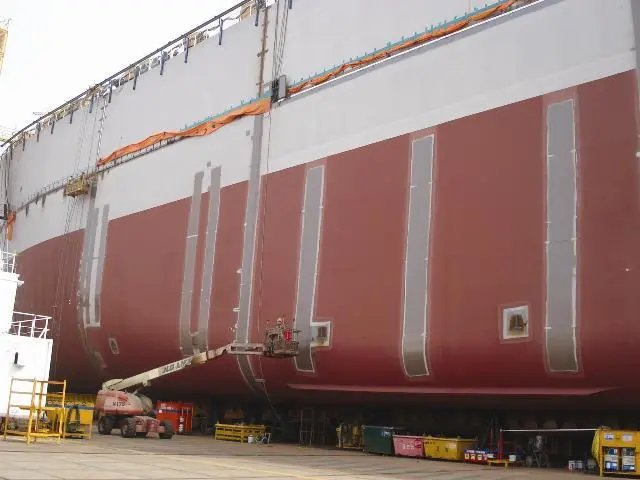
Cargo holds are, according to the company, the areas subject to the severest operating environments; without excellent coating protection, the structural integrity of holds can be compromised, jeopardising vessel profitability and safety.
Hard cargoes such as coal and iron ore increase the potential for significant coating damage during loading. This is particularly prevalent from the loading of coal by high speed belt conveyor systems and is likely to occur when loaders project coal at right angles to the bulkhead. The impact can fracture and detach coatings over a short period, leading to loss of steel protection and subsequent corrosion. Often these areas of damage are high on the bulkhead and are therefore difficult to repair in service.
Once suffering this form of impact damage, owners and operators are faced with more frequent repair, increased costs and potential downtime of their vessels.
Rob Taylor, market manager bulk carriers, International Paint said, “We have developed a product to exactly meet this market need. New Intershield®803Plus has excellent impact resistance, offering the very best in protection against ‘shooting’ damage. It also provides superb general abrasion resistance, good corrosion protection, VOC compliance with 75% volume solids, fast drying times and all year round workability. The product has a smooth surface for easy cleaning, is certified for the carriage of grain and is FDA compliant”.
The product has been tested using a new method which is able to replicate the in service damage experienced in coal and iron ore carriers. Results show that Intershield®803Plus outperformed other premium cargo hold coatings.
Universal primers
Another recent introduction from International is a range of universal primers, enabling yards and owners to comply with the IMO performance standard for protective coatings (PSPC) and new regional regulations limiting VOC emissions.
International says that for the newbuilding shipyard the product range offers universal application, high volume solids with low VOC, year round workability with fast drying, low temperature cure and long overcoating intervals, while owners can benefit from long term asset protection with controlled through life maintenance costs, high performance corrosion and abrasion resistance and PSPC compliance.
The new Intershield 300HS is a high solids version of International’s successful Intershield 300 epoxy coating which offers 78% volume solids, lower VOC and application direct from the can without thinning..
A new pure epoxy universal primer, Intergard 7600, is light coloured, with good abrasion resistance, claimed excellent application properties, low temperature workability and long term overcoating intervals with no requirement for surface roughening.
New Intergard 5600 and Intergard 5620 complete the range. These light coloured, epoxy universal primers have evolved from Intergard 403 and Intergard 423 technology. These products are designed for year-round sprayability with long term anticorrosive performance.
Environmental issues
International Paint has stated that it is concerned at the lack of attention that has been given in official circles to the environmental benefits of low-resistance hull coatings.
The company refers in particular to MEPC 59, and its disappointment that more emphasis was not placed on the role that hull coatings are playing in cutting fuel consumption and reducing emissions. Ii says that in the second IMO study on greenhouse gas emissions, hull coatings merit barely a mention.
Dr Julian Hunter, head of International’s regulatory affairs division, who regularly attends at the IMO, says: “Modern foul release coatings can make a huge difference right now to ships’ fuel consumption and therefore their emissions. We can demonstrate some remarkable fuel savings figures verified by some of the world’s leading blue-chip owners. Savings typically lie in the range of 6% – 9% as compared with conventional hull coatings, and that’s a significant benefit.”
International reports that leading owners and charterers are already investing in the latest foul release coatings and are reporting startling cuts in fuel consumption and corresponding emissions of CO2. However, in an overall shipping context, the number of companies choosing to invest in the latest generation of coatings is still relatively small.
Related Articles
 EMISSIONS REDUCTION TECHNOLOGY
 ALTERNATIVE FUELS & LUBRICANTS
 ALTERNATIVE FUELS & LUBRICANTS