



Radar system looks near as well as far
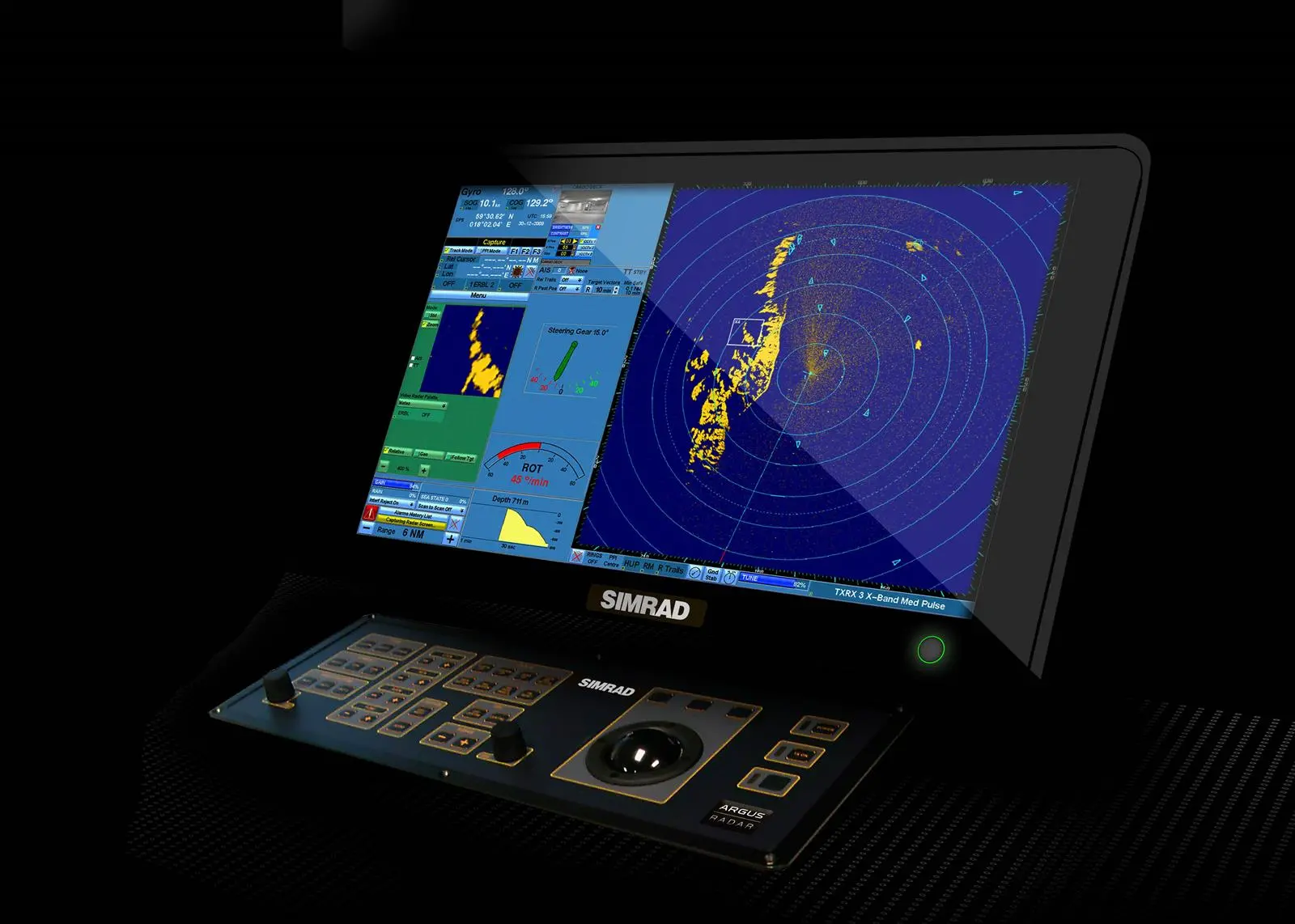
Since most of the Simrad product line was acquired by leisure marine company Navico, which also includes B&G instrumentation and Lowrance sounders, the Simrad name has been associated with recreational and light commercial vessels. The company’s broadband radar technology is said to differ in a number of ways from both normal SOLAS navigational radars and other solid-state radar systems, which make it suitable for integration into a ship’s radar system. And that is exactly what Navico has launched to the deep-sea market, a system that integrates both long-range conventional (‘pulse’) radar and short-range broadband radar.
The company points out that radars commonly used onboard ships are governed by the SOLAS performance standards which, justifiably, require high power and large antennas for their prime purpose of navigation and tracking other large vessels, at long distances. The normal radar suffers from ‘blind spots’, where the signals are obscured by masts, funnels etc, and in particular the astern view is usually affected by obstructions. The so-called ‘main bang’ area surrounding the ship is another limitation, being caused by the long pulse needed for long-range use proving less capable of detecting close-range targets. Additionally, the ‘pulse’ operation of normal X-band and S-band radars can make it difficult to distinguish between small targets and rain or sea clutter. Other drawbacks are that the high power makes the radar signals harmful to humans, so the antenna has to be mounted high up and well away from crew or passengers.
Navico’s solid state FMCW broadband radar technology is claimed to overcome these disadvantages. The Simrad Argus range combines conventional radar technology with broadband radar, to provide an all-round close-range view as well as the normal long range. The system combines one or more conventional antennae with broadband antennae mounted on the bows and the stern quarters, to allow ship operators to monitor the entire surroundings. Because the broadband antenna is compact and light, and emissions claimed to be around 10% of those from a mobile phone, Navico says it can be safely and easily mounted anywhere on the ship. It uses an Ethernet connection, and with only a few moving parts it is said to need little maintenance.
This, the company says, has obvious advantages as an anti-piracy aid. The piracy problem is growing, with pirates often attacking after dark and from astern to best avoid detection by normal means. The Argus radar is claimed to be able to detect suspicious targets of 1m high at a range of 10 miles. This is because the twin-antenna long-signal technology means the effect is ‘always on’ rather than the ‘pulse and return’ of normal radars, making it easier to distinguish small solid objects from sea and rain. Early warning of an attack enables ships to swerve back and fro on its course, causing the vessel to roll, sending the message to attackers that they have been noticed and making it harder to board. If necessary, the crew can retire to the citadel, where the broadband radar can remain visible on a Simrad multi-function display despite the usual attempts to disable the bridge navigation equipment.
Further deep-sea applications for the Argus radar are as an anti-collision device – the broadband radar can identify small vessels and floating objects – and as a precision docking radar; it can detect targets as close as 2m away.
Navico CEO Leif Ottosson said that: “The Simrad Argus radar series is set to be the standard for tomorrow’s maritime fleet. And with Simrad Broadband radar, ship‐owners finally have the ability to monitor the entire surroundings of a vessel, significantly reducing blind zones.”
Tim Ryder, director professional market, said: “Dubbed the anti-piracy radar, it is compact and robust and easy to install at strategic locations on the vessel.”
According to Navico, the introduction of Argus marks its strategic breakthrough for the Simrad brand into the SOLAS vessel segment and a prospective ship protection market with an estimated value of up to £12 billion.
Related Articles
 ALTERNATIVE FUELS & LUBRICANTS
 GENERAL NEWS
 GENERAL NEWS