



MAN powers record-setting vessel
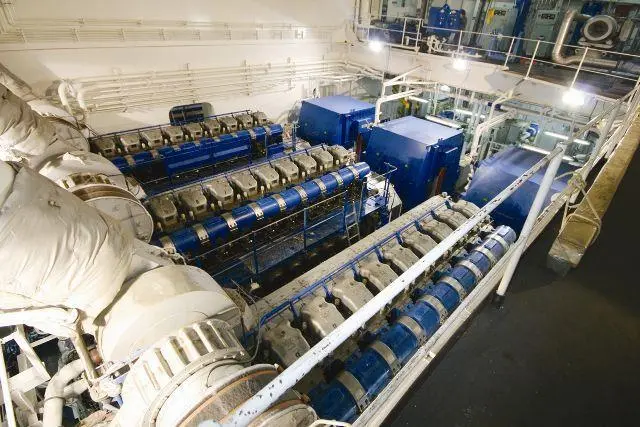
Driven by a diesel-electric propulsion system comprising a series of MAN Diesel 32/40 medium speed engines, the new addition to the Belgian group’s fleet is said to be the world’s largest fall-pipe and rock-dumping vessel with a capacity of 19,500m3. The 191.5m long, 40m wide newbuilding is powered by five MAN Diesel 9-cylinder 32/40 main engines, each delivering 4,500kW at 720 rpm and manufactured by STX Engine, MAN Diesel’s Korean licensee.
The Simon Stevin will mostly be deployed in offshore applications, such as the laying of oil and gas pipes at great depths and the vessel can level the seabed and dump rocks down to a depth of 2,000m. According to Jan de Nul, the fall pipe can process rocks with a diameter up to 400mm, a figure greater than any other fall-pipe vessel in service.
The fall pipe has an advanced, fully automatic unfolding system, featuring an ROV at its bottom that accurately corrects its position. The 191m long vessel has a 33,500 tonnes loading capacity, some 25% greater than the previous record-holder, and is capable of dumping 2,000 tonnes of rock per hour. The new vessel has a service speed of 15.5 knots, can accommodate more than 70 persons and has its own helipad.
The four-stroke engines run on HFO and are capable of continuous operation at loads down to 20%, while running at even lower loads is possible for limited periods, thanks to the engine’s optimised design. The 32/40 can also accept overloads of 10% in conditions characterised by frequency variation.
As the vessel is subject to a dynamic load demand, high and sharp load variations can also occur. Accordingly, each engine is fitted with a so-called ‘jet assist’ device that enables a quick response to such variations by injecting compressed air directly into the compressor wheels of the turbochargers.
MAN Diesel’s 32/40 type is claimed to offer optimised, operational economy and minimal maintenance requirements. It offers lube oil consumption of about 0.5 – 0.8 g/kWh, a figure that was considered as a design parameter for the piston liners, covers and rings. Another characteristic is the 32/40’s stepped piston. Here, the crown is forged with high-quality, stable steel (with shaker cooling); while the skirt is cast in spheroidal graphite cast iron. This piston design, together with a fire ring, prevents bore polishing of the cylinder liner and reduces lube oil consumption. Furthermore, the chromium-ceramic composition of the first piston ring contributes to long periods between maintenance.
As with all MAN Diesel engines, NOx emission levels for 32/40 engines fall below the upper limits specified by the IMO without negatively affecting fuel consumption or operation. The 32/40 can employ SCR (selective catalytic reduction) technology to meet even more stringent NOx limits.
The La Naval de Sestao shipyard is currently finishing the construction of the dredger Leiv Eriksson, a sister ship to the record-breaking Cristóbal Colón and due for delivery in April this year. Ordered by Dredging and Maritime Management SA, a Jan de Nul subsidiary, these twin vessels feature two MAN Diesel 16/48B main engines and are, by some distance, the largest trailing suction hopper dredgers in terms of capacity. They can dredge up to a depth of 155m, a technical feat that only Jan de Nul is currently capable of achieving.
The construction of vessels at La Naval de Sestao is part of the Jan de Nul Group’s 2007-2011 building programme and worth Euro 1.8 billion. The programme aims to create the largest and most modern dredging fleet in the world, capable of carrying out even the most demanding offshore dredging, rock dumping and construction works, in the process cementing the Jan de Nul Group’s position as a leader within international dredging and offshore niche markets.
Related Articles
 ALTERNATIVE FUELS & LUBRICANTS
 GENERAL NEWS
 GENERAL NEWS