



Engine indicator goes electronic.
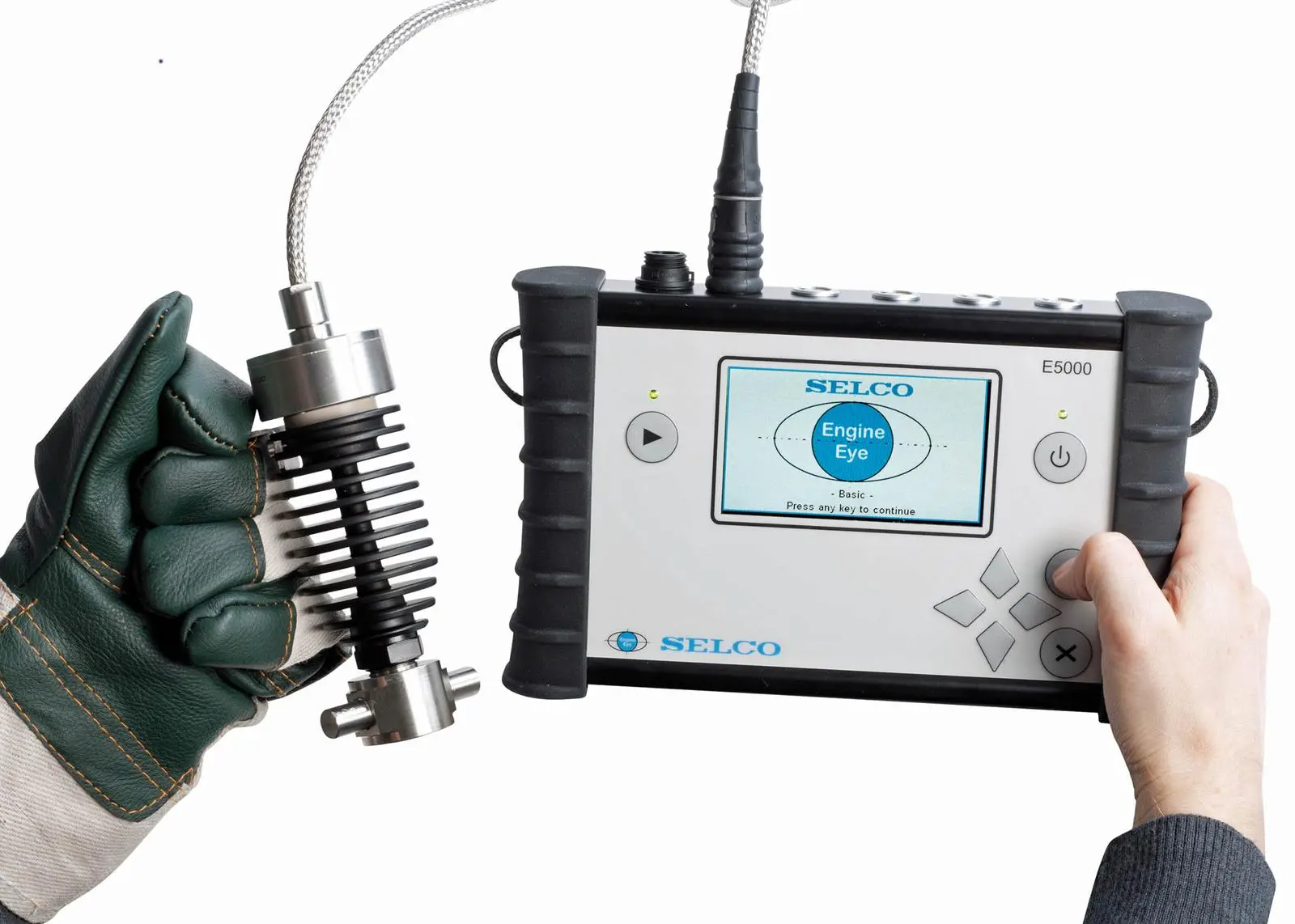
Selco’s EngineEye is a handheld high performance cylinder pressure indicator, said by the company to offer long-term quality measurements of the engine combustion process using a convenient and safe method, based on an old and trusted tool.
Selco says that its EngineEye is suitable for all large engines, whether running HFO, MDO, LPG or natural gas, as long as they are equipped with an indicator cock. The sensor technology is based on a GaPO4 crystal, which offers linearity and low thermal drift, therefore allows for long term pressure readings. The sensor may be left measuring on the open indicator cock for long periods, allowing engines to be tuned for continuous running. The EngineEye also features a patented ‘safe pressure sensor’ which ensures that the sensor will stay sealed even in the event of a membrane collapse. A built-in charge amplifier sensor avoids problems with special plugs and cables. A newly-designed crank angle sensor belt allows simple, high resolution measurements for all shaft diameters.
The unit comes with software which allows data to be transferred to a PC for analysis and diagnostics, with digital and graphical readouts plus trend indications. The data may be printed, or e-mailed to superintendents on shore for more detailed analysis. The unit itself is designed for reliability in a marine environment, and includes a built-in functionality check, while Selco says it does not need regular calibration.
Selco says that it is increasingly important to ensure compliance with emission regulations, green visions and pressure on costs. The company says that one important step in this direction is to optimise the settings of the engine and thus reduce the fuel consumption, increasing efficiency and reducing emissions and wear; setting and balancing the engine for optimum operation requires suitable tools which provide a clear insight into the quality of the combustion process within the engine.
Although in skilled hands, combined with a fine ear and an in-depth knowledge of engine working principles, the mechanical indicator served well in achieving good engine running, present-day demands go deeper. Measures such as NOx optimisation require a very different combustion process, so electronic MIP systems are replacing mechanical indicators and are now becoming the preferred tool.
Related Articles
 ALTERNATIVE FUELS & LUBRICANTS
 GENERAL NEWS
 GENERAL NEWS