



Design released for low-carbon bulker
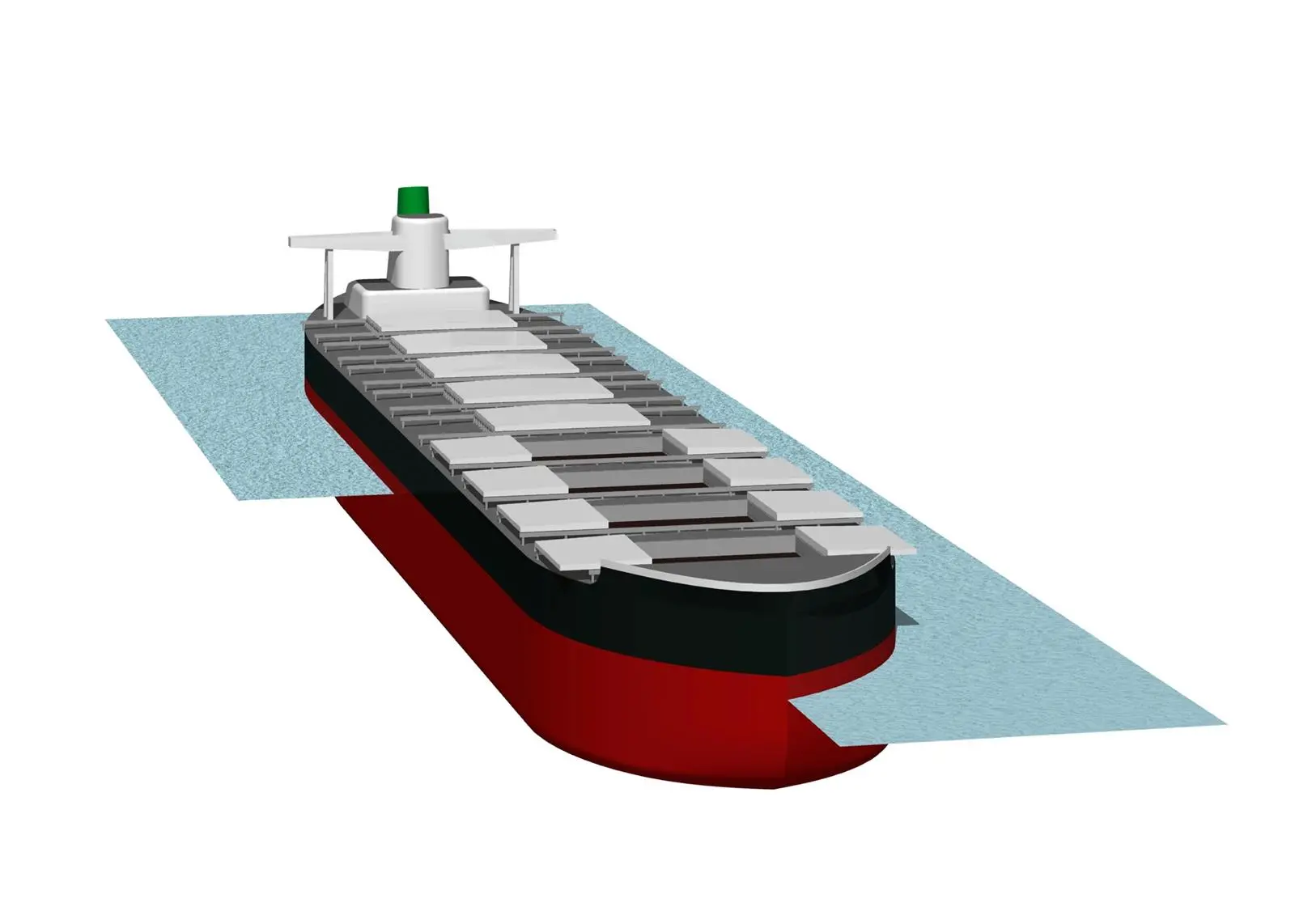
The company says that since April 2010 it has employed over 50 of its staff in design, R&D and commercial aspects of the ‘green ship’ project, in order to achieve reductions of greenhouse gases of 25% within two years, and 50% within 10 years. The reductions will come mainly through improved hull performance and more efficient machinery; Universal says this is though co-operation with its partner outside research institutes and its suppliers, as well as through the company’s t own efforts.
As an example, Universal cites the following features of the 200,000dwt G209BC bulk carrier, one of the G-series ships:
1) Reducing GHG by 25% through development of: Low resistance and high efficiency hull form; low wave and wind resistance; high efficiency propeller and energy saving device; and high efficiency machinery plant.
2) Use of the ‘Sea-Navi’ optimum routing monitoring system for optimisation of voyage route, which would help ship operators to draw up the SEEMP once this enters into force in January 2013.
3) Saving over 10 tonnes of fuel per day, and increasing maximum cargo dead weight by about 3% against the company’s previously-best ships. Universal says its predicted fuel saving has reached over 20%, which will further enhance the claimed class-leading performance and efficiency benefits of the design.
4) A target EEDI level of Phase 3 (reference line for vessels contracted on/after January 2025), under the Energy Efficiency Design Index; adopted at IMO MEPC62 in July 2011. The report of EEDI pre-verification can be prepared at the stage of any actual business deal.
Universal believes that its G-series is more than just a concept design, but a realistic proposal which could be actually delivered in 2014. The company says that the environmental friendly G-series technology could be applied not only to bulk carriers, but to tankers and other types of vessel.
Universal says that its goal is to attain a target of 50% GHG reduction by 2020, and with this aim in mind it is continuously researching and developing every aspect of technology. The G-series, with 25% GHG reduction, is merely a halfway point along the route to this longer-term target.
Related Articles
 ALTERNATIVE FUELS & LUBRICANTS
 GENERAL NEWS
 GENERAL NEWS