



Going to the rescue
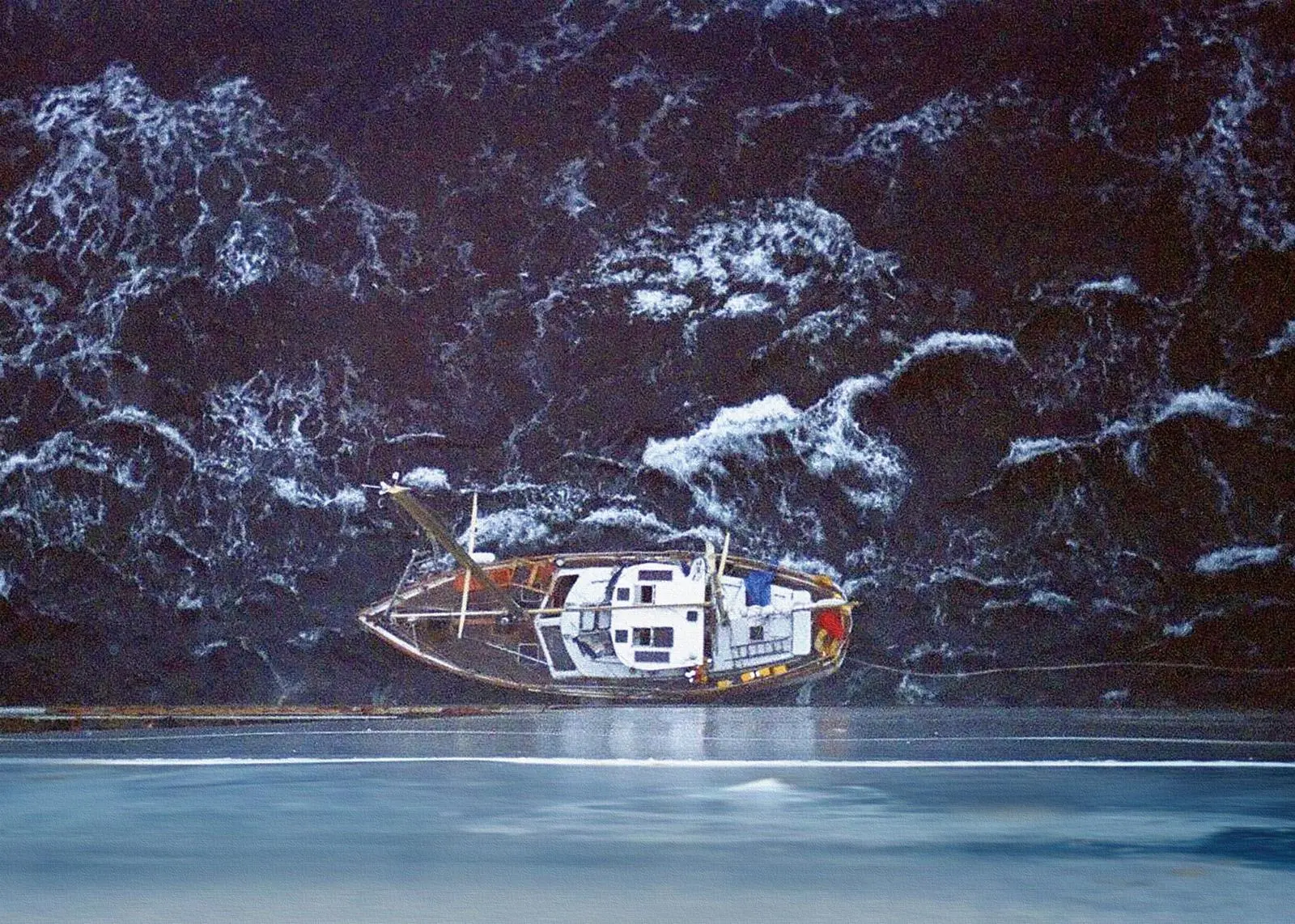
Although the failing catamaran was around 700 miles west of Ireland, by daybreak a 300m vessel was nudging alongside – a superb piece of seamanship considering the force 8 gale – but things started to go downhill from there, writes Mr Pike.
Firstly, it proved to be more than a 10m climb from the boat to the ship’s deck: unfortunately the deckhand couldn’t find any ropes so the catamaran simply started to drift along the side of the larger vessel.
As it passed, the rigging then caught in a projection which brought the mast down. The cat eventually drifted under the ship’s stern where the 9m propeller started chopping bits of out of the bow. Worse was to follow because as the ship lurched in a large swell it pushed the catamaran underwater.
Luckily no one was injured but it took some time before another attempt could be made. This time it went well: the ship had a rope ready to hold the catamaran’s crew and the electric pilot hoist carried everyone up to deck level – where we were asked to sign a disclaimer saying we would not sue for damage to the boat!
Although one is always very grateful to be rescued, this attempt shows the problems that can develop when a modern ship is sent out to people in distress.
Modern ships, with their high freeboard and dedicated cargo arrangements, are not well suited to rescue at sea and crews have little or no rescue experience. Yet traditionally they are obliged to go to the rescue unless there are mitigating circumstances. Surprisingly, in most cases it works.
The US Coast Guard organisation AMVER has a long list of ships prepared to be called on. Vessels report their voyages and positions and from this AMVER can identify the nearest available ship and ask it to divert. It is a voluntary scheme but around 5,000 vessels now participate and their record is excellent: last year 265 people were rescued by AMVER ships.
However, what the statistics do not show is how many people were not rescued and how marginal some of these operations might have been. It is assumed that when a ship is sent to the rescue then the matter is being dealt with, which throws the onus of responsibility onto the ship’s captain to make it work.
With the design of many large, modern vessels this can be a real challenge. Most of the rescues are either from yachts or small fishing boats in trouble, plus the occasional refugee boat which can be heavily over-loaded.
As most of these craft are disabled at the time, it is up to the ship to take the initiative and park alongside. This requires considerable seamanship skills and once in place it is usually a case of the survivors having to climb the side of the ship on pilot ladders or scramble nets.
With a low freeboard this should not be a major problem but when the rescue vessel is something like a big container ship then that climb may be 10 or 12m: for exhausted survivors this could be almost impossible. Electric pilot hoists are one solution and I have seen a ship lower its gangway, which makes for an easy climb.
A recent Marine Accident Investigation Branch (MAIB) report further highlights the difficulties. A tanker was sent to rescue the crew of a 12m yacht in the Atlantic where 7m seas were running. One of the yacht’s crew made it but it took half an hour for him to climb the pilot ladder. The skipper of the yacht was not so fortunate and after two hours of trying to climb the ladder he lost consciousness and was dead by the time he was finally hauled on deck. In the ‘lessons learnt’ section, MAIB commented, “Modern ocean-going merchant ships tend to have a high freeboard and their ability to rescue people from the water in heavy seas is often very limited”.
The International Maritime Organisation (IMO) is considering the situation, and has already published a guide to recovery techniques that suggest that survivors should be brought aboard in the near horizontal position: this of course is desirable but entails some form of lifting apparatus.
However, an interested group that includes the Nautical Institute has told the IMO subcommittee dealing with the matter that “performance based standards” for recovery systems are unrealistic, impractical and too restrictive, simply because commercial ships are not designed for rescuing large numbers of survivors from the sea, and would have to carry dedicated recovery equipment. This group proposed alternative functional requirements in support of the ISM Code.
Following this, the subcommittee is thinking about replacing the phrase “recovery systems” by “recovery capability”, and, in recognition of the fact that recovery in the near horizontal position is difficult for certain ships, it is retaining this as a proposal in the guide, rather than being set in stone. It was also suggested that a recovery rate of at least 10 persons per hour is too prescriptive. So the matter is still under discussion and the IMO has set a new 2012 target date for resolution.
The IMO has said that there is a “compelling need for positive action to be taken to address the problems of recovery of people from survival craft or from the water and providing information about the various types of recovery systems currently available or under development”.
Ships’ lifeboats these days are of the fully enclosed type which leads to greater chances of survival for the occupants in cold climates but which also makes the recovery of the survivors from the lifeboat a difficult operation. Recovery from liferafts can be equally difficult and as the IMO statement suggests this is an area when positive action is required.
The IMO has taken the route of trying to reduce the need to abandon passenger ships. In the event of damage the ship is now its own best lifeboat, having separate engine compartments and survival areas in the accommodation. The potentially large number of passengers involved makes this a sensible option for many accidents but it doesn’t provide a solution when a ship is on fire or grounded, and lifeboats or liferafts are still required. There are also concerns about cruise ships operating in remote areas where help may not be immediately at hand.
Further, lifeboats are being increasingly installed on cargo ships where launching them could pose an additional danger. While free-fall lifeboats are often used on small ships, larger vessels still tend to use the side mounted variety. The problem is that these are often being installed close to the bow or stern in order to maximise cargo space or to be closer to crew areas: however, the bigger overhang can be hazardous.
Lifeboats are designed for a one way trip with little or no thought given to any means of recovering them after launching. This is fine when abandoning ship but it can pose problems when the lifeboat may be the only available way of recovering survivors, particularly if they are injured.
Moreover, while lifeboats can be launched and recovered for practice in fine conditions, out in the open sea the risks multiply considerably and the crew are unlikely to have had any training or experience in this. On one rescue I was involved with, the captain said that there was no way he was going to launch the lifeboat to go to our assistance because it would put his crew at too much risk.
The crux of the matter is, what level of risk is acceptable onboard a ship involved in a rescue operation?
There is no easy solution and it’s a question that gets more acute as ships get larger.
As the AMVER statistics show, ships are still being called upon to carry out rescues in ocean waters. Perhaps the AMVER system needs to be more selective in the type of vessel sent to the rescue if there is a choice, and there is certainly scope for improving both the design of lifeboats and launch systems.
Related Articles
 METHANOL
 MONITORING, CONTROL & DIGITALISATION
 MONITORING, CONTROL & DIGITALISATION