



The right to bear arms?
Despite the assertion by Alastair Evitt of InterManager that the “issue has brought the shipping industry together”, and InterManager’s campaign urging flag states to allow owners the “freedom to choose” whether they wish to deploy armed guards onboard, there is still considerable hesitancy around the subject, if not outright contention.
The fact is live ammunition makes most people uneasy, even if it’s deployed by trained, professional guards. And this of course is the crux of at least one matter: private security firms are blossoming but it’s an unregulated industry.
“There continue to be grave unanswered questions about liability and responsibility associated with the use of weapons onboard merchant ships,” said Nautilus International general secretary, Mark Dickinson, adding “there are a number of unresolved issues arising from their deployment.”
He goes on to say, “There needs to be consideration and agreement on key issues including the liabilities of masters and officers in the event of something going wrong, or the problem of flag states, coastal states and port states facilitating the carriage of weapons onboard.” He also points out that the thorny of issue of the cost of security has the potential to give further incentives to ship owners to flag out and give rise to issues around the quality and regulation of private armed security guards.
Further, there’s been assertions that there have been many more releases of live ammunition onboard commercial vessels than get reported. One industry source said a while ago that it often wasn’t in a crew’s best interest to report near misses, sometimes because taking security personnel onboard had been done by sidestepping the law and “smuggling” the arms onto the ship. And sometimes it was – chillingly – because they had won a spat with a pirate boat but rather than take prisoners aboard, the security guards stripped them of communications and arms, put a bullet in the pirate’s outboard and pushed them out into the sea, probably to die.
Some say proper military Vessel Protection Detachments rather than the privately contracted security operatives proposed by UK Prime Minister David Cameron would be more suitable, and would “ensure there are no concerns regarding training, authority and liability,” said Mr Dickinson. He added that there should be “absolute clarity on the type of weapons private security guards can use”.
Further, while there is much focus on armed guards onboard ships, there is still significant room for consideration of other, more passive yet highly effective, forms of defence against piracy and armed attacks.
Jonathan Delf of BCB International says that, “Whilst having armed personnel onboard commercial ships would act as a powerful visible deterrent to pirates, it is a high risk venture which could result in costly unintended consequences. Indeed, using more aggressive countermeasures like weapons could escalate the situation unnecessarily and might result in a higher number of injured crew members, as well as endanger the valuable ship or its cargo.
“Moreover there are legal issues surrounding the carriage of weapons including when docking in different ports around the world. Many ship masters will be understandably concerned and wary about using lethal force.”
One passive form of defence is simply early warning. Captains and fleet managers currently have multiple information sources for pirate information – including the International Maritime Bureau and NATO – but this means gathering information from each site and collating it, before trying to interpret what it means for them.
So, a new software programme from Applied Weather Technology aims to provide a comprehensive, at-a-glance overview of all pirate-related information. Additionally, the GlobalView software facilitates three-way communication between captains, fleet managers and AWT route analysts, keeping all parties informed and engaged in real-time.
What is useful is that it shows the status of these vessels or previous attack locations in an intuitive way. Coloured alerts describe the type of pirate activity in the location noted: red for hijacked, orange for boarded, yellow for attempted boarding and green for suspicious vessel. The recent attacks have a ‘halo’ around them so it is easy to distinguish them from the older events.
Further, skull and crossbone flags visually identify the location of pirate motherships. By clicking on the flag a description will pop up giving known details, and ‘cone’ or circular shaded areas show up any anticipated movement.
There are other overlays that can be useful: these include a situation overview, descriptions of recent attempts and maps of attacks over last week.
It’s also useful to keep close track of the vessels. Apparently Transas’ recent contract for a monitoring system, FleetViewOnline, for Claus-Peter Offen Tankschiffreederei was sealed because one of its tankers had been the victim of a piracy attack and the company wanted a solution to that allowed constant monitoring of its entire fleet.
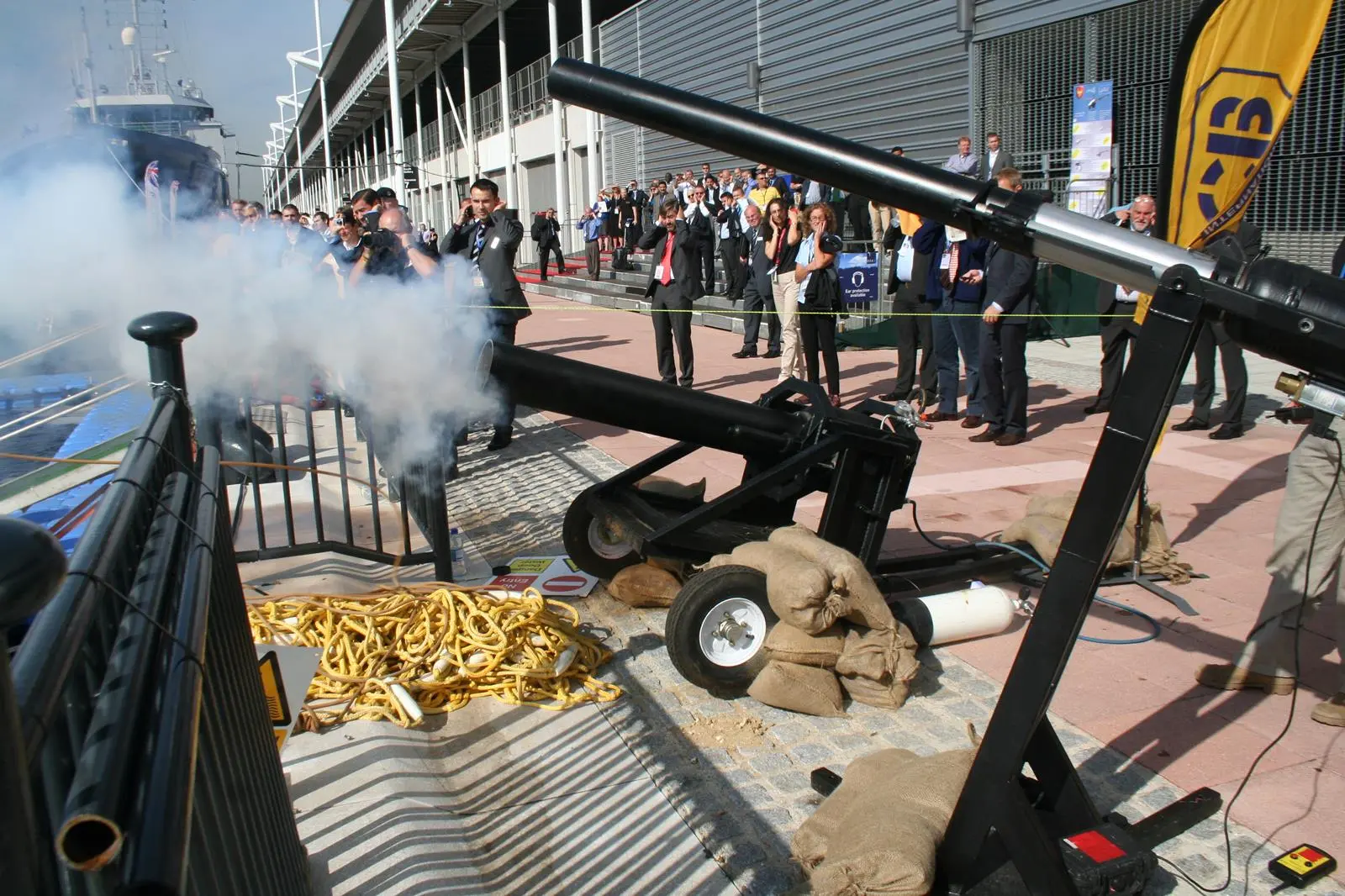
To help shipping companies successfully bridge the deterrence gap between early warning measures and firing bullets, BCB has developed pressurised air launchers which can fire a variety of projectiles at different pressures. This means they can provide a ‘layered’ deterrence system, with the force being escalated in proportion to the threat.
However, James Norwood of Transas explains that despite the differing opinions, “thorough, grounded preparation based on best practice, will at least mean crews have less chance of panicking or getting confused if the worst does come to the worst.”
Transas have developed an anti-piracy module to its NTPRO series of navigation simulators which allows pirate attacks to be simulated against merchantmen. The attacks can be deterred by the bridge team conducting evasive manoeuvres and further the simulations allow for the involvement of armed boarding teams as they have the capability to engage the pirates in skiffs using virtual arms through laser-linked rifles. “This means that not only can you run through rules of engagement but also train deck officers and armed boarding teams to work together,” says Norwood. Further, you can work out what plans have a better chance of keeping everyone safe if you run it through simulations.
Related Articles
 METHANOL
 MONITORING, CONTROL & DIGITALISATION
 MONITORING, CONTROL & DIGITALISATION