



Taking a systematic approach to screening fire risks
With owners ordering ever larger cruise ships to achieve economies of scale, there are an increasing number of vessels under construction and on the drawing board whose design features deviate from some of the more prescriptive aspects of Chapter II-2 of SOLAS. As a result they require a safety assessment of their alternative design arrangements in order to gain approval.
Under SOLAS II-2, for designs that deviate from a particular statutory requirement, IMO sets guidelines for agreeing the alternative design arrangements and these are in two basic parts. The first involves the analysis of the design in qualitative terms, including expert evaluation of the proposed arrangements to assess the safety implications and the rationale for the deviation. The second stage involves quantitative calculations to prove the design performance. Fire screening falls within the first procedure.
To meet the needs of naval architects and ship owners working on large cruise ship designs, Glasgow-based Safety at Sea has developed an improved fire risk screening methodology, as an evolution of an earlier model developed in 2007. This latest screening tool can estimate and assess the risk contribution of every space which may be considered a potential place of fire origin onboard a passenger vessel.
The risk contribution of these spaces is added up to estimate the risk contribution of specific areas of the vessel, or fire zones, in relation to the risk contribution of the vessel as a whole. According to Luis Guarin, director, safety engineering: “The method is particularly useful when undertaking preliminary assessments of alternative designs, as it facilitates the task of making informed choices about casualty scenarios for quantitative and fire engineering analysis.”
When dealing with large fire zones, the results of the screening process can be used to identify specific locations where there are the highest levels of risk, in order to support the definition of particular casualty and design scenarios for the qualitative analysis phase. In addition, the results of the fire screening can be used to identify areas onboard which may require special attention in relation to fire safety, even if they are not subject to alternative design and arrangements.
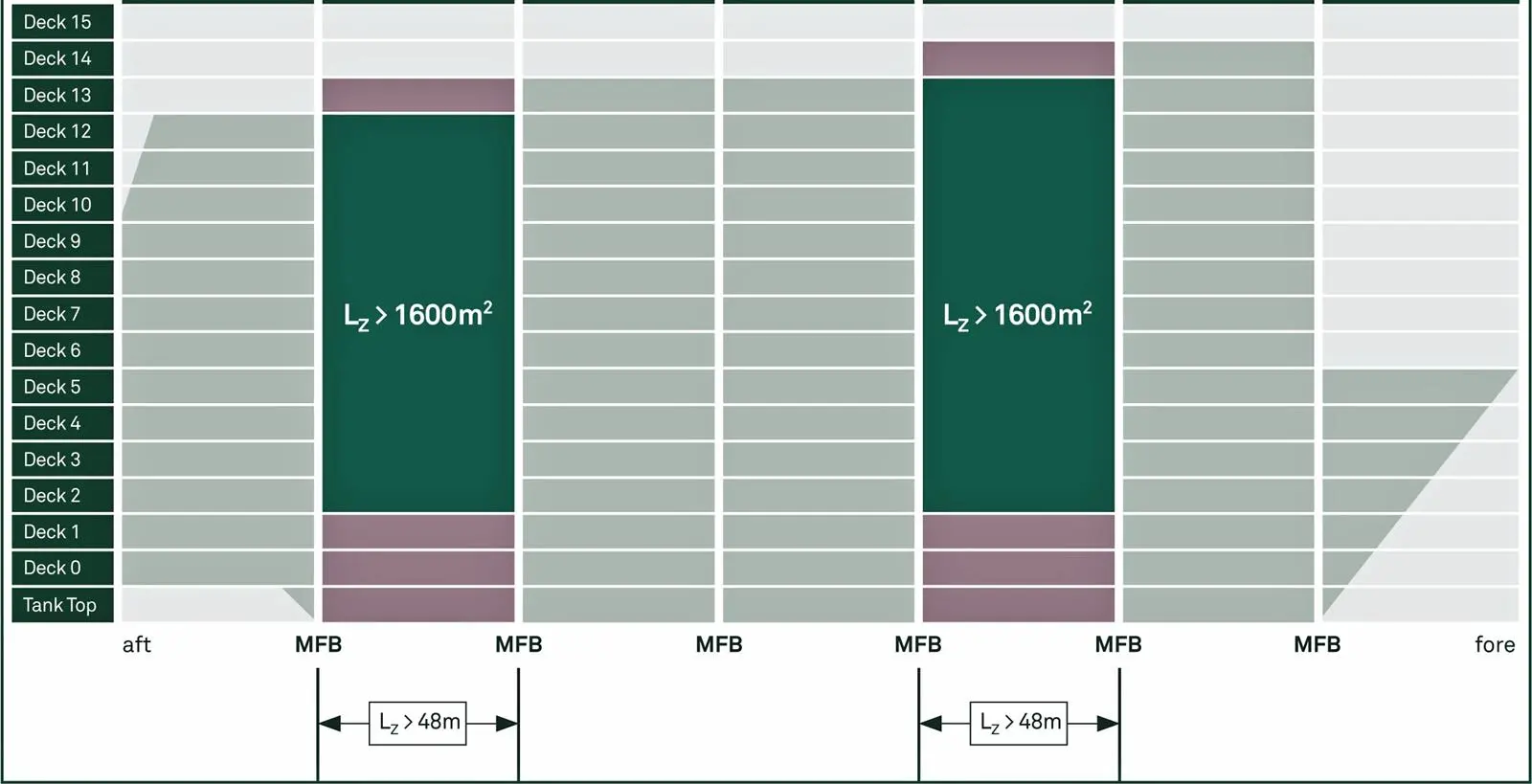
Taking a large cruise ship design as an example, one of the most common ‘triggers’, as far as alternative design arrangements are concerned, is the existence of fire zones larger than 48m in length or 1600m2 in deck area. A hypothetical example is shown in Figure 1, illustrating a representative cruise vessel with two main vertical zones (MVZs) exceeding 48m in length.
In this particular case, out of the possible 31 fire zones deviating from SOLAS requirements, the design team has to identify a number of representative fire scenarios – typically two or three per MVZ – for subsequent quantitative analysis. Safety at Sea believes that its systematic fire risk screening tool can be of assistance in such situations, identifying areas where fire engineering analysis needs to be focused, and moreover doing so much quicker than with other methodologies.
In its earlier fire screening model, Safety at Sea used a ‘first-principles’ approach, based on simplified fire dynamic calculations. Practical difficulties associated with that approach, and the observation that relevant fire protection arrangements influencing all of the various probabilities have a degree of correlation with the space category (CAT) defined in SOLAS Regulation II-2/9, led to the development of a more practical approach.
The new approach draws on available casualty data as a function of the CAT of each space associated with a particular incident/accident. For example in assessing the probability of a first aid failure, Safety at Seas has based its statistical inference on incidents where there was either a failure to detect a fire, a failure to extinguish the fire within five minutes or an emergency response failure. The probability of a fire fighting failure assessment was based on incidents where there was a failure to extinguish the fire within 30 minutes and where boundary cooling was executed, while the probability of containment failure was based on incidents where there was a failure to contain a fire, where the fire was extinguished in 60 minutes of more or where there was a secondary ignition.
According to Guarin: ”Rather than relying on expert judgment and opinions alone, we have developed a method of screening the complete layout of the vessel based empirically on statistical data. This allows for a systematic evaluation of all the fire zones to assess which are most likely to experience fire and which areas are most vulnerable to fire. It also allows the designers to screen a vessel for all risks associated with fire, so they can focus on those areas where the risks are highest.”
The input data used in the screening consists of information for each space onboard a vessel which could be considered a possible fire origin. This included the:
- name of the space;
- location (deck and MVZ);
- number of spaces (if repeated in the same fire zone);
- deck area (in m2) of a single space;
- SOLAS space category (if available, otherwise a preliminary value is automatically assigned); and
- occupancy (if available, otherwise a preliminary occupancy is assumed, based on Chapter 13 of the FSS code, for night and day cases).
Safety at Sea points out that all of the information can be extracted from a general arrangement (GA) plan. For a representative cruise vessel layout, a total of about 4,000 to 5,000 single spaces would typically be included in the screening.
As part of the screening process, Safety at Sea assigns various attributes to each space being evaluated. The space use definitionis selected from a list of categories for which a historical frequency of fire outbreak exists. This data, taken into account in conjunction with the actual size of the space, determines the likely frequency of fire outbreak.
A ranking of fire zones in order of risk can then be undertaken, on the basis of frequency of fire outbreak, frequency of fire escalation and/or risk to human life. Figures 2 and 3 show a summary of outcomes from the screening process. As can be seen, in many cases fire zones not deviating from SOLAS requirements attain a much higher fire risk than those that do.
Certain generic trends have been identified by Safety at Sea as a result of using the screening tool. For a typical cruise vessel layout, the company says the following spaces are the most significant in terms of frequency of fire outbreak:
- large public areas (stairs, lobbies, corridors);
- engine room / machinery spaces;
- galleys;
- passenger cabins;
- laundry / dry cleaning facilities; and
- garbage treatment / incinerator room.
As far as the frequency of fire escalation is concerned, the most significant areas are the engine room / machinery spaces, external deck areas, galleys, large public areas and cabin balconies, while in terms of fire risk, the most significant locations are the engine room / machinery spaces, luggage handling areas, galley, Internal promenades and lifeboat deck areas.
The casualty data used to develop the new screening approach was taken from cruise vessels only, and included more than 600 fire incidents, collected over a period of around four years. Guarin says: “Using the new fire screening method, we are able to harness casualty and fire incident data and use statistical tools to quantify the different profiles that are involved. The process is faster and can evaluate large areas quickly. Moreover if the design is changed, calculations can be redone relatively easily.”
To date the Safety at Sea fire screening process has been used during the design of Oasis of the Seas, the largest cruise ship afloat. In addition it has been employed on two newbuilding projects; one a cruise ship that is now under construction and another which is at the planning stage. Both of these vessels have large floor spaces, and large fire zones, and so required alternative design arrangements.
The fire risk screening framework developed by Safety at Sea can be used not just at the early design development stages of a newbuilding, but also for existing ships. In the latter case the screening model can be enhanced by drawing on operational experience, and used to assess and monitor risk on a continuous basis, in order to support a company’s risk management strategy.
The screening process, if applied to a number of vessels, can be used to benchmark the fire risk across a fleet. In this way design elements and trends that lead to changes in the risk profile can be identified and fed back into the design process.
The same principles can be applied to cargo ships; Safety at Sea has completed a fire risk screening study for a leading bulk carrier operator. Guarin says:”We had to enhance the screening process to accommodate the fact that the availability of historical data is very limited. This was done by a more explicit link between safety objectives, functional requirements and specific SOLAS requirements and performance criteria. In this way we used the fire screening process, to assess the risk associated with old ships and help the operator decide if upgrades to meet current rules retrospectively are necessary.”
Safety at Sea is actively examining the scope for applying its fire screening approach to other ship types.
Related Articles
 METHANOL
 MONITORING, CONTROL & DIGITALISATION
 MONITORING, CONTROL & DIGITALISATION