



More gas engine options come to the market
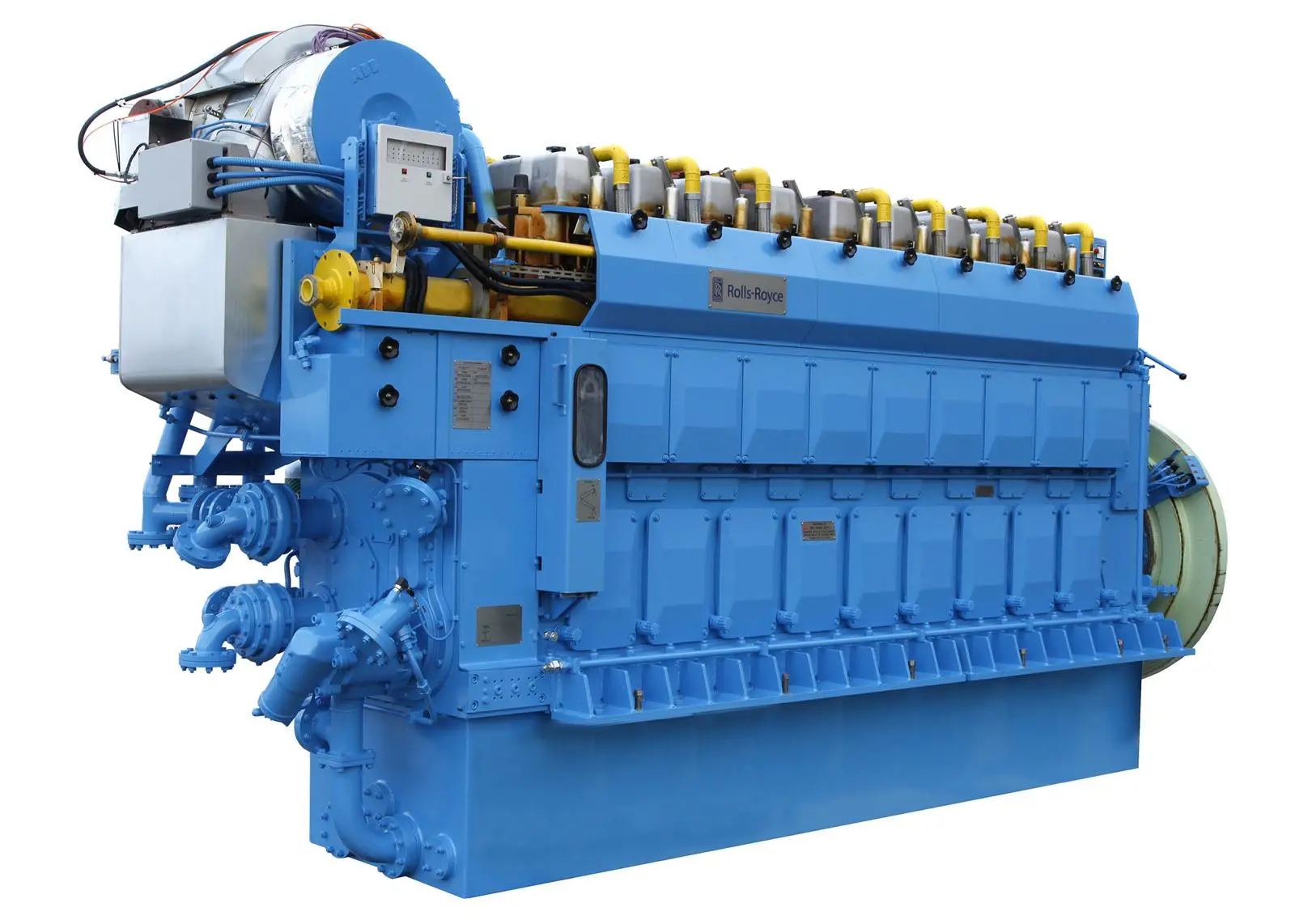
Lean-burn medium-speed gas engine technology is central to a visionary project for a new breed of shortsea cargo vessel. Each of two 5,000dwt multipurpose carriers ordered in Japan by the Norwegian transport company Nor Lines will be powered by a single, natural gas-fuelled B35:40L9P engine from the Bergen stable of Rolls-Royce.
Through its use of a nine-cylinder unit, the project introduces the B35:40 gas engine in its in-line configuration, complementing the existing vee-form models and the smaller C26:33 in-line range.
The Rolls-Royce gas engine portfolio as a whole covers unit power requirements from 1,400 to 9,000kW, in generator and mechanical propulsion drive applications. Within that coverage, the development of the six-, eight- and nine-cylinder versions of the 350mm-bore, medium-speed design provides new options in the 2,400-4,000kW band.
The B35:40L9P installation nominated for each of the versatile new freight ships contracted by Nor Lines has a rated output of 3,940kW at 750rpm. The vessels will be constructed by Tsuji Heavy Industries to a design conceived by Rolls-Royce to meet the exacting environmental requirements for operation in emission control areas (ECAs). Since the ships will serve ports along the Norwegian west coast, exhaust emission levels are of prime importance.
While the Bergen B32:40 and C25:33 diesel engines with Clean Design notation comfortably meet IMO Tier II emissions criteria without necessitating additional exhaust cleaning measures, the B35:40 and C26:33 gas engine derivatives achieve a NOx emission level lower than that prescribed under the future Tier III edict. Furthermore, the new-generation gas engines emit around 17% less greenhouse gas per unit of power produced than a comparable diesel engine, with a claimed 92% reduction in NOx and negligible SOx and soot.
Thus the installation specified for each of Nor Lines’ newbuilds will ensure compliance with IMO Tier III requirements, and provide for efficient deployment under Norway’s own very strict regime relating to emissions from ships trading along its shores.
A key operational merit of the Bergen gas engine range, the ability of the prime mover to drive a controllable pitch propeller mechanically, is fully utilised in the Nor Lines project. Conducive to operation at variable load and speed, the engine maintains a high thermal efficiency down to low part-loads, such that both engine and propeller can be run at their design conditions for maximum efficiency.
A lean-burn prime mover is being combined with Rolls-Royce’s innovative, hybrid shaft generator (HSG) system in the two ships. Although each vessel will be fitted with two gensets based on diesel engines, the HSG installation should minimise use of these auxiliaries. The HSG enables electrical power for the ship’s service net to be produced even when engine speed has been reduced, such that engine speed and propeller pitch can be optimised to prevailing operation conditions.
The flat consumption curve on low load in combination with the HSG means that it should be possible to achieve a full gas fuel solution in most circumstances without recourse to the auxiliary engines, even in harbour mode.
The Hordvikneset factory at Bergen is a pioneer in the development of lean-burn gas engine technology, applied to several hundred engines, albeit predominantly in land-based applications. The intensification of environmental controls on shipping, with its particular implications for coastal and intra-regional vessels, has spurred considerable new interest in gas-fuelled machinery.
Rolls-Royce’s unerring commitment to research and development has both broadened its product offering in the lean-burn category and enhanced the performance levels of such machinery with regard to both emissions and efficiency. These endeavours have helped cultivate greater receptivity to gas engine solutions in the marine market.
For example, by giving particular attention to the issue of methane slip in the C-series gas engine development project, the Norwegian technicians addressed an area which has long been seen as a disadvantage of natural gas-fuelled machinery. The C26:33 is seen as the successor to the K-series gas engine, which has proved successful in land and marine applications through four generations before reaching its developmental limit.
Norway’s progressive expansion of the coastal LNG bunker supply infrastructure has provided the vital complement to the company’s latest engineering advances and helped nurture owners’ and charterers’ growing interest and investment in gas-fuelled vessels.
While expanding its offering in the marine market for gas medium-speed diesel and gas engines, it appears that Rolls-Royce is not planning to develop a dual-fuel engine.
HYUNDAI TO ROLL-OUT DUAL-FUEL PROGRAMME
In a concerted drive to broaden the market reach of its home-grown, HiMSEN four-stroke brand, Hyundai Heavy Industries’ Engine & Machinery Division (HHI-EMD) plans to introduce three dual-fuel (DF) medium-speed engine series over the next few years.
The initial offering will be the H35DF, which is due for first delivery in 2013, to be followed by the smaller H26DF and H21DF designs within the subsequent two years.
As the latest expression of HHI’s sustained, vigorous investment in engine technology, the HiMSEN H35DF type will meet IMO Tier III criteria governing NOx emissions when operating on gas, and will be IMO Tier II-compliant in diesel mode.
The engine is to be produced in six to nine-cylinder in-line models and 12- to 20-cylinder vee configurations. With an output of 480kW per cylinder at a running speed of 720rpm, the H35DF will thereby span the power band from 2,880kW to 9,600kW at maximum continuous rating. The unit power yield corresponds to that of the H35/40G gas engine series, and is just under the 500kW/cyl obtainable from the original H32/40 diesel.
The DF engine uses micro-pilot injection, with no more than 1% diesel fuel, for ignition. In gas mode, with 99% gas fuel, the consumption rate is expected to be 7,740kJ/kWh.
Development work on the H35DF was implemented in January 2011, and type approval testing is provisionally foreseen for May 2012. Marketing would start shortly thereafter, with a view to delivering the first production engine in May 2013. The next design in the dual-fuel programme is the H26DF, on which development is to begin in July 2012, with the target of having the first engine ready for installation by the end of 2014. It is anticipated that work on a third design, the H21DF, will be set in train in January 2013, with a target of shipments from mid 2015 onwards.
The H26DF perpetuates a lineage that began with the H25/33 medium-speed diesel and continued with the new vee-type version, on which the nascent H26/33GV gas engine is modelled. In the case of the envisaged H21DF, the design will draw on the form of the H21/32 diesel, which signalled the market entry of the HiMSEN brand in 2001.
JAPANESE MAKERS REVITALISE PRODUCT RANGE
Engine building remains elemental to Japan’s maritime industrial infrastructure, continuing to ensure a level of machinery sourcing potential that helps confer national self-reliance, competitiveness and critical mass in ship construction and the allied sectors.
In addition to the country’s prolific output of low-speed, two-stroke propulsion machinery, undertaken largely on a licensee basis but also as an OEM in the case of Mitsubishi Heavy Industries, many of the indigenous designs are four-stroke engines of relatively slow crankshaft speeds. While this later, characteristically Japanese sector is the subject of continuing model refinement, specialists in four-stroke, medium-speed plant are also rolling-out a number of new developments.
Reliability, durability and low maintenance costs have always been watchwords for Niigata Power Systems in diesel engine design and manufacturing, driven by the specific needs of the fishing vessel, tug, offshore, and coastal shipping sectors. The Japanese company’s 2011 production programme included the first deliveries of its next-generation of medium-speed engines, the AHX series.
Following the initial shipments of the 280mm-bore 28AHX design, the company recently unveiled the 165mm-bore 17AHX type. The AHX family will be progressively expanded, providing an efficient platform for IMO Tier II compliance and a basis for hosting future measures to meet Tier III criteria.
Available in both propulsion and genset drive versions in five-, six-, seven-, eight- and nine-cylinder configurations at running speeds of 900, 1,000 and 1,200rpm, the 17AHX can ingest fuel oil up to 700cSt viscosity. At 900rpm, the engine delivers 100kW per cylinder, while the 1,200rpm variant has a top rating of 125kW/cyl, such that the largest model for propulsion applications, the 9MG17AHX, has a maximum output of 1,125kW.
The production programme for the 28AHX type embraces six-, eight- and nine-cylinder engines covering an output range of 2,070-3,300kW at a maximum speed of 800rpm. The company claims that the engine-internal emission reduction methods adopted have resulted in 30% less NOx in relation to ‘conventional’ engines, plus a 2% improvement in fuel efficiency at rated output and more at lower load.
The 28AHX has been conceived with close reference to the needs of coastal ships and special-duty vessels, and not least those specified with Niigata Z-peller azimuth thrusters. The engine’s improved low load and transient performance is salient to such applications. The first two 6MG28AHX-designated production engines were shipped in 2011 to the Nagasaki yard of Watanabe Shipbuilding, for installation in two 699gt coastal passenger/cargo vessels.
Niigata’s R&D technicians are investigating various measures and ancillary components, including catalytic reactors, as a means of enabling the AHX series to fulfil Tier III limits on NOx.
Daihatsu’s offering has been augmented by new 185mm- and 230mm-bore, six-cylinder designs for both marine genset and propulsion applications, reckoned to give fuel savings in the order of 3-5% relative to the previous generation, plus reduced NOx emissions ensuring IMO Type II compatibility.
The smaller of the two series comprises the 6DE-18 auxiliary and 6DEM-18 main engine. As a genset drive, the type is available at 720rpm and 900rpm running speeds, covering an output range from 360 to 808kW, while the 6DEM-18 propulsion engine can be supplied in either 750rpm or 900rpm version, for a maximum output of 850kW.
The 6DE-23 auxiliary and 6DEM-23 main engine have been similarly prepared for the various running speeds, giving respective maximum ratings of 1,425kW as a genset aggregate and 1,500kW as a propulsion drive. Generator engine specifications have been carefully considered in relation to bulk carriers and Aframax tankers in the case of the 6DE-18 and as to VLCCs, smaller types of containership and vehicle carriers as regards the 6DE-23.
Yanmar has also enlarged its portfolio of medium-speed marine diesels through the introduction of the 6EY22 series for genset applications. In addition to improved fuel efficiency in conjunction with IMO Tier II emissions performance, the design is notable for its circa 10% weight reduction and 17% lessened installation space requirement relative to preceding types. It employs the ASSIGN combustion system originated by Yanmar.
In its 6EY22LW format, the new auxiliary provides a rated power in the 660-1,080kW range at 720rpm, equating to generator capacity of 600-1,020kWe. The faster-running 6EY22ALW version spans a power band of 880-1,370kW at 900rpm, for generator ratings of 800-1,300kW.
HOME-GROWN DESIGN TIPPED FOR VOLUME PRODUCTION
While new, respective joint ventures by Chinese enterprises with Wärtsilä and Caterpillar are set to augment the medium-speed diesel dimension to China’s growing production of marine engines, capabilities are also to be strengthened by a home-grown design.
Under development by Shanghai Marine Diesel Research Institute (SMDERI), the nascent 210mm-bore type promises some 220kW per cylinder. Suitable for operation on both heavy fuels and distillate, the CS21 four-stroke, medium-speed engine is to be released as an in-line series in six-, eight- and nine-cylinder configurations, covering the power band up to approximately 2,000kW.
The design employs an electronically-controlled, common rail fuel injection system, and marries advanced technology and compact dimensions with production-friendly features. It uses the Miller cycle to achieve the requisite combination of low NOx emissions and competitive fuel consumption.
A test programme on a six-cylinder engine equipped with an ABB turbocharger has been implemented at SMDERI’s Shanghai complex. SMDERI is part of the China Shipbuilding Industry Corporation (CSIC), one of the two largest shipbuilding conglomerates in China. The CS21 will form part of the portfolio of CSIC Diesel Power Co.
Target markets for the new design include China’s considerable fleets of coastal ships and inland waterway vessels, and also fishing vessels. It is anticipated that the CS21 will in time be volume produced, and will form the basis for future product development, including larger-bore engines and a dual-fuel version.
Related Articles
 PROPULSION
 GENERAL NEWS
 GENERAL NEWS