



European hybrid tugs are coming to fruition
After several years of consideration and planning many port operators are now putting in place targets for reductions in exhaust gases and other harmful pollutants. Those measures encompass shore-side equipment, visiting shipping, floating plant and tugs. Tug owners, designers and specialist shipbuilders have carefully researched a wide variety of alternative propulsion systems, ranging from entirely new ‘hybrid’ concepts to the use of altenative fuels. For several towage organisations decisions have been made, and for economic reasons a cautious approach is being taken to the introduction of new ‘green’ tonnage.
Caution has been necessary due to the costs involved and who will pay for significantly more expensive tugs in highly competitive sectors such as shiphandling. There is, however, evidence that some clients will force the pace of change by specifying environmentally-friendly equipment to service particular contracts.
Prior to making decisions on radical new propulsion systems, tug owners have needed to study in detail the operating profile of the tugs in their respective fleets. Most tugs in the shiphandling sector use maximum bollard pull for only a very small percentage of their operational cycle. When accurate fuel monitoring and recording systems are used it becomes obvious that substantial savings can be made by applying fuel-saving measures, and by using shore power when the tug is alongside. The arithmetic is obvious: less fuel equals lower costs and lower emissions. With that as a starting point, other measures can be incorporated to lower emissions further. After expending a great deal of time and expense on research, new vessels and new orders are coming to fruition.
EUROPE’S FIRST TRUE ‘HYBRID’ TUG
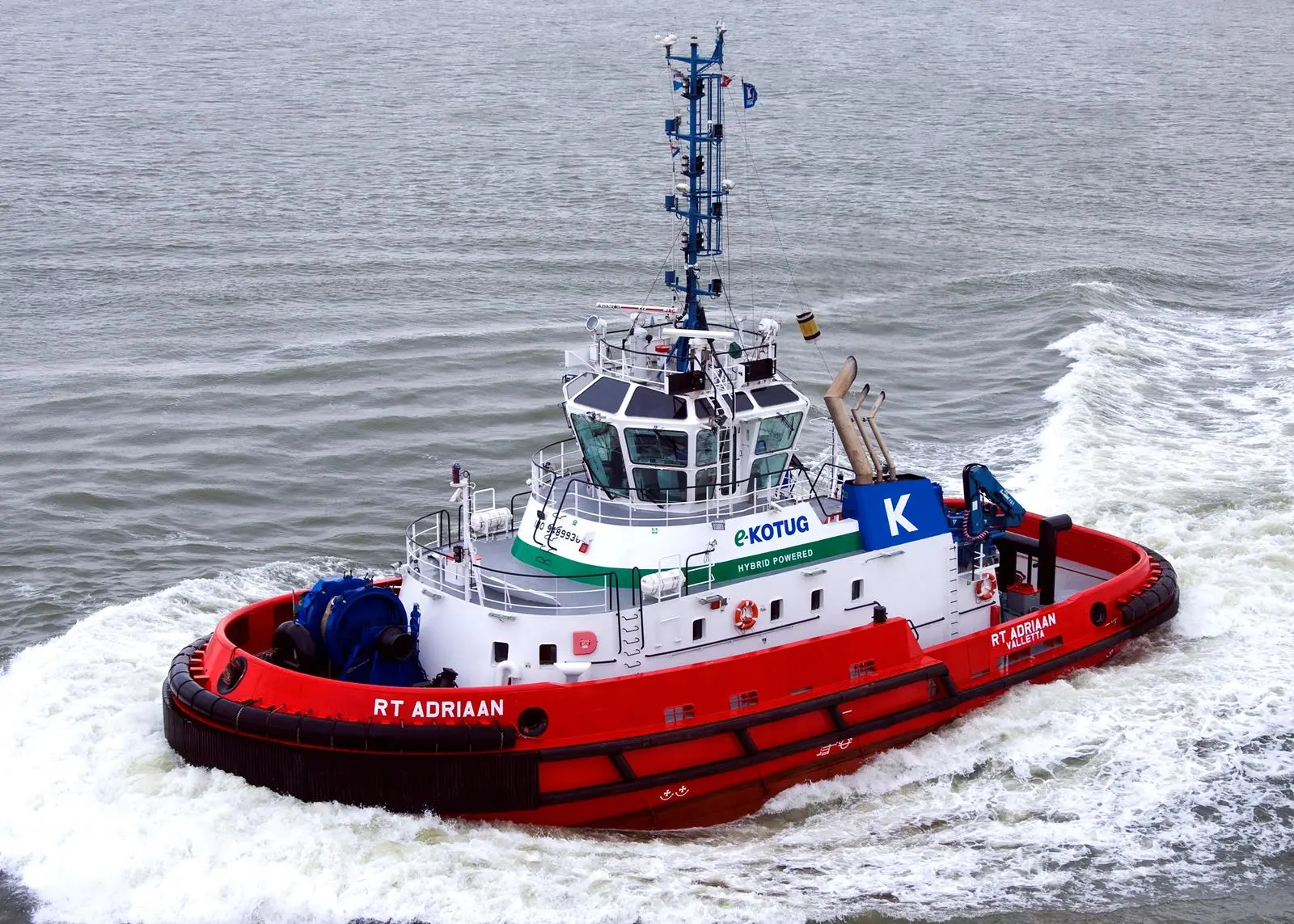
In March of this year RT Adriaan, Europe’s first hybrid shiphandling tug, entered service with the Kotug fleet in Rotterdam. Known as the ‘E-Kotug’ the vessel is the result of a carefully planned conversion of a recent new addition to the company’s fleet, completed in 2010 to one of the latest ‘Rotor Tug’ designs. The 32m tug is powered by the Rotor Tug’s unique triple-unit propulsion system, comprising three main engines producing a total of 6,884bhp to give a maximum bollard pull of 85 tonnes towing ahead, astern or sideways.
RT Adriaan was converted into a fully functioning hybrid tug in a little over three months. The tug was withdrawn from service in the Port of Rotterdam and entered the Padmos shipyard at Stellendam in the Netherlands to be retrofitted with a XeroPoint hybrid propulsion system designed by Aspin Kemp & Associates (AKA) of Canada. Prior to the conversion to its own vessel, Kotug was inspired and encouraged by the first two hybrid tugs, which are operated by Foss Maritime of California, which have similar AKA power management systems.
The conversion process included installing electric motor-generators in the driveline of each of the triple propulsion systems. A lithium polymer battery pack was installed in the, tug along with the hybrid power management switchboard, and connections were made to the existing auxiliary generators. The batteries, supplied by Canadian specialist Corvus Energy, are claimed to have 10 times the capacity and lifespan of conventional lead acid batteries. The process of optimising the power management system, to ensure that the vessel operates efficiently in each of its hybrid modes, is essential.
Commenting on the tug’s initial performance, Daan Merkelbach, Kotug International’s manager of nautical and QHSE said: “We are happy with the first results of the ‘E-Kotug’ after its conversion into a hybrid rotor tug. In partnership with AKA Canada, supplier of the Xeropoint hybrid propulsion system, an extremely environmentally friendly and fuel-saving tugboat was developed. Retrofitting an almost new rotor tug with this system has ensured that the electric motors and diesel engines, generators and environmentally friendly batteries will be controlled efficiently. Kotug believes that the hybrid option is the best solution for harbour tugs, due to its highly variable duty cycle.”
In a conventional diesel powered tug the main engines and the diesel driven auxiliary generators are rarely operating in their most efficient mode, which is heavily loaded. Studies have shown that during harbour towage, 100% of full load (maximum bollard pull) on the main engines is used for only 2% of their operating life, leading to very poor fuel consumption and excessive exhaust emissions. Much the same can be said for the auxiliaries, that spend much of their time idling or lightly loaded.
Aboard the E-Kotug RT Adriaan the situation is quite different; at low speeds travelling between jobs (about 4.5 knots), while maintaining station, or on standby duties the batteries permit the vessel to be operated in noiseless zero emissions mode, with no generators running. As the speed or load is increased, one or both auxiliary generators come on line running at their most efficient loading. Any surplus current is used for battery charging. The main engines will start only when demands are made for high bollard pull situations. Hybrid technology allows engines to be shut down at sea. Fast switching from hybrid modes with electric motors to conventional modes with diesel engines is possible. For low power operations the E-Kotug is fully operable on battery power alone.
In the RT Adriaan and the two Foss hybrids the Xeropoint power management system is the key to their success. It automatically provides the power necessary to perform all of the tug’s normal functions, utilising the batteries, auxiliary generators and main engines as required in a stepless manner, requiring little or no additional effort from the tugmaster.
In this particular case the vessel can always revert to operation as a conventional rotor tug if necessary. The system design increases redundancy and reliability.
Emissions of CO2, NOx, PM and soot are reduced. With hybrid technology, engines run at or near their best efficiency and only when needed. Lower fuel consumption and cleaner combustion contribute to a claimed 50% reduction in harmful emissions.
Fuel economy has improved: The rotor tug’s main engines are designed for a high output. Because hybrid technology shares the propulsion load between diesel and electrical sources there is no unnecessary idling.
Savings on maintenance: Hybrid technology means minimised engine use and more time between engine overhauls and oil and filter changes.
Kotug says it has built its reputation as an innovative International maritime service provider on its many years of experience. The company and its employees have an active ‘Go Green’ policy. The most visible examples of its green commitment are shutting down the ship’s machinery and relying on shore-side power in the port, the use of LED lighting on board, and a green passport for supplies, washable filters, sulphur free bunker fuels. By encouraging an active fuel saving scheme among tug crews Kotug won a ‘fuel save award for Dutch inland shipping’.
‘SVITZER GAIA’ MAKES AN APPEARANCE
Also making its first appearance earlier this year was the Svitzer Gaia, the first of two prototype hybrid shiphandling tugs built for Svitzer, part of the Danish AP Møller–Maersk Group. As one of the world’s largest providers of towage and marine services Svitzer has a global fleet of well over 500 vessels. When Svitzer first announced their intention to construct its first eco-tugs the company made it clear that the new environmentally friendly vessels were part of its ongoing environmental plan to reduce the company’s environmental footprint. As part of that plan, the organisation had already set a CO2 reduction target of 1% each year through the years 2008-2012. To achieve that, Svitzer’s environmental plan focuses on three elements: a fuel efficiency program, the use of alternative fuels and this new tug design.
Svitzer has worked with its subcontractors for two years to develop the new eco-tug design. The two new vessels are being built in the Baltija Shipyard in Lithuania to a design based on the well established Svitzer ‘M’ class of 30m ASD shiphandling tug. The second tug was scheduled for delivery in March. Designated the S65/32 (ECO), this new variant is approximately one frame longer at 31.5m overall, with a breadth (moulded) of 11m and draught of 3.9/4.5m. The vessel has a design speed of 12.5 knots and a maximum bollard pull of at least 65 tonnes.
The Svitzer Gaia has a diesel-electric propulsion system with a maximum power rating of 4,800kW. Three individual Wärtsilä diesel-electric generators provide electrical power to a pair of Schottel fully azimuthing propulsion units. Siemens is responsible for the electrical systems, including power management.
Long-term collaboration with Wartsila in product design resulted in Svitzer ordering the ECOTUG propulsion solution from Wartsila. At the heart of this diesel-electric propulsion system are three 8-cylinder in-line Wartsila 20 generating sets, equipped with Wartsila NOR (nitrogen oxide reducer) installations, provide the vessels with electrical power. The Wärtsilä NOR units are selective catalytic reduction (SCR) converters which already meet the demands of the future IMO Tier III regulations as regards NOx reductions. The NOR equipment is located in the engine room resulting in the unmistakable positioning of all three silencers above the exhaust stacks. Space in the engine room is at a premium, even with the added length of the vessel compared with the original ‘M’ class.
The Schottel propulsion units are purpose-designed Combi Drive SCD 1515 units incorporating a single fixed pitch propeller and matching nozzle. This version of the combi drive lends itself particularly to situations where static thrust and part-load operation are required. Each of the SCD units has an input power of 2,100kW at a speed of 700rpm. A frequency-controlled electric motor is mounted vertically in the support tube of the azimuthing unit, which means that the combi drive has just one reduction stage, resulting in increased mechanical efficiency. The result is a powerful, compact, azimuthing thruster that eliminates the need for an ‘above-water’ gearbox, drive shafting or separate motor mounting, and is easy to install.
The new eco-tug is also equipped with a Schottel type STT 110 transverse bow thruster with fixed-pitch propellers and powered by an electric motor. In this particular thruster, propeller direction can reversed to control thrust direction without the need for an additional reversing gearbox. The input power is 190kW at a speed of 470rpm.
The towing winches installed are electrically driven and supplied by the same integrated power supply as the propulsion system and bow thruster. Electrically powered winches have the additional advantage of reducing noise and eliminating the need for a hydraulic system and any possibility of oil leakage.
Svitzer Gaia will have only one diesel generator running when cruising or lying idle in a port but as additional demands are made for power during shiphandling operations one or two additional generators will be started automatically.
At the time of writing Svitzer’s first new eco-tug was undergoing commissioning and trials in the Danish port of Fredricia. No results of those trials have yet been announced but it is expected that a 10% reduction in fuel consumption and a reduction in NOx emissions of 70% to 80% will be achieved, thus meeting the IMO Tier III requirements that come into force in 2016.
When the two eco-tugs were ordered, Svitzer CEO at the time Jesper T Lok said: “The tugs cost around 50% more to build than regular tugs but Svitzer believes it will be a worthwhile investment. The technological solution is now acceptable but we intend to keep developing the technology and we will hopefully also reach a more cost friendly solution. Even though the eco-tug is more expensive we believe it will be a success and that ‘going green’ makes good business sense. We expect that especially terminal towage tenders increasingly will insist on environmentally friendly solutions and that it will emerge as a demand also from several port authorities. We ventured into unknown territory with this project. We have had to invent the technology ourselves, but our cooperation with tried and tested suppliers has been very fruitful. More eco-tugs will be joining the Svitzer fleet as part of its fleet renewal”.
A more recent statement from Svitzer announced that a 20 year contract has been signed by Chevron Australia and Svitzer Australia for the provision of marine services required for the Gorgon Project LNG terminal at Barrow Island, Western Australia. Included in the contract is a requirement for four 33m, 80 tonnes bollard pull ‘hybrid’ tugs built specifically for the Gorgon Project, which operates on a Class A nature reserve. The tugs will be constructed to the Svitzer S80/33 (LNG) design but with diesel-electric-battery propulsion systems and other ‘green’ features including; solar panels for water heating; double skin fuel tanks: a water recycling plant; low-spilling sodium deck lights and low-sheen paint to reduce water reflection.
TWO ‘GREEN’ DAMEN TUGS FOR ISKES
The latest European order for true hybrid tugs has been awarded by Iskes Towage & Salvage of Ijmuiden to Damen Shipyards, Hardinxveld in an unusual contract between Iskes, Offshore Ship Designers (OSD) and Damen, signed in November 2011. Damen has been entrusted with the construction of two vessels to a new ‘green tug’ ASD 3212 design produced by Iskes and OSD.
Iskes Towage & Salvage has strived to reduce CO2, SOx and NOx particles since 2009, with the ultimate goal of achieving zero emissions. Triggered by the ports of Rotterdam and Amsterdam commitment to the world ports climate initiative, Iskes teamed up with OSD to develop a tug capable of reducing emissions by 30%. Other stakeholders include the Dutch research centre Marin and tug operator Smit.
At the time of signing the ‘Green Tug’ project was in the final detailed design stage, in close cooperation with Damen Shipyards Hardinxveld and Damen Research, especially with regard to propulsion and bollard pull. The tugs are scheduled for delivery by mid 2013.
Damen Hardinxveld MD Jos van Woerkum said: “The ‘green tug’ has several similarities with our Damen E3 project that aims for environmentally friendly, economically viable, and efficiently operating ships”. This is the first time Damen has undertaken the construction of vessels that have not been designed in-house. However, the Damen ASD 3212 design neatly fits within the OSD-Iskes Azistern 3270 concept.
The ‘green tug’ will have diesel-electric-battery propulsion, incorporating electrically powered azimuthing propulsion units, bow thruster and winch. In keeping with other hybrid propulsion concepts described earlier, the power management system will be designed to use the minimum power possible, whilst ensuring that the tug master always gets the response he needs, regardless of whether the power comes from batteries or from one or more diesel engines.
The vessels will have a bollard pull of 70 tonnes and will be equipped with a double drum winch with independently controlled drums. This enables two towlines to be deployed at the same time and controlled independently – a very practical method when manoeuvring in confined spaces.
Related Articles
 PROPULSION
 GENERAL NEWS
 GENERAL NEWS