



Engine service organisation reports difficult cases
The global service organisation of MAN Diesel & Turbo – known as MAN PrimeServ – has now grown to 74 hubs. In the last two years eight new service centres have been added, in locations like South and Central America, Western Africa, the Middle East, China, and in Northern Russia. The Motorship visited the PrimeServ hub in Hamburg, MAN Diesel & Turbo’s biggest such centre. The Hamburg facility covers a total area of 25,000m2, including a workshop of 10,000m² in size and a quay 173m long. It has a workforce of 276, and in the last year recorded sales worth €76.1million.
“If you see a containership on the River Elbe, there is a 75% probability that there is a MAN engine on it. We need a big service network. In every big harbour we want to offer PrimeServ,” Dr. Tilmann Greiner, senior vice president, who heads the unit in Hamburg, said about the reason for the many new hubs set up lately. He presented a selection of interesting recent repair cases.
CRANK REPLACEMENT DURING VOYAGE
The first case involved the replacement of an engine crankshaft during the voyage.
“If a crankshaft becomes defective, there is a huge problem for the ship, and we are the specialists for repairing these,” Mr Greiner pointed out. “We can do it not only in a drydock or at our quay, we can do it also during the voyage.”
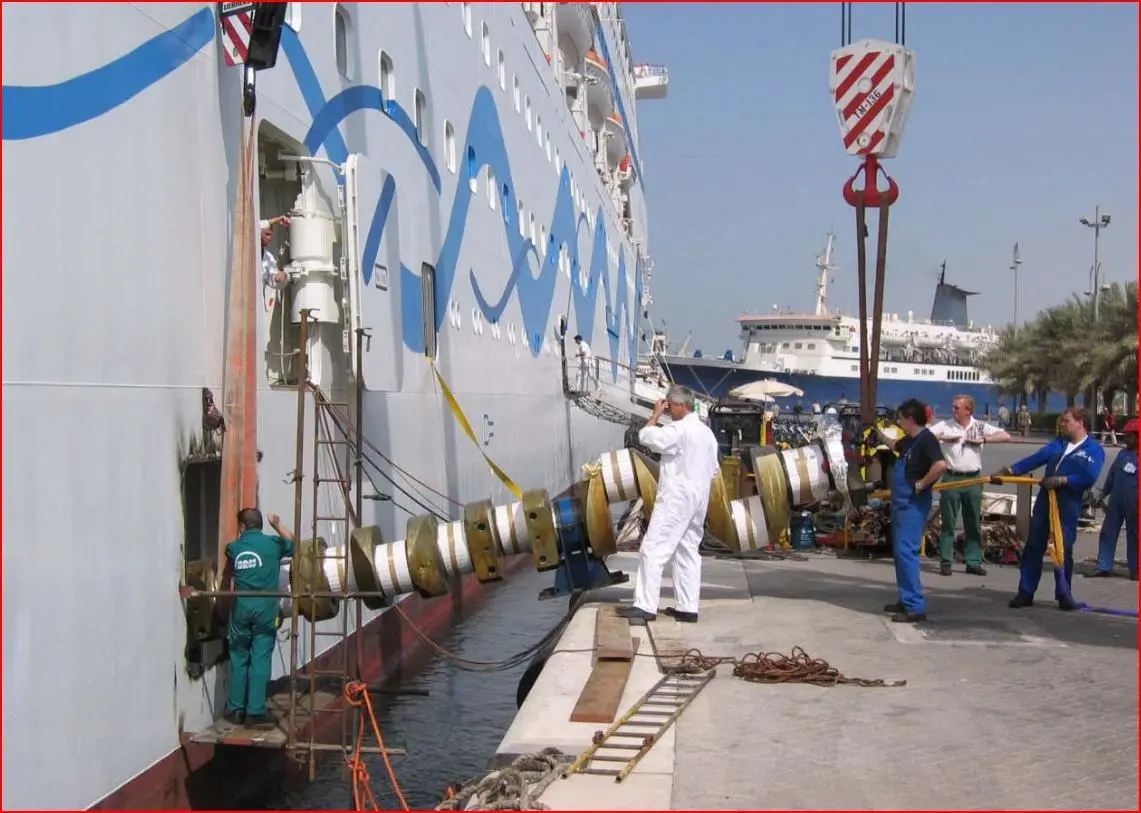
A few years back PrimeServ in Hamburg sent a new crankshaft to Dubai by airfreight, for one of Aida Cruises’ vessels. The crankshaft of one of the four MAN medium speed engines was defective and needed to be replaced. A hole was cut in the hull and the new crankshaft was taken onboard. The engine block was raised using hydraulic jackets placed in supporting blocks while the block was raised. The unserviceable crankshaft was taken out and cut into smaller pieces for easier transportation, and the new crankshaft was installed. The whole replacement process was done while the cruise ship was in operation, aiming towards and cruising through the Mediterranean Sea. The ‘sea trials’ were carried out in the waters of Tenerife. The crankshaft had been in operation for some five or six years; a bearing failure had severely damaged a crank pin, but the cruise itinerary could be continued as planned.
REPLACEMENT OF MAJOR ENGINE PARTS
In the second case, the engine frame, crankshaft and other major itemswere replaced on a ship in the Bahama Islands
Mr Greiner explained:”We had a problem, also on a cruise vessel, where the engine was totally defunct, not only the crankshaft. It was also the frame, the casing, the cylinder block, everything. We could have used a new engine, but there was none available at that time, so we built up a new engine.”
A new cylinder block was cast in Augsburg. It is only possible, by the way, to carry out this work at around 3am because melting this amount of iron causes a considerable power drain from the city’s main grid. After a cooling period of more than two weeks, the casting was machined. The trunk engine, weighing 120 tonnes, was transported to Grand Bahama Shipyard, and installed onboard the drydocked cruise ship. The work from casting to completion of the engine installation took only six weeks, for MAN Primeserv, which the company says was a record.
EXHAUST REPAIRS FOR SOLAS COMPLIANCE
The third case involved modernisation and refit of the main engine exhaust insulation lagging in order to comply with the IMO SOLAS (safety of life at sea ) regulations. Mr Greiner said that once again a cruise ship was involved, this time it was P&O Cruises Oriana, in dock for refurbishment at Blohm & Voss in Hamburg, in December 2011.
The worn out insulation lagging of the engine exhausts was removed. A completely new manifold was constructed by PrimeServ Hamburg, and was installed “making the engines look like new and to ensure safety,” according to Mr Greiner.”The insulation was then thermo scan photographed to verify that there were no hot spots that might cause fire by oil or fuel accidently spraying on to the exhaust gas manifold. We did very good work, and will now repair all these big cruise ships with this insulation.”
UNIQUE CRANKSHAFT REPAIR METHOD
In the fourth case, MAN PrimeServ employed a repair method that it claims is unique to the company, with no other service company able to carry out this work. Mr Greiner says that this applies to large two-stroke engines, the crankshafts for which are built up from individual components, with shrink-fitted webs, journals and flanges. The smaller four-stroke crankshafts are forged in one piece. If a two-stroke engine stops suddenly, it is possible for the shrink fitting to slip.
“Normally one would need a new crankshaft, with a production time of one year and a delivery time of another two months. The vessel would be out of service for a year and a half,” says Mr Greiner. “We have developed a repair method, which only we can do until now, which we can do in four weeks.”
The repair itself only takes one or two days. Liquid nitrogen is lifted onboard in a container, along with tanks of oxygen and propane gas. PrimeServ cools down the inner pin, the journal of the crankshaft to -150° C, using the nitrogen. The web is heated with propane and oxygen, to +150° C. Using a hydraulic jack to pushing the piston while supporting the adjacent piston with another jack, the web is lined up with the pin.
“We have only five minutes to do this, and this is where our skill comes in,” Mr Greiner says about one particular repair case. “This saved 14 months of repair time for the shipowner. At that time the charter rates were sky high, and we could invoice every amount, as the savings were incredible. For 12 or 14 years, to our knowledge, we have been the only company doing this type of repair. There were some former Sulzer people who tried it, but if you do not have the skills, you can really damage the engine.”
Mr Greiner believes that worldwide there are maybe ten cases per year, which would not provide sufficient volume for another provider. It is also necessary to have backup from an engineering department, in order to establish such things as the correct temperature to heat up the parts. “I have to admit that this is one of the last repair methods where we are only ourselves without a competitor,” Mr Greiner concludes.
Related Articles
 PROPULSION
 GENERAL NEWS
 GENERAL NEWS