



New propulsor designs target speed and manoeuvrability
Research is underway by Philip Rolla, founder of Rolla Propellers, into the development of improved propeller blade geometry for surface piercing propellers. Rolla Propellers is now part of the Twin Disc group which supplies both submerged propellers and the surface piercing designs in which Mr Rolla has specialised. His blade development improves the distribution of pressure and control to wetted and ventilated regions of the blade via a positive step between the one-fifth and four-fifths chord length of the blade. This creates a high pressure peak or zone in what is now a low pressure zone on either the blade face or back, or both, to create speed-controllable wetted and ventilated regions.
Mr Rolla has a large number of patents for propeller innovations and he cautions that care must be taken with blade designs resolved for maximum efficiency by computational fluid dynamics (CFD) analysis. “Sophisticated design tools can give you a critical blade section with high efficiency but very thin section thickness in the trailing edge part of the chord which can easily lead to failures in reverse or crash stops,” he says. Rolla Propellers has always been respected for the structural integrity of its propellers, he adds. The surface propeller with its ventilated back cannot be completely resolved with lifting surface and CFD tools, and the systematic tunnel tests that Rolla carries out are the design basis for the propeller characteristics such as basic dimensioning and camber.
Mr Rolla has also recently patented a waterjet design that enables at least two waterjets to be powered from a single power source. This allows for the uncoupling of power to either one of the waterjets while the vessel is in operation, and Mr Rolla claims that, in this way, improved efficiencies can be achieved at higher speeds by reducing the cross-sectional diameters of the jets’ exhaust outlet ports. Additionally, because the waterjet diameter required for low-medium speed conditions is approximately double the area that is needed for efficient high speed operation, a twin system can be used, which can provide greater efficiency over a range of speeds. By using a splitter gearbox, the single power source could be used to power two waterjets up to a certain speed and resistance and then one jet can be disengaged while a narrower diameter high speed waterjet remains engaged.
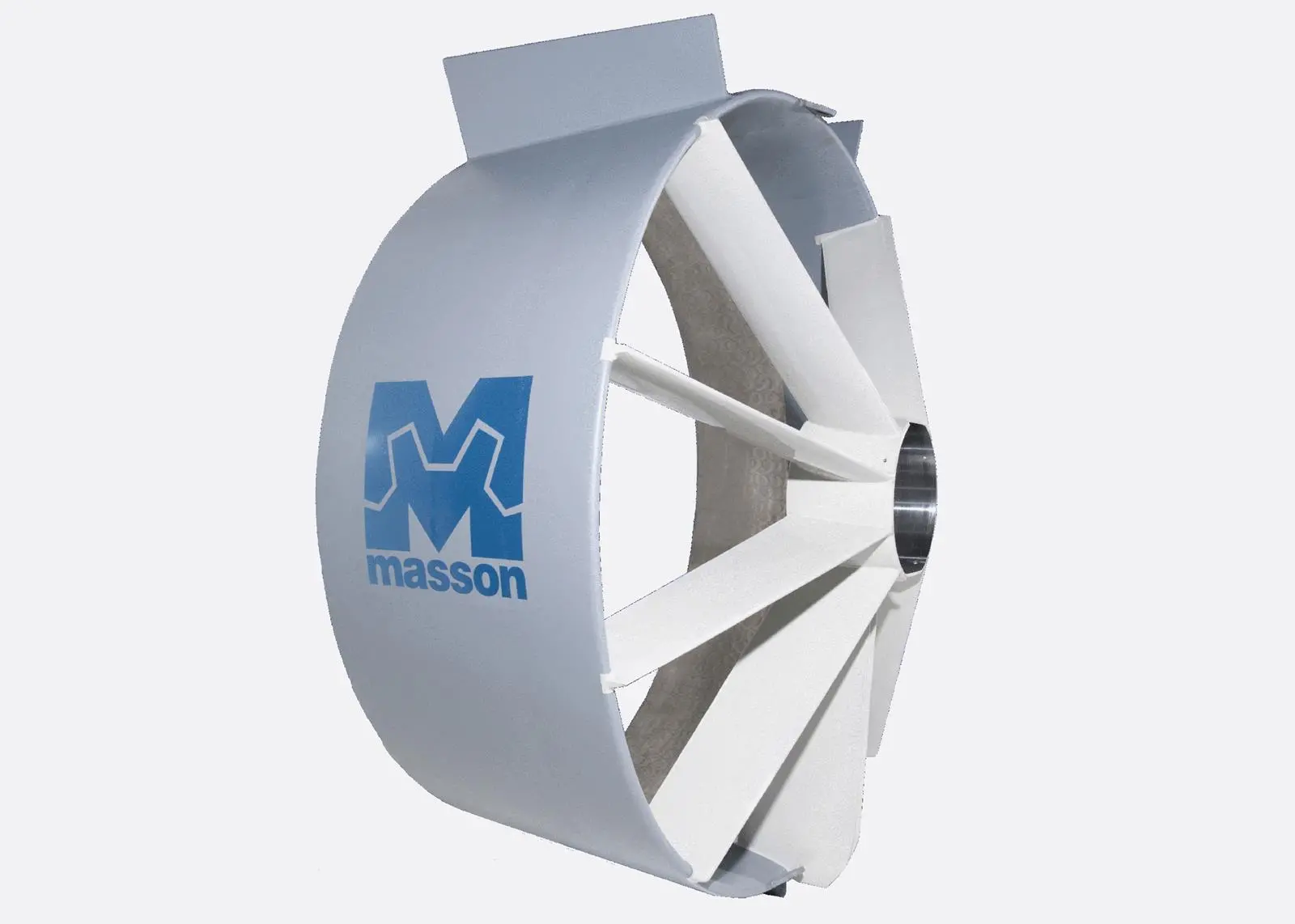
Masson Marine has developed a propeller-pump for improved propeller efficiency that consists of a stator assembly, specific nozzle and rotor. The nozzle drives the water and the stator makes it rotate and therefore increases the torque on the propeller. This process leads to a decrease of the wake effect on the propeller and Masson Marine claims that, compared to a conventional propeller, the propeller-pump delivers an increased propeller efficiency of 15%. The system was designed in collaboration with the French Defence Procurement Agency (DGA) and especially its test cenre located in Val-de-Reuil (Normandy), DGA Hydrodynamics, which specialises in naval hydrodynamics and hydro-acoustics. DGA Hydrodynamics Val de Reuil carried out a full CFD design. The system is available as a stand-alone or as part of a range of azimuthing thrusters. The deep-sea trawler Barra Ar Vicher built by Chantier Glehen of France for owner Armement Bigouden has been fitted with the propeller pump and a controllable-pitch propeller. Two 300kW azimuthing units have been fitted to the French frigate L’Hermione – a copy of the original Lafayette frigate.
Masson Marine has also expanded its range with new high ratio gearboxes. Possibilities include the new MM W3350 available in two different ratios: 6.444/1 and 6.842/1 for a power respectively of 855bhp and 711bhp at 1,800 rpm. Another possibility is the W7400, k= 7.521:1 with 1,474bhp at 1,800 rpm and up to k=9.077:1 with 1,216bhp at 1800 rpm. There is also the possibility to reach k= 14,007:1 with an input box.
Eliche Radice of Italy is one of the few companies that handles all stages of propeller production directly, starting from the specifications in its foundry to the finishing stages and control of the propellers. The company has provided the fast supply vessel, Blue Daddy, with four shaft lines and propellers coupled to four Cummins KTA50 engines. The vessel was built at Victoria Shipyards for Bambini and is able to carry 71 people at an operating speed of 29 knots. High performance and high versatility was required in the propulsion design with variations in crew transport and deck cargo capacities required. Also contributing to the project was Tecnonavi for the hull design, class society RINA, the Krylov Ship Building Research in St Petersburg and Professor George Trincas of Trieste University.
Related Articles
 PROPULSION
 GENERAL NEWS
 GENERAL NEWS