



MAN boosts dual-fuel marine offering
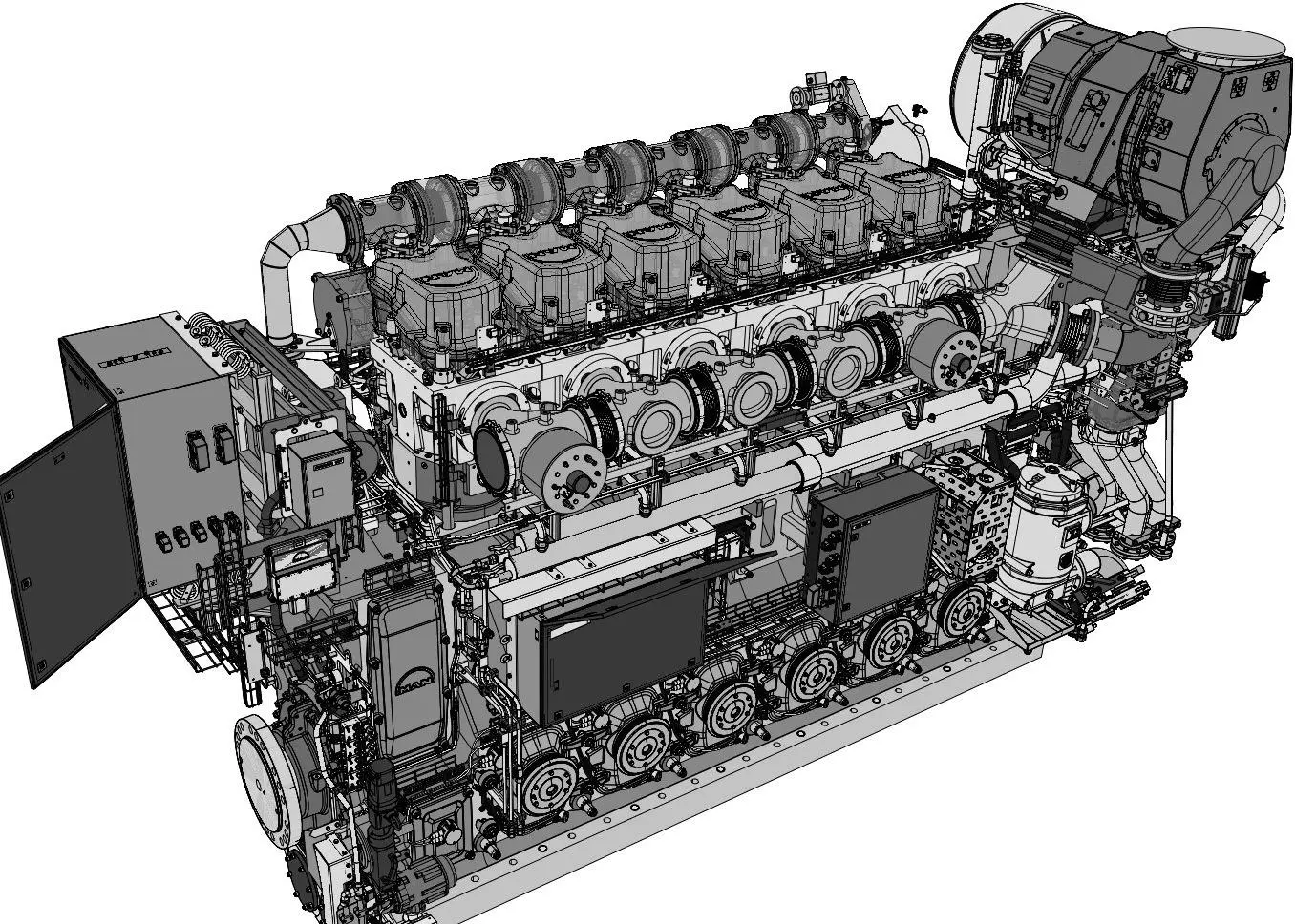
Key goals of the technical programme have been a high specific output and efficiency while ensuring compliance with IMO Tier III emission limits in gas mode and IMO Tier II criteria in diesel mode.
The test phase of the first prototype, an in-line model, was implemented during the second quarter of 2012 at the group’s Augsburg works in Germany, and it is anticipated that the series will start to become available in 2014. Work on the vee-engine design versions is progressing in parallel, and this will ultimately take unit power coverage to a maximum 10,600kW.
The 350mm-bore 35/44DF design delivers up to 530kW/cylinder, the highest power output in the segment for a dual-fuel engine, and embodies common rail technology. In a dual-fuel context, it complements the company’s larger 51/60DF series, which has made inroads into the LNG carrier dual-fuel electric propulsion sector.
The potential market served by the 35/44DF and its 3,060-10,600kW unit power coverage is both wide and disparate, and includes many types of vessel, including ferries, that will be particularly affected by new edicts in designated emission control areas (ECAs). The design enables shipowners to satisfy future, tougher emissions legislation without having to fit exhaust after-treatment plant.
One of the aims has been to provide owners with a retrofit option for the 32/44CR-T2 common-rail diesel engine, using a high level of component synergies and the same crankcase, which can be re-machined on board.
The engine is intended mainly for operation in gas mode, and the pilot oil ignition system system it employs is independent from the main common rail injection system for running in liquid fuel mode. The pilot injection in the 35/44DF is a high pressure system derived from technology used for the truck industry.
The main common rail injection arrangements derive directly from the 32/44CR-T2, and provide an emergency back-up when in gas mode, and allow for deployments in liquid fuel mode. The 35/44DF accordingly offers a very high degree of fuel flexibility, suited to operation on HFO, MDO and MGO besides natural gas, and has been engineered to ensure a seamless switchover from gaseous to liquid fuel, and vice versa, at any time and load.
Technologies and advanced features combined in the new series include high-efficiency turbocharging, intelligent gas control, double wall gas piping, air/fuel ratio control, pressure relief valve, on-engine electronics, and knocking control, as well as intelligent, pilot and main common rail oil fuel injection.
By using gas, emissions of NOx may be reduced by some 85% compared to operation on oil. Furthermore, SOx emissions are almost eliminated as gas contains no sulphur. Moreover, the absence of residuals in natural gas means that the production of particulate matter is practically non-existent. Since natural gas contains less carbon per unit of energy than liquid fuels, CO2 formation is lowered by up to 20%.
The impending release of the 35/44DF is salient to a current Norwegian ro-pax ferry project. Two newbuilds under construction for Fjord Line have been specified with MAN L32/44CR medium-speed diesels, for optional retrofit as dual-fuel engines to burn LNG at some later stage under the future ECA regime in Nordic waters.
Each of the vessels is being equipped with four 10-cylinder models of the common-rail L32/44CR type, making for a total propulsive power concentration of 22,400kW. Conversion to LNG is being considered as part of an EU project supporting the use of gas as marine fuel. First-of-class Stavangerfjord is expected to be ready to enter service between Norway and Denmark during the autumn of 2012.
MAN recently augmented its offering to the stationary power generation market with a purely gas-burning reciprocating engine, the 20V35/44G, which has the same cylinder dimensions and maximum output as that of the 35/44DF. It is anticipated that the first 20V35/44G engines will be placed with pilot customers next year.
The power plant business is also served by a dual-fuel version of the 32/40-series marine diesel. The 32/40DF genset engine is available in both in-line and vee-type layouts and produces 400kW per cylinder.
TECHNICAL DATA
Number of cylinders L 6,7,8,9,10
V 12,14,16,18,20
Bore mm 350
Stroke mm 440
Speed rpm 720/750
Mean effective pressure bar 20.1/20.0
Cylinder output @ 720rpm kW/cyl 510
Cylinder output @ 750rpm kW/cyl 530
SFOC (specific fuel oil consumption) @ 100% MCR g/kWh 187
SFGC (specific fuel gas consumption) @ 100% MCR kJ/kWh 7,700
SLOC (specific lube oil consumption) g/kWh 0.5
Related Articles
 PROPULSION
 GENERAL NEWS
 GENERAL NEWS