



No-loss electric drive for Korean ‘green ship’
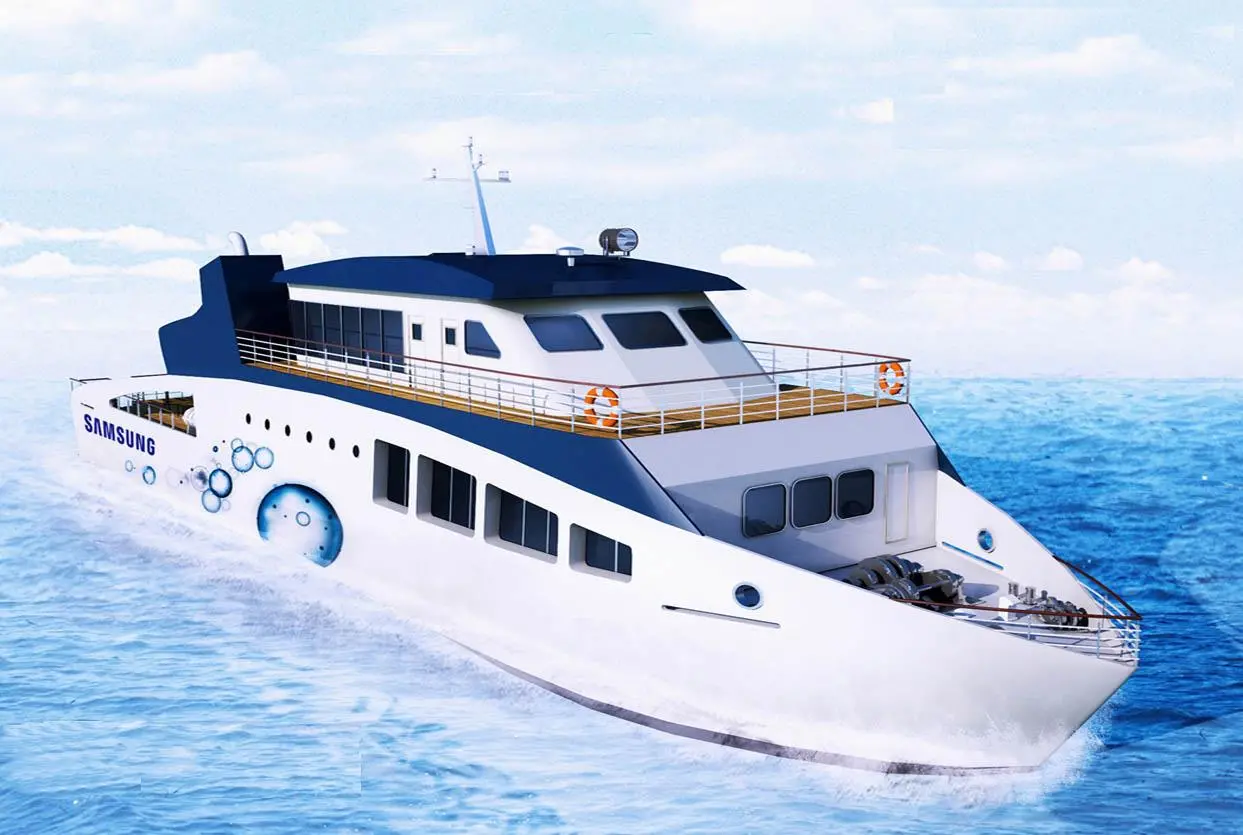
The recipient will be a 200gt harbour master’s vessel, known as a guideship, to be constructed by Samsung to its own design on behalf of the state-owned Incheon Port Authority. The Korean government has stipulated qualities of environmental sustainability as a priority for the vessel, which is scheduled to enter operation in December this year.
The guideship is considered a pilot project for the adoption of ‘green ship’ technology in Korea. Following the nomination of Wärtsilä dual-fuel (DF) machinery, the patented Stadt Stascho No-Loss Drive system has been confirmed for the propulsion arrangements. Given that the guideship’s duties will include a passenger carrying role, the newbuild has seminal importance as a DF-electric passenger vessel.
Complementing the outstanding emissions reduction performance of DF plant running in gas-burning mode, the efficiency and minimal electrical system losses conferred by the Stadt Stascho concept promise substantial savings in energy consumption and environmental impact over time. Stadt’s No-Loss AC drive supplies sinusoidal voltage and current to the electric motor and back to the main switchboard. It gives very low harmonic disturbances without using transformers or filters.
The propulsion solution enables the DF engine-driven generator to operate at a steady load independently of the amount of power used on the propeller, driven by the robust No-Loss system.
The fact that no large transformers are used saves space and weight and reduces power losses. Incheon Port’s new vessel will also benefit from the high redundancy factor in the drive technology, cutting the risk of loss of propulsion to an absolute minimum, according to Stadt. The AC drives are split into three segregated power units, so that only a part of the propulsion power will be lost in the event of a failure. Furthermore, the use of DC capacitors is very limited in Stadt Stascho drives, a feature which is said to have a signal bearing on the improved reliability offered relative to DC systems.
Freedom from disturbances such as electromagnetic interference (EMI), acoustic noise and vibrations is an important aspect of Stadt Stascho, since such properties have increasing value across all types of vessel, not least in the passenger ship and military vessel categories.
Incheon’s prospective ‘green ship’ will be of 38m x 8m main dimensions, and her anticipated speed is some 15 knots. The dual-fuel engine ordered for the project is a nine-cylinder model of Wärtsilä’s 20DF series, which has a nominal maximum continuous rating of 1,584kW. In gas mode, NOx emissions abatement is such that the engine will meet the upcoming IMO Tier III standard, and SOx will be negligible. Furthermore, running on gas is expected to generate 25-30% lower CO2 compared to diesel operation.
Related Articles
 PROPULSION
 GENERAL NEWS
 GENERAL NEWS